
Between Bohinj and Bled
We left Lake Bohinj late at night with exhaustion settled so deep it felt structural, like it had moved into our bones and started paying rent. I was at the wheel, shoulders slightly tense from the fox episode still hovering in the background the way certain images do after dark—uninvited, persistent, ready to replay as soon as the road turns quiet. Mo sat next to me, finished too, but doing that soft, stubborn thing he does when he cares: forcing his eyes open, angling his body slightly toward mine, staying present without performing it, the quiet kind of vigilance that says I’m here, you’re not alone, even when his own brain is begging to shut down.
The road cut through a forest dense enough to swallow sound. No streetlights. Barely any cars. Just the engine hum and the trees forming a tunnel that made me imagine deer at every shadowy edge, the kind of sudden movement you don’t get warning for. Mo put house music on—his choice, steady and rhythmic—and I understood the logic immediately: a beat is a leash for the mind when everything else is trying to drift into sleep. We drove like that for a while, the campervan moving through darkness like a slow animal, and I watched Mo from the corner of my eye more than I watched the speedometer.
Something about him felt different.
Not wrong. Not bad. Just unfamiliar.
He was softer than usual, almost docile, and it wasn’t only fatigue. There was a way he seemed to adjust himself around me—agreeing with everything, anticipating needs before I voiced them, smoothing every edge before it could become friction. He felt endlessly amiable, endlessly accommodating, as if he’d decided this trip was not the place for banter, not the place for debate, not the place for those playful disagreements that usually keep us awake. And Mo is dominant by nature—not forceful, not imposing, but grounded and decisive, comfortable in control, the kind of man who normally takes up his space without apologising for it. Seeing him so agreeable, so quietly compliant, made me pay attention in a new way.
I didn’t bring it up. I didn’t want to put him on the spot, didn’t want to puncture whatever balance we were riding. I told myself it was the environment—the constant movement, the unfamiliar rhythm of travel, the way a campervan turns you into a smaller version of yourself. Still, I became more attentive, quietly observant, committed to understanding the shift without interrogating it. Sometimes love is noticing a change and choosing gentleness instead of demanding an explanation on the spot.
We made it close to our destination without incident, which already felt like a minor achievement.
The parking spot suggested by the app was absurd: steep, exposed, right next to the road, a place where sleep would require negotiating with gravity all night. We tried another option. Then another. Each one worse in a different way. Eventually, exhaustion made the decision for us and we pulled into a bay near a petrol station—practical, unromantic, hopefully invisible. We were too tired to care.
Thankfully, we’d already eaten and showered in Bohinj, so we moved quickly: lock the campervan, brush teeth, bodies horizontal, no speeches. The world switched off.
A Sharp Turn, Without Warning
The ride from the petrol station toward Lake Bled unfolded gently at first, almost deceptively so. Ljubljanska cesta carried us away from the utilitarian edges of town—fuel pumps, parked cars, sleepy signage—and slowly into a landscape that softened with every curve, as if the road itself was trying to calm you down. Low houses gave way to meadows. Campgrounds appeared tucked between trees, their wooden cabins lined up with quiet discipline. Cyclists passed us in steady rhythm, the morning air still cool enough to make movement feel clean. The road narrowed, the forest thickened, and the lake refused to reveal itself all at once; instead it offered flashes between trunks—cold blue water, darker where the sky pressed low, lighter where clouds reflected in pale streaks.
Along the shore, luxury hotels emerged—restrained and elegant, stone and glass kept intentionally quiet, as if anything louder would be disrespectful to the place. Camping areas stretched close to the water, dotted with towels, bicycles, and people moving slowly, unhurried, existing in that rare state of not needing to prove anything. Ahead, Bled Castle began to rise, perched high on its cliff with a presence that didn’t need drama; it already knew it would be seen.
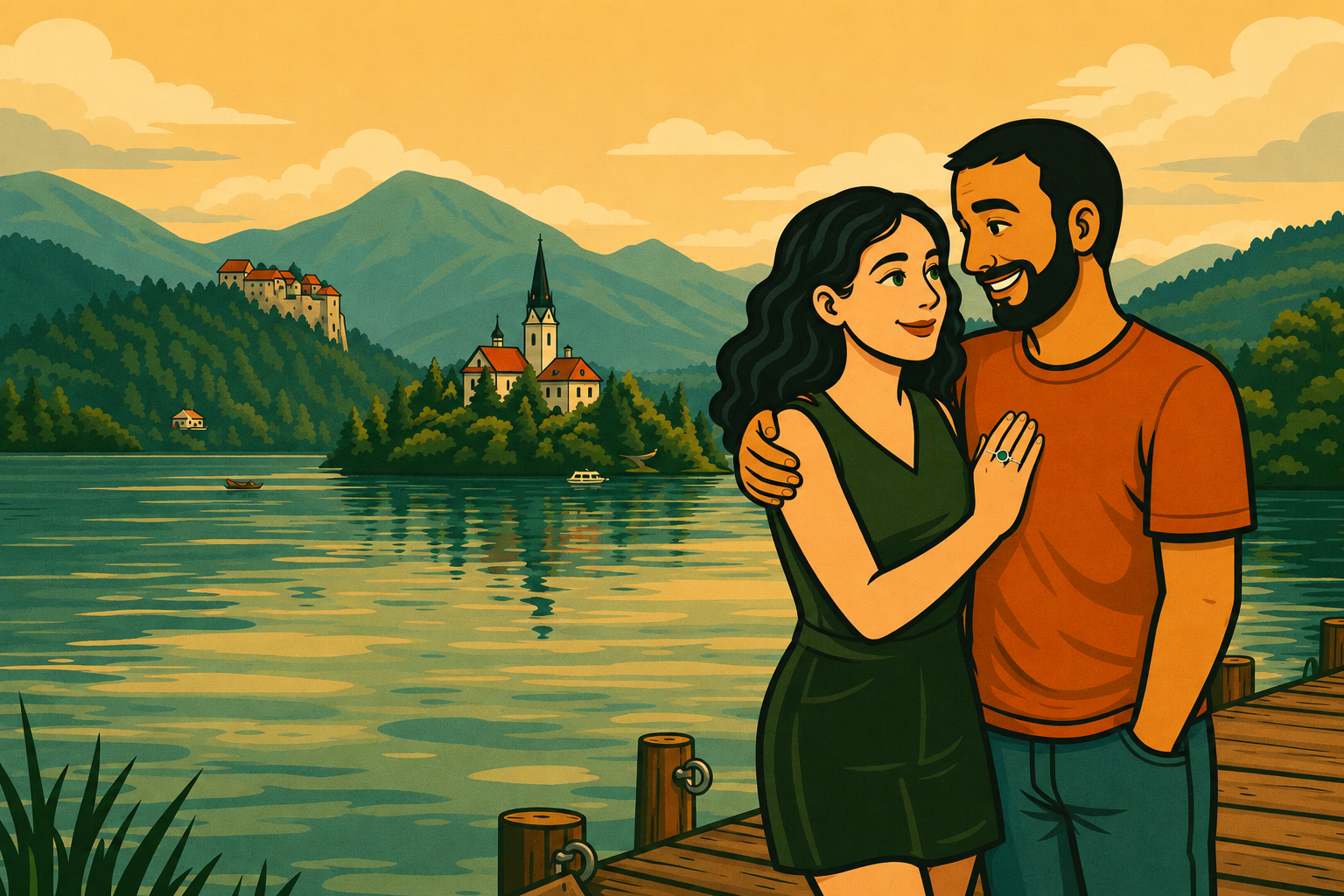
We parked the Vespa near a restaurant, close to a camping area, crossed the road, and stepped into a wide lawn that opened toward the lake. People lay scattered across the grass—some sunbathing, some drying after a swim, others simply staring at the water like it was enough. It was lively but not chaotic, human without being claustrophobic. And I noticed the dock immediately.
I stepped onto it slowly, letting the view settle before reaching for my phone, because some moments deserve to land in your body first. The lake stretched wide and calm, a muted mix of blue and green under a gloomy summer sky. To the left, Bled Castle stood firm and watchful. To the right, the island floated in perfect balance, the Church of Mary the Queen rising delicately from its centre, framed by trees, reflected softly in the water.
It was peaceful in a way that didn’t beg for attention. Romantic without trying.
And that was exactly what I needed. Far from Dubai. Far from the noise, the constant comparison, the low-grade anxiety that city injects into you without consent. In Dubai I always feel late—behind, not enough, like life is a treadmill set to a speed you didn’t agree to. And it’s worse once you work in real estate, because you watch insane amounts of money pass right under your nose, close enough to smell, and the scent alone awakens a hunger you didn’t have before. You start comparing yourself to people impossibly ahead, and even when your life is objectively fine, it begins to feel insufficient. It becomes a loop: earn more, achieve more, prove more, and still feel like you’re not even playing the same game.
Standing on that dock, surrounded by mountains, birdsong, cold air and water, all of that fell silent. I was present. Fully. The moment felt complete, sweet, self-contained, and I remember thinking: it can’t possibly get better than this.
Maybe.
Mo was about to join me when I noticed two young women waiting politely for their turn to take photos. Mo offered to take their picture in exchange for a short video of us. They agreed. I didn’t understand what kind of video he wanted. I didn’t know how to pose. I asked questions. He got awkward, uneasy, and then asked me to put my phone on the ground to record as well. I laughed, confused—why?
One of the women was still holding his phone, waiting.
I kept asking, almost interrogating: what’s the plan, what do you want me to do, just give me directions and I’ll follow, because right now I’m lost. And then the thought began forming, slowly, dangerously, like a wave you see from far and still hope isn’t coming for you.
Is he going to?
By the time the thought finished its sentence, it was too late.
He knelt.
His face was red, eyes watery, smile wide and nervous, the kind of expression that doesn’t belong to acting. “Will you marry me?”
Black case. Opened. Diamond.
If Error 404 had a face, it was mine.
A sharp hit in my chest, then my stomach. My body buzzed, tingled, detached, like the signal between brain and reality had briefly dropped. I couldn’t process it. This was the sharp turn. The one I didn’t see coming. Not here. Not now. Not on this trip.
We had spoken about marriage, about a future, but never like this. Never like this. We had fought badly before leaving Dubai—days of silence, the first time since we started dating. The usual fractures: his restlessness, his fear of missing out, his inability to stay still; my need to withdraw, to read, to write, to be quiet. His devotion to his family house, clinging to it like a nest, unable to imagine a shared life with me as something fully grown and separate. No routines together. No gym, no groceries, barely coffee. Family time replacing couple time. Even after my LASIK surgery, he dragged me around exhausted until his mother noticed and told him to take me home. I admired his loyalty—just not when it turned into obsession, not when it erased us.
I had exploded. I told him I wanted to break up. He was shocked, like the idea had never crossed his mind. We eventually made peace with promises and exhaustion, and I decided I’d observe him on this trip, see who he was outside his comfort zone.
And while I was analysing, doubting, weighing—he was planning this.
I asked if he was serious. Once. Twice. I laughed, looked away, realised the two women were still filming. I knelt to hug him, laughing nervously, and whispered yes into his ear like a secret I wasn’t ready to release into the universe.
His face said everything. That was love—unhidden, unguarded. I had never been loved like that. And I had never loved like that either, with all of myself.
Applause broke the spell. Strangers in swimsuits clapped. I apologised to the women, stood up, held his hand, and we stayed there a little longer letting it sink into our skin. Another stranger helped with photos.
The ring is stunning: a square emerald-cut diamond at the centre—clean lines, architectural, almost restrained—framed by a fine halo of smaller stones that soften its geometry without stealing focus. The band is slim and delicate, pavé-set, letting light travel all the way around without ever feeling excessive. Everything about it feels intentional—balanced, elegant, confident.
We walked toward the Olimpijski Veslaški Center almost without speaking. My legs were moving, but my mind hadn’t caught up; everything felt slightly delayed, like sound after lightning. Mo suggested calling his family. They’d known about his plan. Their joy exploded through the screen—voices overlapping, laughter, disbelief, pride, celebration that didn’t need translation. I smiled, waved, nodded, let myself be seen without fully being there.
I tried calling my mum. It rang. She answered. I hesitated. The words stayed in my throat. I wasn’t ready—not yet—so I ended the call gently and put my phone back in my bag. I wanted to keep this moment intact, unshared, still forming. Just ours.
As we continued walking through the forest, the dizziness arrived—physical, not poetic. Not joy, not fear. Shock. As if my entire system had been jolted and didn’t know where to place the energy. My chest felt hollow and full at the same time. My head floated slightly above my shoulders. I slowed down and focused on the ground beneath my feet—gravel, roots, uneven earth—on the smell of damp leaves, on the rhythm of our hands intertwined.
Mo stayed close without crowding me. He didn’t speak much. He didn’t need to. He was glowing—nervous, euphoric, relieved. His hazel eyes, framed by long dark lashes, were bright in a way I’d never seen before: open, certain, like he’d finally stepped fully into his own decision. Seeing that certainty made everything else fall quiet.
We stopped for gelato—pistachio for him, walnut for me—because life has a dark sense of humour and will hand you something seismic, then ask you to choose flavours like nothing happened. Mo’s phone started vibrating: messages, then calls, one after the other. His mother had shared the news and congratulations flooded in. He answered, smiling, half-laughing, trying to speak and listen at the same time. I stayed slightly to the side, holding the moment gently, untouched.
My own phone stayed silent by choice.
I didn’t tell anyone. Not yet. I needed time for my body to catch up, for shock to soften into something I could name. I wasn’t ready to release it into the world where it would become commentary, reaction, noise. I wanted it whole. Ours.
As we were leaving the area near the Olimpijski Veslaški Center, a French man stopped us to ask for directions to the Ojstrica viewpoint. We looked at each other, blank. We had no idea what he was talking about. We apologised and pointed him toward the nearby restaurant, suggesting he ask the staff. Given Slovenian hospitality, I wouldn’t have been surprised if he was still wandering around, politely lost.
We walked back to the Vespa and started riding away. Just a few metres down the road there it was—a sign. Small. Unassuming. Ojstrica.
Mo made a U-turn without hesitation.
We parked, locked the Vespa, and set off on foot, curiosity leading the way. The trail rose gently through the woods, rocky and uneven in places, asking for attention but not demanding effort. We climbed quietly, stopping now and then—to catch our breath, to take a photo, to absorb what was still unfolding inside us. About twenty minutes later, the trees opened up.
From above, everything aligned.
The island sat perfectly in the centre, the church rising quietly from its heart. The castle held its position on the cliff, solid and timeless. The water below shifted between green and blue, catching light in patches under the heavy sky. It was even more beautiful from here—wider, calmer, complete. Something in me settled. The dizziness softened. Shock loosened its grip. I realised I’d been wrong earlier: it could get sweeter than that dock. Much sweeter.
We stood there without rushing, letting the view imprint itself. This felt like the moment we’d both, in different ways, always hoped for.
We had met a year earlier through beach volleyball—instant attraction, no negotiation, no confusion. The same humour. The same loyalty. The same hunger for closeness. Cultural differences dissolved so quickly they barely registered. I had crossed the planet—the Americas, China, Fiji, the far edges of Africa—eventually landing in the Middle East. And there he was: the man I’d hoped for even in seasons when I claimed I didn’t care about love, marriage, or permanence. The one who fit not the version of myself I was trying to construct, but the one that had always been there.
We took a few more photos, then sat side by side in silence, letting the place hold us a little longer before we began the descent. On the Vespa ride back, I wrapped my arms around him tightly. The air was cold and sharp against our faces, noses reddening, cheeks flushed. Nothing to solve. Nothing to chase. Just motion, nature, and the quiet certainty of having landed exactly where we were meant to be.
We stopped at a local bakery for fresh sourdough and savoury pastries—simple, warm, perfect. Nothing could touch me.
I was already elsewhere, somewhere between yes and forever.


Leave a Reply