
About Touring Ljubljana and the Europe of My Books
We woke up to rain drumming on the campervan roof—not the aggressive kind, not the “Dubai panic, everyone film it” kind, but that steady, generous European rain that sounds like the world is being rinsed back into itself. In Dubai, rain is a rumour you hear about and then miss by ten minutes; here, it was real, thick enough to blur the windows into soft-focus grey and make the whole morning feel privately owned. We stayed in bed longer than usual, watching the streaks crawl down the glass like slow handwriting, listening to the roof sing, both of us quietly hoping it would keep going so we’d have an excuse to do nothing together for a little longer.
But our Vespa wasn’t as romantic about the storm as we were. Outside, puddles thickened into mirrors, fog rolled down like a curtain, and the air looked like it would swallow visibility for breakfast. So we waited—not with impatience, but with that strange luxury travel occasionally gives you: time that doesn’t need to prove itself. Mo brewed the coffee. I plated breakfast like it was a small domestic ceremony we were stubbornly carrying across borders: soft-boiled eggs with yolks still blushing, thick sourdough toasted and layered with cream cheese, a salad of mixed greens and halved cherry tomatoes, sea salt and lemon zest, the kind of simple meal that feels almost moral when the weather is dramatic outside. No scrolling, no rush—just cutlery, sips, and the steady comfort of food made by hands that love you.
When the rain eased into something negotiable, we rode the Vespa through half-dry clothes and wet streets to AKC Metelkova—an autonomous social and cultural centre born inside old barracks, first Austro-Hungarian then Yugoslav, now reclaimed and turned into a living, unruly collage. You don’t really “visit” Metelkova; you enter it like a dream someone had after reading too much history and drinking too little water. Neon snakes wrapped around drainpipes. Mosaic fragments climbed the walls like vines. Rusted limbs and metal shapes hung where you least expected them. The graffiti spoke in full sentences—anti-fascist slogans, queer love, rage, joy, resistance—everything loud and layered and unapologetic, as if the walls had decided silence was a form of complicity.
It reminded me of Christiania in Copenhagen, but with less hemp softness and more edge, more past, more bruises showing. Still, something in the scene tightened my spine: a couple of guys leaning into the graffiti like they belonged to it, sunken eyes, beer cans, visibly high, not aggressive but present enough to make the air feel slightly off. We took our photos quickly and left without discussing it, the way couples do when they’re both thinking the same thing and don’t want to turn it into a debate.
Back on the Vespa, we zigzagged through the city and started climbing toward Ljubljana Castle, and that’s when we made the least poetic discovery of the day: the under-seat storage had turned into an oil crime scene. Our spare motor oil had leaked everywhere—insurance, registration documents, even the bag with our chargers—everything smelling like a mechanic’s garage in July. We tried mopping it up with rainwater, which just spread the problem into a wider area of disappointment. Leaves didn’t help. Dirt didn’t help. Mo swore. I laughed. He slipped down a wooded path beside the parking lot trying to rub soil into his hands like he was returning to prehistoric solutions. He glared at me. I laughed harder. He glared harder. I blew him a kiss. He rolled his eyes with that exhausted affection that says I still like you, but please stop being amused by my suffering.
In the end, the holy relic came out: his portable hygiene spray bottle, carried everywhere like it’s part of his identity. We squirted enough water to wash off most of the oil and a portion of the shame. Not perfect, but good enough to keep moving—because travel is basically a long series of “good enough” decisions disguised as adventure.
We didn’t go inside the castle. No protest, no ideology—just pragmatism. If we paid entry to every medieval fortress in this part of Europe, we’d be broke before Croatia. So we walked instead, taking the gravel path that loops behind the castle and cuts through the vineyards. The leaves were thick and dark green, heavy with late-summer grapes. Mo picked one and popped it into his mouth with a grin. “Sweet,” he said, delighted like a child. I tried mine and almost spat it out—sour like betrayal. He laughed. I sulked theatrically. Then we played tag along the path, ducking under stone arches and slipping through hedges, half children, half lovers, always hovering between the two.
At some point he insisted on photos—because he is the archivist of our relationship and I am the woman who forgets to document her own life. I lined him up against ivy and skyline, tried to frame him with the light breaking through clouds, and he hated it immediately. The angle. The lighting. My technique. I got annoyed. Threw him a look. He threw one back. I pouted. He melted. That’s our language—not warfare, not drama, more like magnets: pulling, repelling, always swinging back into orbit.
From up there, Ljubljana stretched out under a sky that had been rinsed clean: the Ljubljanica curling through the city like a ribbon, the Triple Bridge glowing faintly with foot traffic, Prešeren Square pulsing gently in the distance. Green rooftops. Copper spires. A skyline that still knew how to hold itself with dignity, like it hadn’t been bullied into becoming something else.
We rode back down and parked near Dragon Bridge, Ljubljana’s guardian beast, its oxidised wings catching the light like armour. The streets were slick with rain and smelled like wet stone and exhaust, and the Central Market was awake in that calm, steady way: not frantic, just alive. Produce lined up like answered prayers—tomatoes heavy and ripe, figs ready to burst, blueberries in paper punnets, honey jars catching the last of the light. We bought the usual suspects, and then Mo spotted a tiny bottle of medica, Slovenian honey brandy, and decided we should try it. We shared a shot and regretted it instantly—fire, sweetness, nausea in one sip. “Cures everything,” the seller said. “Even marriage,” I replied, and Mo laughed in a way that suggested he wasn’t entirely sure whether I was joking.
In the side market, it got even more tempting: handmade wooden spoons, herbal ointments, traditional embroidery, small ceramics painted with patient hands. I touched everything. Mo bought honey for his mother, as he always does—his way of saying “I’m thinking of you” without ever needing to verbalise it. We wandered the Old Town past Baroque façades and Art Nouveau balconies, buildings washed clean as if they hadn’t aged since 1902. Everything looked maintained, not revived. Like no one ever allowed it to decay. Even the McDonald’s felt apologetic in its signage.
And that’s when it hit me: intactness. A city still used by locals, not only staged for visitors. Bridges and squares still doing their social job, not just acting as photo backdrops. This wasn’t the Europe limping through gentrification and garbage strikes, not the one choking on its own tourism; it was the Europe of my books, the continent that raised dreamers and diplomats and heartbreakers, the one that used to speak in train whistles and handwritten postcards. I missed it—not as a concept, but as a body I used to inhabit. For a few hours, Ljubljana let me back in.
We passed a bookstore, a violinist playing something too delicate for the wet air, and a small shop selling legal weed. We went in. Mo was skeptical in the way he gets when anything touches the line between curiosity and risk. “THC-free,” he clarified three times. I nodded, amused, not pushing, because I know how to respect boundaries around substances—even soft ones. He bought a pouch. We left hand in hand, blending back into a city that still felt like itself. And then, as if we’d never left it, we found ourselves again at Dragon Bridge—two shadows on a cobblestone stage, ready for the next scene.
Back to the Mountains and a Fight for Survival
We left Ljubljana with figs in our mouths and rain still clinging to our sleeves—not just saying goodbye to a city, but to a version of Europe I hadn’t seen in years. Not only the Europe of novels with duchesses in silk and lonely ladies in hotel lounges, but also the late-90s, early-2000s Europe we were taught to dream about: British teenagers meeting at cafés and shopping centres, bedrooms that looked like Claire’s had exploded—lava lamps, lip-glossed diaries, platform shoes, Big Ben posters—London as the myth, Spain as sunshine on skates, Paso Adelante convincing us that all we needed was Madrid and passion and we could become something more than “stuck.” Back then, Europe was the dream. Why would we look elsewhere?
But by the time I finished high school in 2014, that dream had started cracking. Economic recoveries masking deeper fractures. The 2015 refugee crisis reshaping borders and conversations. Then Brexit—the quiet cough that became a rupture. So when life kicked me out of my cocoon in 2016, I didn’t go to London or Madrid. I went to Key West, Florida, aiming for something else entirely and learning quickly that the map doesn’t care what you imagined. Then the U.S. elections hit and the cultural temperature dropped, and I was an outsider again. So I chased the horizon—Shanghai to Suva, Bogotá to Fortaleza, Cape Town to Dubai—places I’d never dared to picture for myself, until the European bubble popped and the world flipped, and I went looking for a new North.
Still, Ljubljana brought something back: the balconies, the dignity, the way the city didn’t need to shout to be heard. For a few hours, I felt folded back into a continent that used to know how to dream. And yet—strangely—I was happy to leave, because the mountains were calling.
Mo was excited too, but I felt it in my bones: that pull, that familiarity, like music I hadn’t danced to in years. I grew up with the Italian Alps as background noise—Dolomites a weekend plan away. Later, Cape Town taught me to go steeper, longer, harder—breathless morning hikes, trail runs that doubled as therapy. And the real roots were back home, where we’d ride scooters into the woods, laughing too loud, too young to care, lighting up joints like it was a ritual, talking about the people we’d become. Sometimes we scared ourselves over nothing—a cat in the bushes. Sometimes we got lost and guessed our way back down muddy, starving, sunburnt, happy. It was never just about views. It was chaos and quiet. Green stillness and reckless limbs. Peace that isn’t polished, that smells like moss and freedom.
Dubai doesn’t have that. It has slick things, shiny things—Maldives getaways, rooftop brunches, seafood towers, strangers in sunglasses—but not this. Hatta is there, sure, but it’s bare, silent in a sterile way. No trees to whisper secrets. No trails that remember your feet. So as much as Ljubljana stirred something soft in me, heading north felt like stepping back into something true.
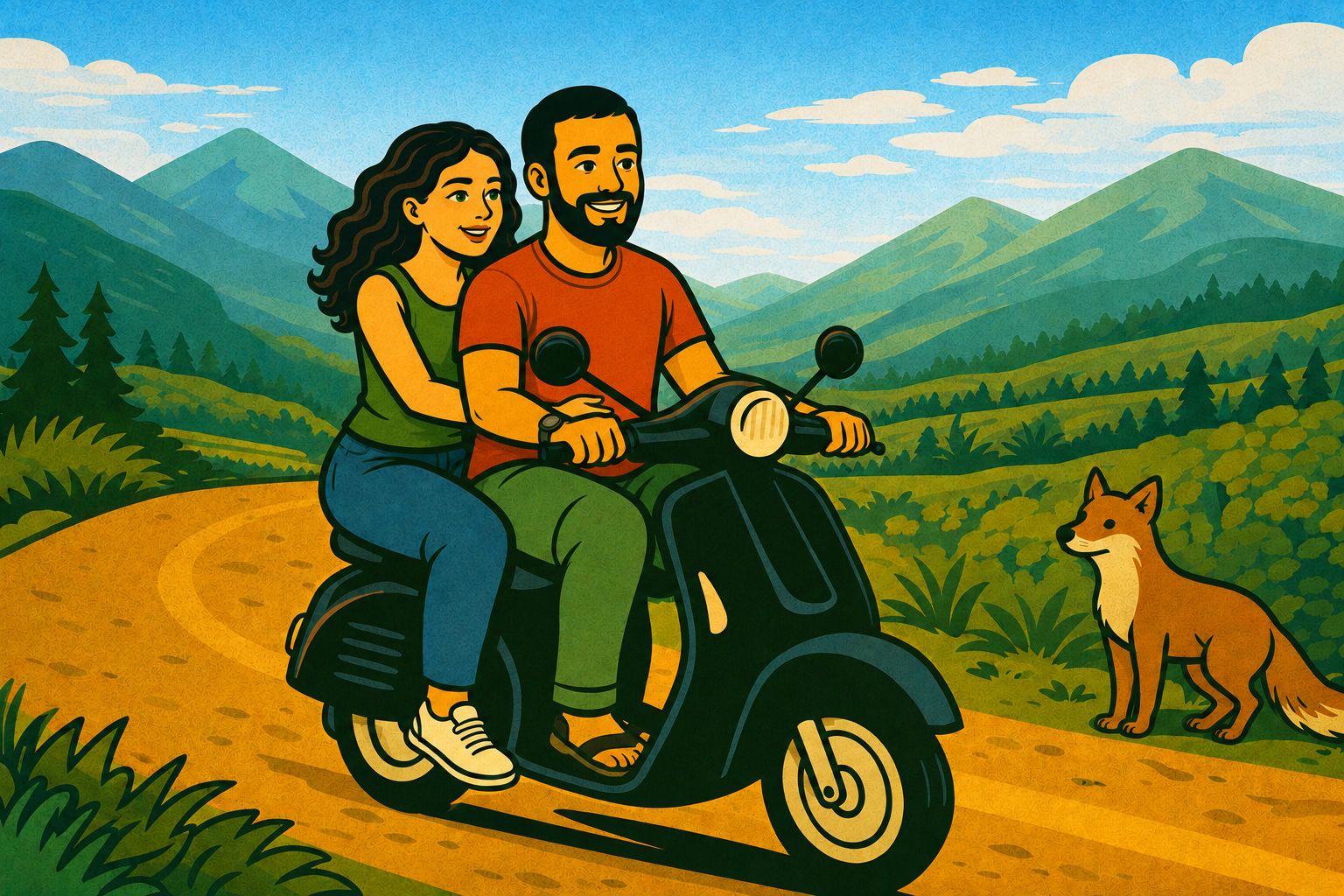
We parked the campervan at Bohinjska Bistrica train station, a quiet spot wrapped in damp mountain air and the metallic clank of tracks. From there we rode the Vespa through sleepy roads ribboning between pine forests and postcard chalets, rain leaving beads on the asphalt like scattered pearls. It was the kind of ride where you don’t talk much because breathing is enough: wooden cabins with flowers on balconies, mist-tipped trees, cows chewing in fields, watching us pass like we belonged to a slow-moving dream.
When we reached Lake Bohinj, the world exhaled. Gravel crunched beneath our shoes and the air changed—denser, wetter, cleaner. We dropped the Vespa and ran toward the shore like kids breaking out of school. We’re both water people. Maybe it’s our signs—Pisces and Scorpio—not that I swear by astrology, but I do recognise the primal way we dive into water like it’s home. We played. Splashed. Teased. Held our breath to see who could sink deeper. I dove down with eyes open and touched the rocks beneath, delighted by the simple violence of cold water waking you up.
We stayed until our skin pruned and the rain returned—drizzle at first, then a full curtain. We grabbed our towels and sprinted to the nearest café wet, shivering, and completely alive. Inside, the vibe matched what we’d started noticing in Slovenia: hospitality delivered with a baseline of irritation, as if our existence disturbed the air pressure. We ordered two slices of Bled cream cake and Prekmurska gibanica—famous, yes, but not exactly the love story you want; the sugar tasted artificial, the layers collapsed under their own ambition. Still, it was food, and we were starving.
We ended up chatting with two New Yorkers sitting next to us, a couple about our age. They were heading to Butik Electronic Festival the next day—she worked in radio, he brewed beer in Brooklyn—and conversation moved the way it always does when strangers meet on the road: quickly, casually, as if you’ve been waiting for someone new to talk to. We introduced ourselves too. Mo said he was a facility engineer. I said I worked in real estate. And then—of course—Mo launched into a passionate rant about the catastrophic state of Dubai’s construction quality, right there in front of me, tearing apart the very skyline that pays my bills as if I wasn’t sitting across the table. I shot him a stare sharp enough to slice cake—the we’ll fix this later stare. (Spoiler: we did.)
She and I bonded instantly over our inner Karens—women who live for a well-worded complaint, a refund won through sheer rhetoric, a customer service escalation that feels like Olympic sport. Mo and her boyfriend slipped into techno talk, DJs, festivals, music like it’s a second language. When the rain eased, we said goodbye and walked the lakeside—arms intertwined, wet hair clinging to our necks, water shoes squeaking—past woods and the old Church, letting the light thin out until evening made the edges softer.
Back at the campervan, we tackled dinner with hunger and routine: steak and salad cooked in the tight rhythm of a mobile kitchen. Then laundry—handwashing days’ worth of clothes and hanging them on railway fences in one of the coolest summer nights we’d had so far, acting like we didn’t understand how humidity works or how optimism can be a form of stupidity.
Somewhere between squeezing water out of a soaked towel and wiping down the kitchenette, I heard a sound. I ignored it at first. Then I saw something lurking near the edge of the shadows while I grabbed something from the van. I squinted, tried to convince myself it was nothing, and then it stepped forward with enough confidence to make the scene undeniable: long tail, lean legs, sharp stare.
A fox.
Mo—who had never seen a fox in his life—tried to scare it off with big arms and assertive steps, as if confidence is a universal language. The fox blinked slowly, unimpressed, like it had already read his script. Nothing worked. It disappeared behind a car, reappeared behind another, cheeky and persistent, treating us like the entertainment.
Eventually, Mo grabbed the water hose—not exactly an intimidating weapon, but enough to turn it into a ridiculous cold war. While he played rural defence squad, I finished mopping floors, scrubbing the bathroom, and transferring damp clothes inside, covering every surface in the campervan like I was building a textile installation. Mo urged me to rush because he was “losing,” so I handed him the mop as reinforcement and told him to keep fighting to save his queen. He gave me a look that suggested he wanted to shove the mop in my mouth, then refocused on the fox with the seriousness of a man defending his kingdom.
By the time the fox finally got bored and Mo declared victory, the night had settled fully. We showered, refilled water, wrapped ourselves in warm clothes to survive the cold Slovenian air, sat in our seats, let out a big sigh of relief and exhaustion, and then—because apparently we were never done with motion—we turned on the engine and drove toward the next destination.

Leave a Reply