
Quiet Places Hold Things Longer
We were supposed to drive to Triglav National Park, chase more rivers, earn more sweat, collect more Slovenia like it was a stamp book. Instead, we chose to descend—south, toward Zagreb. Not because we didn’t want the hikes (we did), and not because we suddenly fell in love with motorways (we didn’t), but because reality tapped us gently on the shoulder with that polite European cruelty: Triglav would cost us an extra day, and we were still far from our final destination in Croatia. And with the news of our engagement sitting warm and impatient between us, we wanted to arrive earlier than planned—earlier, not to rush the trip, but to deliver the moment where it belonged: to my family, in person, with faces and hands and noise and the kind of celebration that doesn’t translate properly over messages.
So I opened Google Maps between Bled and Zagreb and started tracing alternatives—slower routes, softer exits, a way to leave Slovenia without ripping the plaster off. And then a small dot appeared: a town with a castle sitting in the middle of a lake. It felt like a compromise that wasn’t a compromise at all—less driving straight into Zagreb, more time inside the last stretch of Slovenia we’d come to love more than expected.
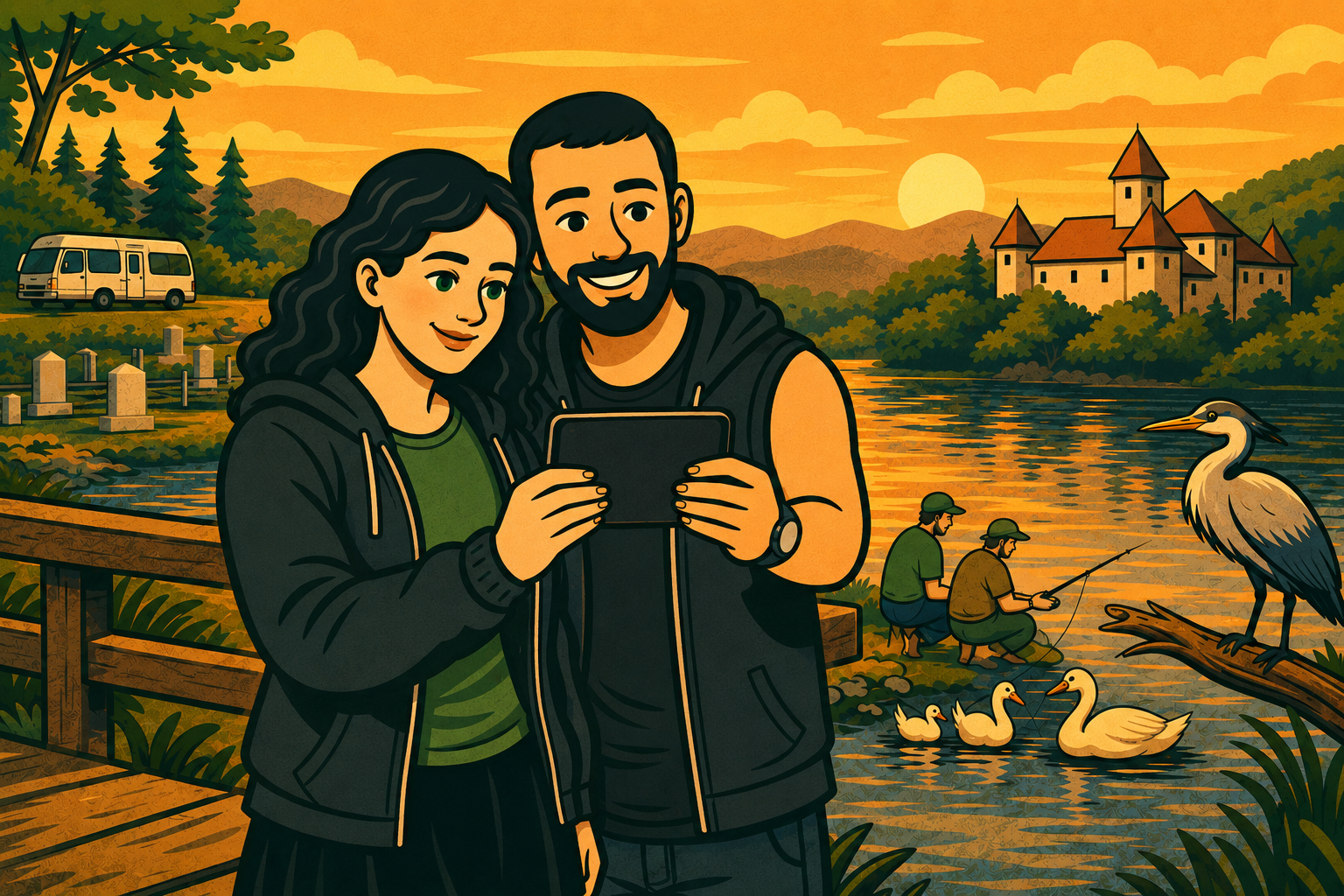
We drove down to Otočec and found free parking beside a cemetery.
I know how that sounds, but in Europe cemeteries are often the most practical places to leave a vehicle: spacious, quiet, and far from traffic. There were houses nearby, lights on, curtains half-drawn, dinner lives happening behind glass. It didn’t feel eerie. It felt like a town that didn’t need to entertain anyone. Once parked, we took the clothes out again to dry a little more—still damp, still refusing to become fully respectable—and headed out for a short walk as the sun began to sink.
Evening settled in quickly, and the town got quieter in that suspended, rural way that reminds me of home: streets that don’t perform, corners that don’t ask for attention, a softness that makes you lower your voice without deciding to. A few people appeared here and there, but no one smiled back. Of course. We’d grown used to Slovenian hospitality by then—warm, restrained, polite in a way that sometimes forgets your face. We walked alongside the cemetery and turned left onto a narrow road with no sidewalks. It looked harmless, empty enough to feel safe, so I walked confidently in the middle of it.
I was wrong.
The first car came quickly. Then another. Then another, close enough to remind us that “quiet road” doesn’t mean “unused road.” That was our cue. We squeezed ourselves as close to the edge as possible and kept going, and after about five minutes the road opened onto a wooden bridge spanning the Krka River.
The water below was still, almost glassy. A few fishermen stood just beneath the bridge, leaning casually with rods lowered, chatting quietly while waiting for luck to decide whether they deserved dinner. The sky was fading into pink and soft orange, and cypresses and pines framed the riverbanks, their silhouettes getting darker by the minute. Willows dipped toward the water. Reeds swayed gently at the edges. A family of swans drifted through the whole scene, perfectly unbothered, like they’d been assigned the role of “complete the postcard” and took their job seriously.
We stood there for a while, thinking about how little it takes for beauty to feel complete when it isn’t trying too hard: water, light, stillness, love beside you, and the absence of urgency. Cars grew fewer. The day exhaled.
That’s when my phone rang.
It was my cousin Samy—more like a younger brother than a cousin. I’m seven years older, and I’ve watched him grow through every version of himself. He stayed with me for two months when I lived in Cape Town, one of those pockets of time that lodge permanently in your memory and refuse to leave. I picked up the video call and found him cooking at his girlfriend’s place, his first serious relationship, his face doing that softened thing young men do when they realise they’re building a life instead of just living one. Seeing him like that still makes my heart swell.
I turned the camera toward the river, the swans, the sky, because when something is beautiful I need to share it before it disappears.
He laughed and said, “Wow, Mo, this is so romantic. You’re not proposing, are you?”
I pinched Mo gently in the stomach—a silent don’t you dare. We both laughed, slightly too quickly, slightly too nervously. Samy didn’t suspect a thing. He thought he was teasing, putting Mo on the spot. Mo leaned into it immediately, because Mo’s favourite sport is improvising confidence.
“Putting me on the spot like that?” he said. “You’ll make us fight. I’ll have to sleep in the cemetery tonight.”
We laughed it off and changed subject.
The call stretched the way good conversations do—casual and unguarded. We talked about who cooks better, routines, life in Bolzano. They asked about our trip, and we shared everything except the one thing that mattered most. That would wait another week. Samy and I slipped into childhood memories, the stupid ones and the tender ones, and his girlfriend and Mo listened, smiling, occasionally adding their own stories, making it feel like a small living room had formed around us on that bridge.
We walked back toward the campervan while still on the phone. Dusk thickened quickly, and the forest around us felt more present all of a sudden. After the fox incident, neither of us felt adventurous enough to linger in darkness. Bears weren’t exactly on my list of desired encounters.
Back at the campervan, Mo collected the clothes from outside while I started dinner, still on the phone with Samy because I wasn’t ready to cut the thread yet. I made a farro salad—Tropea onion, garlic, olive oil, chilli flakes, tuna, chickpeas, black olives—simple, filling, familiar, the type of meal that feels like it’s been made by women for centuries to keep a household steady.
When dinner was ready, we said goodbye to Samy and his girlfriend and sat down to eat quietly, gratefully, like we’d been given a small gift we hadn’t earned.
What He Carried Long Before Me
Recalling childhood memories with Samy felt like opening a door, and once the door was open the air changed in the campervan. After dinner, Mo and I kept talking—about where we come from, about families, about the things that don’t usually surface unless invited gently. That’s when he finally spoke about his father.
It wasn’t the first time the topic came up. He’d mentioned him before, briefly and carefully, like someone placing a fragile object back on a shelf before it can fall. He never shut it down completely, but he never lingered either. There was always a formality in the way he spoke about his family, and especially about his father—a precision with words, as if one wrong sentence might misrepresent the truth, or expose too much of it.
Mo’s father fell ill almost two years ago. None of his three children understood how serious it was. His mother mentioned it once. Just once. No one pressed. No one imagined the scale of it until one day everything collapsed at once. Now he lies in a semi-conscious coma, suspended somewhere between presence and absence, a body still here and a person no longer fully reachable.
My mother often tells me I should ask to visit him since he’s in Mo’s family house. But I never do. They never invited me, and I don’t want to ask. I ask about him. I mention him sometimes. I keep the door slightly open without stepping through it. I can’t bring myself to cross that line.
I don’t know exactly what holds me back. Fear, maybe. Respect, maybe. Or something harder to name: the feeling that this is deeply private, a grief-space that doesn’t belong to me, and that stepping into it uninvited would feel like a violation. My mother points out they’ve changed nurses many times, that even his mother’s friends help with his care, so why would my presence be intrusive?
I don’t have a rational answer. I just feel differently, and so I stay on the threshold.
When Mo began to speak about his father, resentment came first—not gently, not apologetically. He resented his father for never stepping fully into his role as the family’s leader, for refusing stability when his business began to fail, for rejecting a regular job while his wife carried the weight—working harder, stretching herself thinner—until the company shut down and the structure holding everything together finally gave way.
“Pride,” Mo said, simply.
He described his father as someone who seemed passive toward life, toward everything. Joy or disaster, milestones or losses—met with the same neutral expression. But passivity isn’t emptiness. Repression has shape. It has cost. Over time, what isn’t felt doesn’t disappear; it relocates. Mo believes his father absorbed too much quietly until the psychological pressure found a physical outlet. The body collapsed where the voice never spoke.
And yet, as much as Mo resented his father, he resented himself more—for not seeing, for not insisting, for not trying harder to understand him while there was still time. He knows some things would never have changed. Their visions of life clashed. They were fundamentally different. But he is still his father, and Mo wishes he’d been more present, more generous, more patient.
He told me about his sister’s wedding—how he bought himself a new suit and let his father wear one of his old ones. It didn’t fit properly. It looked tired, out of place. That memory still returns uninvited. He calls it selfishness. I see it as youth colliding with responsibility before it knows how to respond.
Since his father fell ill, everything shifted. Mo spends more time with his family now, especially his mother. She is lonely. Her husband is no longer fully there, and her home has turned into a place of constant care—two full-time nurses, six people living in a two-bedroom apartment. Life compressed. Privacy dissolved. At least there is his sister’s baby, a small breathing light moving through the rooms, proof that life keeps insisting.
His brother Zizo is steady and reliable, deeply attentive to their mother. His sister Sonia, despite working full time and raising a one-year-old, helps constantly. They carry each other without drama, without denial, as if care is simply what you do when you love.
Listening to Mo, something settled inside me. God gifted me not only a husband, but a family—built on care rather than noise, on presence rather than performance. Their hearts are clean. And Mo, with all his contradictions, has a soul of gold. I know he will protect me. I know he will try. Even when it’s hard, especially then.
That night, I let him talk. I only asked questions when needed. I didn’t share my own story even though resentment toward a father who isn’t cruel, isn’t violent, isn’t openly abusive is a language I know well.
Because calm, smiling men are often mistaken for good fathers. People notice bruises. They don’t notice absence. They don’t notice the quiet damage of never stepping up, never guiding, never protecting—being present for the easy moments and invisible for the difficult ones. You can scream for their attention and only push them further away. You can do everything “right” and still receive too little.
They drain your mother’s patience, resilience, and care because she must compensate for everything they refuse to carry. They may never strike, never shout, never intend harm—and still leave chaos behind.
I know this type of man.
And even if you forgive, even if you let go of anger, even if time softens the edges—they gave you too little to hold onto. Not enough memories. Not enough protection when it mattered. Not enough love to anchor devotion. You grow up and understand that hating your father harms you more than it harms him, so you choose respect over rage, courtesy over resentment. You accept who he is. You may even care for him in old age, when regret finally finds him.
But you never grow fond of him.
Love belongs to the parent who was there. Always.
We slept deeply that night.
The Morning After Yes
We woke up rested and close, our bodies still carrying the quiet of the night before. I lingered on our conversation, replayed it gently, grateful for the intimacy of it, and yet something inside me remained unsettled.
I wasn’t madly happy—not yet.
The proposal had shifted something deep and structural. This wasn’t just romance anymore; it was commitment in its rawest form. Choosing a man for life. Choosing to respect him, honour him, care for him, love him—not only when it’s easy, but when it’s hard. And because we both want children, the choice suddenly carried weight in very concrete terms.
We’re not struggling, but we’re not secure either. We can take care of ourselves, yes, but adding another human to the equation—let alone two—changes everything. Right now it’s clear I need to keep working two jobs. Mo’s salary isn’t enough for both of us. So what happens when children arrive? Do I work full time, take care of kids, manage the house, and quietly let go of my hobbies? Do I accept a life constantly orbiting his family home, being dragged there so someone else can step in, while he doesn’t have to worry? We had just fought about how much time he spends there. Does he believe children solve that, or do they simply cement patterns that already exist?
I knew I was spiralling. Maybe I was getting ahead of myself. But the fears were real. I want to marry him. I want children with him. I had just imagined we would reach that place from firmer ground, with more clarity, with answers to basic questions: where will we live, with what money, under which conditions? Right now everything felt blurred.
And still—I love him. Deeply. And I want this to work.
Mo sensed it immediately. He could feel the absence of unfiltered excitement. It was just the two of us in a campervan; there was nowhere to hide. He reads me too well. But I wasn’t ready to talk. I knew he’d take it personally. I knew he wouldn’t understand where my fears came from. I didn’t want him to feel the proposal was wrong or unwanted, so I swallowed it for now and kissed him good morning like I could press pause on my own mind.
My body needed movement, an outlet, something physical to counteract everything mental. I pulled on shorts and a tank top, took the weights from the garage, placed my phone on the front window of the campervan, and started a YouTube workout. Mo followed, inspired, grabbing his elastics and easing into light exercises. He’d had surgery on his shoulder a couple of months earlier and still had to be careful. It frustrated him. Sports are as much part of his identity as they are of mine, so skipping beach volleyball and the gym wasn’t easy, but he’d been disciplined with physiotherapy. Recovery was coming.
After forty-five minutes we showered and made breakfast. With Mo, yogurt and fruit are never enough, so I stuck to what I know he loves: bread, eggs, cream cheese, a fresh salad—simple and grounding. Then we decided to walk into the forest and see if we could reach Otočec Castle, the only water castle in Slovenia.
Life buzzed everywhere—blue dragonflies skimming the air, beetles crossing our path with stubborn intent, ladybirds, bees, grasshoppers drawn to cuckoopints, wild carrots, chicory. Slovenia treats nature with seriousness, and it shows. Wildlife thrives here in a way that feels increasingly rare in Europe, even back home.
Halfway through the walk, the Krka River reappeared from behind the trees. A group of youths bathed along its shallow edge, their laughter soft and unforced. A grey heron flew past us and landed on a broken branch, perfectly balanced, resting in the heat. It felt like a postcard, life as it should be, and my mind did its usual thing—wondering why we ever thought it needed to be more complicated than this—then answering itself just as quickly: without modern life there would be no planes, no roads, no campervans, no Dubai, no Mo, no us. And yet, despite all the comfort, we’ve overdone it. Somewhere along the way, balance slipped.
The castle appeared shortly after, standing elegantly in the middle of the river. We tried taking photos, awkwardly balancing my phone against my bag. A large family soon asked us to take a picture of them, and we asked in return. They were cheerful and loud and well-meaning, but they arrived with chaos. Once they left, silence returned immediately and the castle remained—contained, unshakeable.
In front of it, a family of swans floated calmly, babies included. They were used to people—no aggressive flapping, no warning hisses, just coexistence. Now a five-star hotel, the castle preserves its Gothic and Renaissance beauty with dignity. We wandered through its garden—weeping willows bending low, peonies and hydrangeas carefully tended, lilies and roses heavy with colour—some of my favourite trees, some of my favourite stillness.
We joked and chased each other and teased lightly, the way we always do. There was no better place to be after a proposal. It was private, romantic, peaceful, perfect.
And still my joy lagged behind my love.
Walking back through the forest with Mo—watching his enthusiasm for nature, his care, his warmth, his goofy happiness—I thought I was crazy to be so worried. I had a rare man beside me, a good soul. And yet I couldn’t silence my fears. I felt guilty for that, for not being able to surrender to happiness, but I knew I would have to talk to him—just not yet. He was too happy, and that, at least, made me smile.
We reached the campervan and started getting ready to move on.
It was time to leave Slovenia.

Leave a Reply