
Leis, Lists, and the Last Italian Sprint
The next morning, I woke up bargaining with Mo like a negotiator with no leverage: please let me work out before we do the last Italy-errands sprint. He was already anxious about time, but he gave me a strict mercy deal: forty minutes, no more.
So, I did what I always do when I’m being timed: I turned the workout into a speed-run. Lift fast, breathe fast, pretend the guilt can be exorcised through dumbbells. I encouraged him to start packing. He stayed on his phone, instead. I ran into the shower still sweaty, still half in road-trip mode, and skipped makeup entirely because this wasn’t that kind of day. It was a day for functioning, not performing.
We took the campervan to Franciacorta Outlet Village because I’d promised Mo I would take him there to buy gifts—and because the Vespa doesn’t handle an insane number of shopping bags unless you enjoy suffering. My mom came with us, and my cousin Samy joined too, freshly arrived from his own chaotic itinerary, like it’s normal to drive across half of Northern Italy just to show up for a barbecue. It’s love. And seeing him there made me ridiculously happy.
Franciacorta Outlet looks harmless at first—clean pathways, pretty storefronts, controlled light—but it’s still a labyrinth designed to extract money from your half-empty wallet and call it a “treat.” Mo did what he always does: bought gifts for his family with obsessive devotion, carefully, seriously, like he was stocking a small museum of love. And, as usual, he bought nothing for himself. Not even one thing. Mo doesn’t shop for Mo. He shops for everyone else, then acts surprised when people call him generous.
Meanwhile, I stood there with my personal limitation: I’m not a gift person. I don’t speak love through objects. I speak it through presence, consistency, showing up. Gift shopping makes me feel like I’m wearing the wrong costume in someone else’s play—especially because Mo and I have completely different tastes. What he likes looks right to him. What I like looks right to me. And trying to merge that two aesthetics, politely, in public, while you’re hungry and rushed, is more exhausting than walking ten thousand steps in the wrong shoes.
Samy shopped for himself like a man reclaiming joy, and somewhere between a chino and a pastel short-sleeve golf shirt, I broke the news. I showed him the ring.
He shouted a big NO—not disapproval, just pure shock—then hugged me with that strong, comforting embrace that only he can give. He hugged Mo too, smiled, congratulated us, and then—because Samy never misses a chance to be chaotic—asked Mo if he was sure about what he was doing.
Mo, deadpan: “Are you suggesting I should change my mind?”
I kicked Samy gently on the shins like a warning.
Samy grinned. “You know what? Better if you keep her.”
We laughed. Then we stopped for food—piadina for all of us, except Mo, who opted for a four-cheese pizza because yesterday’s pizza apparently hadn’t been enough and his appetite is a steady, unapologetic force.
We resumed the gift quest. Then Samy and my mom left early because real life was waiting: meat to buy, timing to respect, the barbecue to feed. Mo and I stayed behind to finish, and by that point I was running on fumes. I love shopping; Mo doesn’t. Dragging him through it while he tries to hide his frustration is more tiring than shopping itself.
When we finally found what we needed, we sprinted back home with that specific relief you get when you survive something you didn’t want to do, but did anyway because love, again, is often logistical.
We barely had time to shower and change before the next mission: La Gatta for the ice cream cakes—mango lactose-free cheesecake (safe for my cousin Lorenzo) and profiteroles (my childhood craving in adult form)—then straight to my uncle Luigi’s house. I carried those cakes on the Vespa like they were newborns. Every curve, every roundabout, every pothole felt personal. Mo drove slowly and carefully, like he could sense the pressure living in my fingertips, and we arrived with the cakes intact, which honestly felt like a small miracle.
My cousin and mom had transformed the outside space—balloons, tropical decorations, Hawaiian leis for Mo and me—like the evening was a playful little ceremony pretending to be casual. Techno-dance music was already playing, because Samy can’t host anything without turning it into a scene. My mom’s friend arrived. Then my best friend Jules and her boyfriend.
And when I showed Jules the ring, her face did that perfect shift—shock first, then joy rushing in right behind it, like a wave catching up to itself. I loved that moment more than I expected. Not because I needed drama. Because I needed witness. She’s the friend I’ve carried since childhood—the one who knows my seasons, my secrets, my patterns, the one I still talk to daily even with distance chewing at geography. Sharing that moment with her felt like closing a loop.
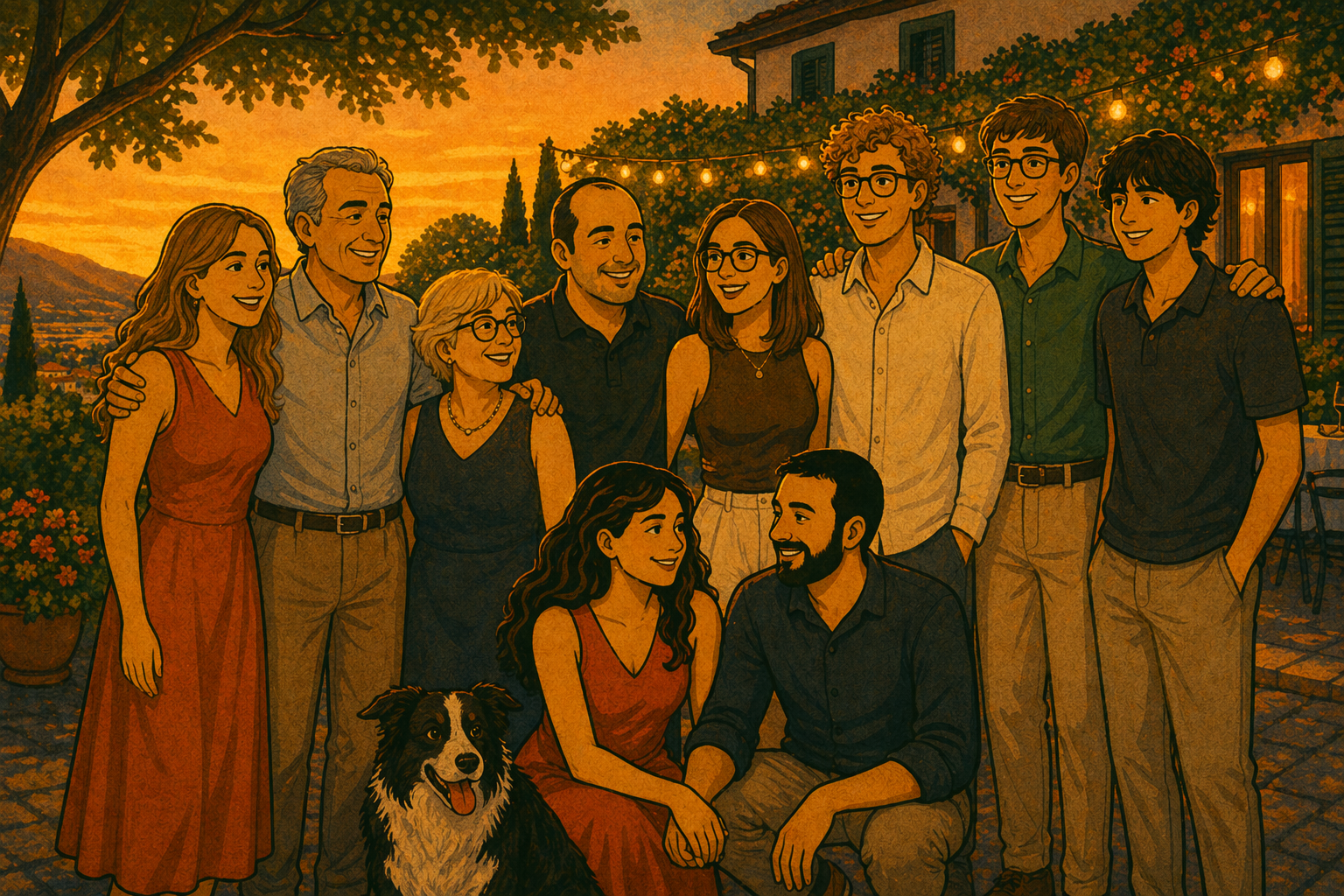
We started with aperitivo: an Aperol Spritz served in a punch bowl, plus pizzette. The sun was setting, the barbecue fire was already going, and the garden looked beautiful—decorations everywhere, people buzzing around in that easy Italian way, chatting and laughing like it was part of the menu.
Beyond the fence, the valley stayed quiet and green, and the sky softened into pastel tones as the light went down. It was the perfect backdrop for that moment—warm, loud in the right places, peaceful everywhere else.
Dinner was a proper barbecue—vegetables, good red wine, Prosecco—everyone talking at once the way Italians do when they’re comfortable, the table loud and alive, food moving around like part of the conversation. Costine were on the menu, so Samy carefully separated them from the beef, which was the halal choice for Mo and me.
And then, of course, someone demanded speeches—because no milestone is allowed to stay private.
Mo’s speech was sweet in the way that makes your chest tighten when you’re not ready to cry in public. He thanked my family for raising me the way they did. He said he couldn’t believe he’d found someone with the same values and morals—loyal, passionate, ambitious, athletic—his “perfect match,” like he still couldn’t fully accept his own luck.
Then he said the line that made everyone react: he had to make it official, to make sure I wouldn’t go anywhere without him.
I translated it into Italian with my usual tone—half sassy, half comedic—not because I wanted to cheapen it, but because that’s how I survive tenderness without dissolving. People laughed. Laughter made it easier to breathe.
When it was my turn, everyone joked they didn’t want to hear me because it was late and I could talk for eight hours if encouraged. I smiled, then did what I always do when I’m overwhelmed: I focused on the people right in front of me.
I thanked my aunt and uncle for the support they gave my mom through her hardest times—the kind that doesn’t announce itself but keeps someone standing. I told them it mattered. That I saw it. That I wouldn’t forget it. I thanked my mom for being my rock across distance, across years, across all the versions of me she’s had to endure. And I said the thing I actually felt: starting a “new family” feels less terrifying when you’re surrounded by people who aren’t just present, but real. Seeing my mom now—really seeing us, side by side, in the same room—watching her look at us with pride and actual joy made something in my chest unclench. Maybe that’s what she needed to feel genuinely excited: not just the news on a phone call, not the idea of it, but the evidence. Us together, fitting the way we do—imperfect, mismatched in some places, strangely right in others—like two puzzle pieces that weren’t designed for each other and still found a way to lock in.
We toasted. We laughed. We danced a little. We called it a night.
I helped Mo pack his things, and we ended up buying an extra suitcase for me to carry because we’d gone overboard on souvenirs. He kept most of the cheese, honey, and jams aside—things he wanted to give his mom as soon as he landed.
Then, we had one of those long cuddle sessions that feels almost embarrassing to describe because it’s so private, so animal, so simple. We were happy in that way, you only get when you stop pretending. I could feel how much he loved me without him needing to explain it. He could feel the same from me. We were close, under the skin close. And for a moment I let myself believe it fully: that I’d travelled the world looking for this kind of happiness, and I’d found it—and that I deserved it, and that I wanted to show it, daily, even when life turns hard and annoying and imperfect.
After just a couple of hours of sleep, at four a.m., we were up again for the airport—barely slept, exhausted in that tender way that feels like you’ve used your life properly. One last drive in the campervan. One last quiet. Then I kissed him goodbye like we were separating for weeks, even though it was only a day.
I was overwhelmed—happy from the trip, sad that it was ending, grateful that I didn’t have to end it alone.
Paying For My Engagement Party
After the airport goodbye, I went back home and tried to sleep a bit more. I managed maybe an extra hour before Mo called, upset: they’d made him throw away all the food items he’d bought for his mom. He sounded genuinely sad about it. I told him not to worry—I’d go to the local market and replace what I could.
I stayed up and got myself ready to meet Samy for breakfast at Café Silvio—pistachio croissant for me, Nutella for him, cappuccino for both.
Afterward, we made a quick stop at the market to replace what had been confiscated: honey and cheese, at least. No fresh jam anywhere. I texted Mo to tell him, knowing he’d be happy to read it the moment he landed in Dubai.
Then we headed to his parents’ storage—where my mom and I keep some of our things now, because we no longer have a house in Italy.
That sentence still hits like a quiet slap: no longer have a house in Italy. Not tragic in a movie way. Just a fact. A practical little grief you carry in your pocket and pretend you don’t feel until it presses into you at random times.
My mom had already done a lot in the storage the day before, and she was already at work when we arrived, but there was still so much to sort. I had to pay for my engagement party, somehow. The storage felt like a physical version of everything you try not to think about: old clothes, random objects, memories stuffed into boxes, life reduced to categories.
Samy got distracted—in the sweetest way—reading old schoolbooks and childhood essays he and his brother had written. We laughed until our faces hurt in some parts, softened in others. Time preserved in children’s handwriting.
We did three landfill runs, tossing a ridiculous amount of old things and sorting paper, plastic, wood, glass, and metal like we were trying to alphabetise our past. It was tiring in the body, but also in the mind, because every object you throw away is a tiny decision about who you’re no longer willing to drag with you.
During one of those trips, I bumped into an old friend I hadn’t seen in years—someone I’d wonder about from time to time as, without social media and too many lost contacts, I didn’t have the chance to reach out to.
He’d had a turbulent past with drugs—especially cocaine—and alcohol. The last time I’d seen him, I remember being genuinely worried; he looked like that substance was eating him from the inside out, mentally and physically. But this time he seemed well and healthy. I didn’t mention any of it. I just told him I was happy to see him and wished him well.
My mom, Samy, and I stopped for a quick lunch at my uncle Luigi’s house, polishing leftovers from the night before, then went back for more reorganising, more cleaning, more trips.
Real life doesn’t care that you just got engaged. It still wants you to take out the trash.
On another run, we witnessed the kind of landfill drama that feels uniquely European: a Senegalese man and an Italian man arguing over how to dispose of a wooden cabinet with glass doors.
The Senegalese man was tossing the whole thing into the wooden container. The Italian man stopped him and pointed out—twice—that he needed to separate the glass. The Senegalese man ignored him at first, then told him to mind his business. The Italian man doubled down: rules are rules, and if the system asks you to separate, you separate.
That’s when it turned personal.
The Senegalese man made it a racial matter, saying the Italian wouldn’t have bothered if the person dumping the cabinet had also been Italian. The Italian man replied—far from gracefully—that an Italian would “probably know” how to follow the rules. And after that, it was just shouting. Not even real arguments anymore, just loudness competing with loudness.
The operator—Moroccan, visibly exhausted by humanity—finally intervened with the reluctant authority of someone who has done this too many times. He told the Italian man to continue with his own disposal and the Senegalese man to properly separate the glass. Even then, the Senegalese man kept muttering, trying to revive the fight, until the Italian man finished what he had to do and left.
Samy and I laughed, not because it was funny-funny, but because it was unnecessary-funny. We understood the Senegalese man’s frustration—dismantling things is annoying, and we’d just spent our morning separating materials like surgeons (books included, because some covers are plastic while the pages are paper, and nothing is ever simply one thing). But we also understood the Italian man’s point: the rules exist for a reason, and if you want a community to function, you can’t treat basic instructions like optional suggestions.
We finished just in time for dinner with Samy’s grandma. Lorenzo joined too. She made her famous chicken schnitzel with roasted potatoes—the kind of food that tastes like someone’s love is structured and reliable. Then she pulled out her wedding album. She’d shown me before, but she was so happy to relive it that I didn’t want to rush her.
Page after page, she pointed at people who were no longer alive. Most of them are gone. And yet she spoke about it with that calm acceptance that only comes from living long enough to realise death isn’t dramatic—it’s just frequent.
She married young, at nineteen. Her husband was twenty-seven. She lost him suddenly to a tumour when he was fifty, left with two daughters, and still raised them well. And now, with both daughters long married with kids and retirement finally allowing her to breathe, she keeps her life full: coffee dates, aperitivo meetings, friends who are mostly divorced or widowed now. A generation of women who learned to keep living even when life takes things without asking permission.
After all the food and chats, I was exhausted. Around midnight, I asked my cousins to drive me home. We were supposed to meet their parents by the mountain, but tiredness won.
Goodbye and Welcome Back
The next morning, we had breakfast again at the same spot, same items, with Samy and my mom—one last Italian breakfast and gossip session before they drove me to the airport.
On the way, Samy’s grandma called with news that jolted all of us: the engineer working on something for my mom and her siblings had died in a tragic motorbike accident. Sudden death. Another reminder that the world doesn’t wait for you to be ready.
We tried to shake off the shock by shifting the conversation, forcing normality back into place for the last minutes together. At the airport, we only had time to kiss goodbye, not knowing when we’d see each other again. That BGY airport has been the backdrop of so many welcomes and goodbyes—tears, excitement, joy, sadness.
But it had never witnessed me engaged, returning to my husband-to-be, while still bitter about leaving Samy and my mom. A new emotional combination. Same gate. Different life.
After the systematic check-in and security routine, I didn’t wait long before boarding. I remembered December—waiting in the same terminal, at the same gate, returning to Dubai while fighting with Mo on the phone because he was on a boys’ trip to Thailand that tested our relationship to the max.
Now I sat in the same place talking to him softly, sweetly, both of us excited to see each other. Same airport. Different versions of us.
I boarded, found my seat, opened the book I’d bought at the outlet—Normal People by Sally Rooney—and fell asleep almost immediately. I woke up after lunch had already been served and cleared, starving, asked if I could still have something, got it nearly an hour later, ate, then slept again, as if my body were collecting rest with interest.
In Dubai, on the bus from the plane to the terminal, I chatted with a newly married Italian couple heading to the Maldives for their honeymoon. They asked everything people ask when they’ve never lived in the Gulf: about heat, traffic, the cost of living, the job market, and how to survive.
I told them the truth as I know it: Dubai is challenging, yes, but it’s also one of the best places I’ve lived if you know how to use it. They said they could never imagine living there. I smiled and told them I once thought the same. Life is built on surprises you don’t consent to.
I collected my luggage and waited for Mo. He arrived a few minutes later. Seeing him felt like returning to the only constant that mattered. He picked me up in his old Accent, and we drove home holding hands, carrying everything we’d just lived through: the flights, the campervan, the Vespa, the sightseeing, the engagement, the family, the fatigue, the strange sweetness of ending a road trip and starting something else.
Dubai didn’t feel like the end.
It felt like a room full of memories—and a door half-open to whatever comes next.
And now—nine months later, after countless fizzy drinks, late-night edits, and me still living in my usual chaos between work and personal dramas—I reread these pages with the same quiet shock I felt when planning for this holiday: my instinct didn’t fail me. I knew something big was coming. I couldn’t name it, couldn’t outline it, couldn’t prove it to myself with logic—but I felt it in the body the way you feel weather before it arrives.
The difference is that this time, unlike the US and China, that vertigo didn’t drag me into another version of myself I needed to escape from. It forced me to unpack fears, yes. It made me look at the ugliest questions without blinking. But it also brought joy—real joy—and the kind of clarity I’d been hunting for in all the wrong places. I didn’t need to change direction. For the first time in my life, I was already in the most right place I’d ever been, even if it was still messy, still imperfect, still full of admin and doubts and sharp edges. I had found someone who made the world feel like home.
So no—this wasn’t just an escape hatch for the days when reality felt too tight. It became a record. A witness. Something that will outlive my moods, my procrastination, and my habit of acting like I have infinite time. And what happened after this trip… it isn’t a new story. It’s the same one, simply taking speed.

Leave a Reply