
Back Home With a Stranger I Love
The next morning arrived with that particular kind of energy you only get in your own land: familiar air, familiar light, and your body pretending it never spent the last weeks sleeping in a campervan. We had a full day planned, and for once the plan didn’t feel like pressure—it felt like a gift I was finally allowed to unwrap. I offloaded and cleaned the campervan—finally able to get back my engagement ring since we securely stored it while we partied in Split—and squeezed in a workout, because I’m still me, and “visiting home” doesn’t cancel the part of my brain that believes movement is a moral duty. Meanwhile, Mo sat with my mom’s friend, attempting conversation in his broken English, trying to explain his crypto and stocks trading “secrets” with the seriousness of a man describing a sacred craft. It was almost sweet watching him find one of the very few people in my world he could speak to without me translating every second sentence. Most of my friends and relatives don’t speak English, except for my cousin Samy, and Mo still doesn’t speak Italian; his relationship with my family has been held together by gestures, instinct, and the fact that laughter is a universal language (and, of course, teaming up in mocking me for any silly reason).
We hopped on the Vespa and started climbing toward Adrara San Martino, and the first minutes already felt like a reset. The road pulled us away from flat, practical life and into the old rhythm of hills: vineyards stitched into slopes, small farm entrances disappearing behind hedges, stone walls that have been holding their ground for longer than anyone’s patience. The air was warm but not brutal, that Italian summer balance where you sweat a little but you don’t feel punished for existing. We passed quiet residential pockets—low houses with shutters half-closed, balconies with laundry and geraniums, the occasional barking dog that acts like it owns the valley—then the scenery tightened into bends that demand attention. Hairpins, narrow lanes, edges that don’t forgive. Mo, raised on Dubai’s generous roads and “modern engineering,” suddenly looked like he was learning a new alphabet. Italian streets up here aren’t always made for comfort; they’re made to fit around the land, not conquer it.
When we reached Gazzenda—my hamlet, my origin point—it felt exactly as it always does: small, stubborn, and oddly absolute. Not the polished postcard of Italy people imagine when they say bella Italia, but the real one: hills and fields, old houses that have watched generations come and go, and a quietness that can feel like peace or like suffocation depending on the day and your age. Via Gazzenda is a string of lived-in places rather than “streets”—stone-and-plaster houses with dark wooden doors, small courtyards, rusted gates that still open, ivy climbing where it’s not invited, and that constant presence of green: chestnut trees higher up, wild shrubs reclaiming the edges, vines, grasses, and weeds that grow as if the valley is always trying to take itself back. Everything looks domestic and rural at once. No performance. Just life, repeating.
I showed him my dad’s house. We tried ringing the bell to see if he was home, but we had no luck, and I didn’t know whether that disappointed me or relieved me. Some doors are easier to point at than to open.
We continued through via Brugali, where my parents had their first factory, and the ride became a slideshow of memories I didn’t realise I still carried so vividly. I pointed out where I had my first scooter accident before travelling to New York at fourteen—an age when you still believe you’re invincible and reality has to physically intervene to correct you. Then I told him about the second one, a year later, when a car hit me while I was again on my scooter, carrying groceries. Tomatoes smashed on the ground, my mom arriving terrified, convinced the red on the asphalt was blood. And me? I was at a waterpark with friends a few hours later, bruised and scratched but fine, because teenage logic turns survival into a bragging right.
I showed him the barn and vineyards that used to belong to my grandfather—sold by my uncle a few years back—where I used to play with my cousins. We’d jump into hay and come out itchy, scratched, wild, and proud of it, like discomfort was proof we’d lived. We’d sneak into an abandoned house nearby, the kind of place that felt haunted only because we wanted it to. We’d visit the cows and the bull too, and we’d be obnoxious about it, half terrified the bull would charge us, half hoping it would, so we could tell the story later like it was an epic.
Somewhere between one bend and the next, I told Mo about the daily bike rides from my house to the factory, the walks in the woods, the mud, the river, the autumn leaves that turned everything orange. I told him about the days I spent dreaming of leaving, because when you’re a kid with big dreams, a small place feels like a locked room. And yet now, riding through it with my fiancé, it felt less like a cage and more like a root. Same roads. Different body. Different story.
Then we reached a farm that holds the worst of my memories—a place where my body learned something too early, the kind of lesson that stays lodged in you even when you grow up and become “fine.” I was eight when the old owner—already in his sixties—worked his way into my trust using the horses and ponies, until one late summer afternoon, he tried to cross a line that would have changed everything permanently. He almost did. And I still thank that eight-year-old version of me for being brave enough to interrupt it: for slipping out, running like a maniac toward my parents’ factory, hiding under the office couch, crying like I’d never cried in my life, terrified in a way the body never forgets, while he followed me, trying to convince my parents that nothing had happened. He was never punished. I didn’t tell Mo any of this. I didn’t want that place to weigh on us on such a beautiful day, and I wasn’t ready to open a wound in the middle of sunlight. So, I just asked him to make a U-turn and ride back toward the main road, like I was avoiding nothing at all. Sometimes survival looks exactly like that: a calm voice, a simple instruction, and a story kept sealed for later.
We left Gazzenda behind and headed toward Adrara San Rocco—my mom’s hometown—passing the cemetery, the industrial area, the Viadanica overlooking it all like a cold observer. It used to be a beautiful symphony of hills with poultry farms, and now it’s an abused cluster of factories—rubber, metal, whatever keeps the valley working even when the valley is tired. Mo drove cautiously through the hairpin bends. We passed my junior high school, still under renovation—apparently for a decade—looking nothing like it did when I was there. Italy has two speeds: ancient and “we started renovating, see you in thirty years.”
We turned left at the traffic light and entered my uncle Luigi’s workshop and gas station. That place is almost a landmark in my brain: work, family, grease, familiarity. We stopped to say hi to him, my aunt Lisa, and my cousin Lorenzo, and to organise the next day’s barbecue. They thought it was just a goodbye dinner. I asked them if they knew why we were having it. They didn’t. So, I showed them the ring.
Their faces shifted. Surprise first, then that quick recalibration people do when your life changes in front of them, and they need a second to update their mental file. My uncle became chatty immediately, telling Mo about an event he attended in town the week before, where they served doner kebabs—his closest encounter with “Arab food,” even if it’s Turkish-German. It was cute watching him try to build a bridge with the only reference he had, like he wanted to offer Mo something, a gesture, a hook. Their congratulations came out a little stiff, not because they were cruel, but because they were processing in real time. What a way to meet them all for the first time and not through a screen: by learning, we are engaged. We said goodbye and let them get back to work, but I carried that moment with me: engagement news delivered in a garage, surrounded by family noise. Not cinematic. Real. Which is better?
We drove on. I pointed at the park where I had my first innocent date at thirteen, where we used to hang out after youth club, where Sunday afternoons and improvised after-parties blurred into each other. We crossed the town square, and I pointed out my friend Fran’s parents’ sports bar and my friend Giulio’s takeaway pizzeria. Then the narrow roads again, the ones that made Mo tense because they looked like they were built for donkeys, not vehicles.
A few minutes later, we reached the next town. The parking lot in the centre and the square were still under construction. Some things never change. The rest looked familiar: the church dominating the scene, the small sports bar that survived longer than the other six that tried to serve the town before it, and my auntie Gina’s mini market—an iconic landmark after seventy years in service. We parked the Vespa in front of my auntie Vanna’s hairdresser shop, and as we walked in, I spotted yet another auntie, Terry, sitting there getting her hair done. I wasn’t thrilled to see her, but I did what you do in small towns: you pretend everything is fine and swallow whatever history is sitting behind your teeth.
We promised we’d come back and first went to see my auntie Gina—my late grandma’s sister—eighty-two years old, strong-headed, full of personality, cheerful and sharp, the type of woman who doesn’t need softness to be loving. She was shocked at first when she heard about the engagement. Her generation believes you should marry people from “your land.” But then she spent an hour with Mo, trying to learn English, teaching him dialect words, laughing like she was younger than all of us, and she softened in real time. By the end, she was hugging and kissing him as if he belonged to her. Mo, who thrives on affection, was glowing. Watching that exchange felt like two worlds shaking hands without a treaty.
We returned to the salon. The atmosphere was pure Italy: loud, bubbly, rough, affectionate, gossip threaded through laughter like it was part of the service. Mo was entertained by how authentic it all was—no polite filters, no fake politeness, just people teasing each other openly, as if affection were something you prove by being brutally honest.
We stepped outside on the balcony while my auntie Vanna was finishing my auntie Terry’s hair. The view opened: scattered old farms up on the hills, paths you can’t even see but somehow exist, the football pitch, the kids’ playground. The air felt fresher, closer to the mountains. When we went back inside, my auntie’s session was done. She was happy with her new haircut—shorter, ash blond—and then she asked me who Mo was, because she didn’t even know we’d been together for a year. I showed the ring. Immediately, both aunties rushed to see it up close, fascinated. Terry joked about not getting one after twenty years, showing bare hands. Congratulations delivered with that Italian blend of teasing and mild coldness, always hiding something deeper. We smiled through it, said goodbye, and I told Mo I wanted to take him to La Glera.
We rode down the steep ramp near the football pitch and the playground, passed my auntie Vanna’s house, slipped through the short tunnel, crossed the bridge where you can look down and catch the torrent mid-breath, then kept going—old windmill, horse stable, old farm—until the arch that leads up to where my grandma’s house used to be.
Used to be doing a lot of work here. The building is still there, the shape is the same, but it belongs to a woman who hurt my mother in ways I still don’t know how to forgive properly and seeing her inside those walls creates a bitterness that doesn’t even try to be poetic. That house held entire seasons of my life: endless summer days with my cousins; Christmas preparations: two floors filled with nativity scenes and trees and decorations from ceiling to floor; and those insane nights every four months when my mom, my aunties, my grandma and I would meet at 3 a.m. to make kilos of lasagna, fresh pasta, pizza, cakes—some for us, some to store, some to share with family and neighbours. Food as labour. Food as love. Food as identity.
I could talk for days about that house. I’ve told Mo some of those stories before —months ago in Dubai, over dinner —and he shared his own: Syria, cousins, grandma’s house, the way childhood has a smell you never fully forget. But standing there again, it didn’t feel like nostalgia. It felt like something that still belonged to me, even if the walls no longer did.
We parked the Vespa and barely crossed a small bridge before I ran into two women I knew—an old friend’s mother and my aunt Vanna’s neighbour. They didn’t recognise me at first. Time does that: you become a ghost of your younger self, and people need a few seconds to match your face to their memory. We chatted briefly; they asked what I was doing, where I was living, and who the gentleman was. I introduced Mo as my fiancé and watched their eyes jump straight to the ring—joyful, curious, impressed in that immediate, honest way. We said goodbye and kept walking, and I could feel that small-town mechanism clicking back into place: people positioning you, sorting you, filing you under ah, so that’s where she ended up.
We passed my late grandma’s favourite church, the Chiesetta in Valle, and I showed Mo the small drain hole we used to sneak through as kids, just to walk around the back and pop out on the other side like we’d hacked the world. We used it as a test of growing up: the day you can’t fit anymore, you’re officially not a child.
Then we followed the river. It was fuller than last year—more rain, lower temperatures, mountain water behaving like mountain water—though still not what it used to be when I was a kid, back when the stream felt higher, clearer, wilder.
I was scared we’d see snakes. Water snakes, mostly. My fear is old, irrational, and completely real. I still remember one summer when the stream was dry, and my dad and I walked inside it, jumping rock to rock. He suggested we get out, but I was stubborn—some things truly never change—and I kept going alone while he returned to the main path. I saw something long and black on a rock, leaned toward it, reached slowly with my hand, and at the last second saw it move. Snake. I screamed and ran back so hard I scratched my father, climbing into his arms, sobbing as my body had just discovered a new language. That was the day I realised I had ophidiophobia. I probably inherited it—my uncle Luigi can face anything, but not snakes. Same with my auntie Gina. That fear sits deep in the body, not in logic.
Luckily, we saw none. Instead, the chestnut woods wrapped the hillside in dense green, alive in a quiet way. Leaves rustled in the afternoon air and released that damp, earthy smell forests carry, mixed with pine resin. Small clearings opened into meadows dotted with wildflowers—yellow buttercups, shy violets, occasional red poppies cutting through—and further up, modest farmsteads appeared, stone and faded plaster, red-tiled roofs warmed by sun. Everything felt quieter here, and the silence had texture: a distant cowbell, a bird diving into the canopy, the water’s continuous insistence.
When we reached the first big pool, Pos de La Ria, memory hit me with no warning. I remembered being a kid and pre-teen, sunbathing in the middle of the road like an idiot, packing our towels the second a farmer’s truck or a Fiat Panda approached, then reclaiming the spot the moment it disappeared around the bend. I remembered the dives from the step stone and the fences for the bravest, and I can say it proudly: I was one of the fence divers. The water was freezing then. It was still freezing now. I went down the steps, dipped my feet, and my whole nervous system woke up. Mountain water doesn’t ask you to be ready; it just tells you, immediately, that you’re alive.
We continued toward the next pool. Under a big chestnut tree, a group of old men sat around a table and benches, shaded and curious. I recognised all of them. They didn’t recognise me. I greeted them, introduced myself, and they needed the names of my grandparents and parents to place me correctly—as if identity here is still a family tree before it’s a person. Once I explained the lineage, their faces shifted into recognition.
One of them, Pietro, is a legend: ninety-two years old and lively like time forgot to slow him down. He took a particular interest in me and offered a dance right there, in the middle of the day, like it was the most normal thing. He mumbled a ballroom melody and carried me around in a waltz I didn’t know how to dance, and somehow I managed—laughing through it, trying to keep it light. Then he made a comment about not being able to do a casqué because I was “too heavy” and used it as an excuse to put his hands on my bottom. I slapped his hands away immediately—fast, firm—still smiling because small towns demand diplomacy even when your body is screaming no.
Mo watched it all, trying to contain his annoyance, and I could feel his protective instinct tightening like a wire. I cut the tension by greeting everyone again, ending the scene cleanly, and steering us away.
We took an even narrower road back. Mo was shocked again but also impressed. Those old houses carried history in their stones, the kind you can’t renovate away even when you try. We stopped quickly at Vanna’s salon to say goodbye, then began heading toward Sarnico because we had dinner plans with my mom and her friend, and time was suddenly not ours anymore.
We flew through Adrara San Rocco, Adrara San Martino, and Villongo, then cut through Rudello and via Cortivo to show Mo my high school. It’s renovated now. I remember when renovations started—my last year as a student. I remember sitting in that classroom dreaming of being elsewhere while pretending to listen to teachers deliver the curriculum like duty, not passion. It was boring, for the most part, and for a while, it stripped away my love for study and creativity. But it also gave me friends I still carry—like Nada, with whom I travelled around Europe and built memories I can still touch.
By the time I resurfaced from that, we were back in the square. Mo was amused by a potable water fountain, like it was an attraction, the way he gets excited about simple things when he’s not under pressure. He spotted an ice cream shop overlooking the lake and was ready to get a cone immediately. I told him to wait. Aperitivo before dinner. Ice cream after. He agreed—surprisingly obedient—and we started walking into the Contrada, with the lake light in our peripheral vision and that familiar home-city feeling returning: not nostalgia this time, but something calmer, like I was finally letting him walk inside my life instead of just hearing stories about it.
The Lake That Watched Me Grow Up
We started the walk from that uphill road where No Stress Pub is—the place where my friends and I used to sit outside on weekends at nineteen, twenty, sipping beers, smoking joints and cigarettes, being friendly with people we would later pretend not to know when we bumped into them again… at least until the next time we were drunk and high and everyone became “family” again. I told Mo those stories as we walked, because I can’t bring him home without also bringing him the version of me that lived here: loud when she felt safe, reckless when she felt bored, tender in ways she didn’t know how to admit. The street itself is full of old stone houses and tiny balconies overflowing with flowers—Italian charm in its purest form, but also in its most curated one: beauty that exists because someone trims it, waters it, chooses it daily.
We climbed stairs, turned into the alley just before Pinacoteca Bellini, and I pointed at the drawings of natura morta made by local kids displayed on the walls—small, honest attempts at beauty, the kind that don’t try to impress you, they just want to exist. We continued along the road where Salumeria della Contrada is, and suddenly I was back to those summer Sunday mornings when my parents were still together: the rare mornings when we’d walk around because I didn’t have catechism, and that alone felt like freedom. Cornetto and cappuccino, or juice if I was pretending to be healthy, then a stroll, then lunch at my grandma’s with the rest of the family. It felt like a different lifetime—one of those lifetimes you don’t realise you’ve lost until you see the streets that held it. My father, once every two years, would go to Cirillo down that same road and buy expensive clothes that would last him forever, because growing up, we didn’t go out much, and my parents mostly lived in work clothes. I remember them in the uniforms of labour more than in the outfits of leisure. Even when they tried to relax, they looked like they were still on shift.
Before turning into Via Tresanda, we stopped to look at house prices at a real estate agency. Villas up to €800,000. Modest apartments at €300,000. Mo and I did the Dubai comparison because that’s what living there does to your brain: it turns every place into a price-per-square-meter argument. Dubai would offer “better value,” we agreed—if value is measured in glossy convenience, fast services, and the quantity of amenities you never asked for but end up using because they’re there. But then there’s the lake. The hills. The air. The fact that you can walk and breathe without feeling like you’re paying for every inhale.
And yet jobs here are limited. Unless you want factory life or a secretary role, you won’t find much. And even then, the money wouldn’t easily afford what Guerini Immobiliare was advertising. That contradiction sits at the heart of many Italian places: beauty priced like luxury, salaries shaped like survival. You grow up surrounded by elegance you can’t buy, and it messes with your idea of what a normal life should cost.
We proceeded through Via Tresanda and passed Dicottedicrude, a local delicatessen, which Mo somehow didn’t ask to visit, which was a miracle, considering his usual relationship with food shops. I noticed many old shops were still standing. It made me weirdly happy, because in many big cities, the historic centres have been eaten alive by cheap souvenir shops and restaurants that strip the place of its identity. I’m an immigrant myself; people moving and settling elsewhere doesn’t bother me. What bothers me is when capitalism sells a place’s history to businesses that preserve nothing, tell no story, and offer no soul. A city becomes a costume. A fake version of itself, worn for profit until it tears.
We reached Piazza Garibaldi and crossed to connect with Lungolago Ing. Carlo Riva. On the right, the lake opened into Paratico; on the left, cafés and bars—most changed since I was young, so my memories don’t attach to them properly. There weren’t many people, which made the walk feel almost private, like the lake had agreed to show us its quieter face. As we approached the newer residences, we saw a man preaching verses from the New World Translation of the Holy Scriptures, his voice cutting through the lake air as if he were trying to slice reality into obedience. People watched him with that specific mix of curiosity and annoyance Italians reserve for public performances they didn’t consent to. Someone muttered that the world is going crazy. Maybe it is. But street preachers aren’t new—they’re just absent in the UAE, where public ideology is controlled, and even private political conversations can feel risky, like the walls have ears and a filing system.
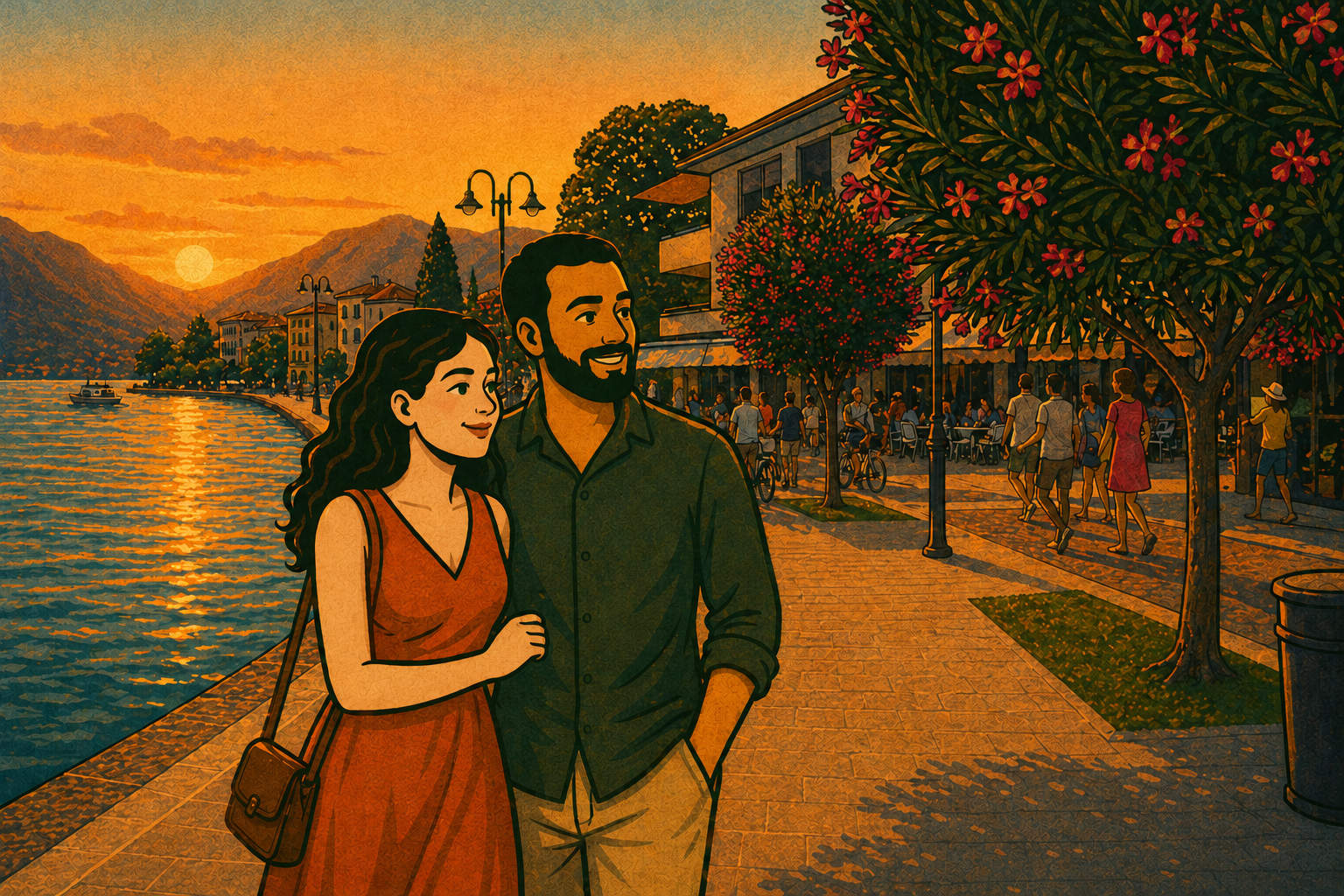
Mo and I stopped at Swing Dehors for an aperitivo. Aperol Spritz each, snacks, the lake view framed by the Capriolo hills—blue and green shades thickening into that end-of-holiday light that makes you nostalgic whether you want to be or not. It wasn’t sadness exactly. More like that soft ache of knowing something good is ending, and you can’t slow it down. I felt both: sad that the trip was ending, grateful that I was ending it here, with him, in a place that shaped me.
We paid and left for Iseo because dinner time was coming. We drove slowly through Paratico with the lake on our left, the breeze turning cooler, and something inside me kept repeating the same thought: this still feels unreal. The places that formed me—places I loved and hated, places I spent years dreaming of leaving, places I now look at with sweet nostalgia—were now being witnessed by Mo. The places where I never fell in love, but where I used to dream of a love like this. And now I could show him. I could share it. That alone felt like a small miracle: not the flashy kind, the quiet kind that lives inside your chest and changes the temperature there.
It took about fifteen minutes to reach the Conad parking in Iseo. We parked, walked through a small residential street leading to Via Campo, then connected to Lungolago Marconi. My mom and her friend arrived just after us, as if the timing had been rehearsed. We met at Ristorante Pizzeria La Filanda, and before the food arrived, we stole the last light for photos—because the lake was doing that thing it does when the sun gets low: turning everything into metal and silk at the same time.
Behind us, from the dock in front of La Filanda, the water stretched out like a sheet of dark glass with gold bruises on it, the kind of reflection that looks edited even when it isn’t. Boats were tied up along the edge, rocking gently, ropes creaking in that small, reassuring rhythm that tells you the lake is alive but calm. Across the water, the hills were already shifting into shadow—greens deepening, outlines softening—while the sky stayed indecently dramatic: peach at the horizon, then burnt orange, then that fading blue that always feels like a promise being withdrawn. The air smelled like warm stone and water and whatever the many restaurants were serving nearby, and every few seconds, a wavelet slapped the dock like it was applauding quietly.
We ordered a pizza each and water, and while we waited, I translated bits from Slovenia and Croatia, filling in the gaps for my mom and her friend, watching Mo do that thing he does when he wants to be liked: attentive eyes, polite laughs, a charm that doesn’t need language to work. Then the pizzas arrived. I had my usual: burrata and cherry tomatoes. My mom ordered the same, because we share a brain when it comes to food. Mo had salmon, cream, and teriyaki sauce—his taste buds always needing a plot twist. My mom’s friend went full meat with parmigiano and burrata. The table looked like a map: different tastes, different backgrounds, one small-town normality holding it all together. My mom and her friend did their best to chat with Mo in English, and Mo did his best to be charming in return. We talked about our holiday, their trips to Southern Italy and Dubai, life—everything and nothing —the way dinners do when people are trying to meet in the middle.
After dinner, we walked the lungolago and stopped for an average ice cream, which still felt like a ritual because summer nights require it regardless of quality. I’d been there earlier in the holiday with my childhood best friend Jules, so the renovated Lungolago Marconi wasn’t completely new to me, but it still took a moment to accept it. They replaced the old blue fences with open concrete, modern minimalism, and removed trees that used to complement the lake’s green shades and the Parco Corno across the water near Predore. The trees were missing in a way that felt physical, like losing a tone in a song you’ve always loved. Sure, it’s more “modern.” But it’s not my style. I love colour. I love softness. I love life looking alive.
Even the art pieces along the lungolago—supposedly inspired by the lake and meant to raise awareness about pollution—carried a message, yes, but they weren’t beautiful to me. I know that’s not the point of all art. Still, I don’t love being punished visually when I’m already thinking about what we’ve done to everything that tries to stay clean.
We kept walking all the way to Lido dei Platani, passing sculptures that have been residents of the lake for years now, and by the time we checked the time it was already eleven. Between chats and slow steps, the night disappeared the way it always does when you’re not trying to control it. We realised it was late, said goodbye, went back to our respective scooters, and called it a night—full, fed, and strangely calm.
The kind of night that doesn’t need fireworks because it already holds enough.


Leave a Reply