
Hawaii Beach, and the First-Day Curse
We left Senj around 11:30 a.m., the kind of late-morning departure that still pretends it’s early if you say it confidently enough. I was driving, period pain still sitting in my lower back like a threat, and the painkillers I’d swallowed in desperation were doing their job a little too well: the ache was muted, yes, but my eyelids were getting heavy in that slow, syrupy way that turns a motorway into a lullaby. We chose the faster route anyway—because we were trying to arrive, not to fall in love with the road—and Croatia kept teasing us regardless: stretches of straight asphalt that hypnotise you, then sudden openings where the coast flashes blue between hills, small towns clinging to the shoreline, rooftops packed tight as if they’re leaning into each other for wind support. The sea would appear and vanish again with every curve, and when it stayed visible for longer, it looked unreal—bright, sharp, almost metallic under the sun, with little bays and inlets cutting into the land like someone had taken a blade and gotten carried away.
By the time we reached Novi—maybe thirty minutes in—I knew I was losing. Not dramatically, not heroically. Just that quiet internal warning that says: if you keep going, you’ll end up fighting sleep with one eye open, and that’s not bravery, that’s stupidity. I pulled over, handed the wheel to Mo, and fell asleep almost instantly, the way you do when your body has been begging, and you finally stop pretending you’re in charge. I woke up abruptly every now and then—curves, sudden bursts of wind hitting the campervan like a shoulder check, my subconscious refusing to fully surrender. I trust Mo’s driving. I do. I just trust him less with a campervan, especially when the road starts doing that coastal thing where it looks calm until it isn’t. Each time I jerked awake, my mind would race to the same paranoid checklist: did he miss a gear, did the wind push us, is he correcting fast enough—while he, poor guy, kept driving steadily, focused, surprisingly confident.
I came back to consciousness properly when we were passing Fiume—Rijeka—and the sadness hit me in a very Italian way: not regret, exactly, but that sharp curiosity you feel toward places that have lived in your schoolbooks. Fiume wasn’t just “a city we drove past.” It was a contested symbol, argued over by empires and kingdoms, a place that became a stage for post-WWI madness, where even D’Annunzio—the warrior-poet with his theatrical appetite for history—occupied it in 1919 and held it in that feverish limbo until the Rapallo treaty and the so-called Bloody Christmas pushed him out. I stared at the signs and thought about streets carrying that kind of residue, about whether the city still feels mixed—culturally layered, emotionally complicated—or whether time has smoothed it into something simpler. I said a quick goodbye to it in my head, a little mournful, because we still had distance ahead and Pula was the point: last Croatian stop, last sea taste before Italy.
Mo listened to my mini-lecture with the polite blankness of someone missing too many European history chapters to feel the weight I was feeling, then kept driving—now fully in his “I’ve got this” mode—until Pula finally arrived around 2 p.m., sunlit and impatient, like it had been waiting for us to stop being dramatic and just get in the water.
Park4Night led us to a spacious parking lot by St. Paul’s Church, where we found the only semi-flat, shaded spot, and we didn’t pay for it, which felt like a small victory in the ongoing war between travellers and parking systems. We secured our home on wheels, offloaded the Vespa, and Mo immediately changed into his swimming costume, already half-mentally in the Adriatic. I didn’t. I packed my swimsuit “just in case,” but I didn’t have tampons, and I was bleeding too much to pretend this was going to be a simple beach moment for me. So I stayed in my clothes, slightly annoyed at my own biology, and told myself I’d still enjoy it—if not in the water, then at least with my eyes.
The Vespa ride toward Verudela had that resort-peninsula feeling: pine trees and holiday complexes, people in flip-flops moving with beach purpose, signs pointing to beaches and coves like an invitation list. The road slipped between hotels and apartment blocks, then opened into those glimpses of water that make you sit up straighter even when you think you’re used to the sea by now. We parked, walked toward Hawaii Beach, and I could already hear it before I saw it—the layered sound of summer: voices, splashes, laughter, that constant Mediterranean buzz that feels chaotic but also weirdly organised, like everyone has agreed to share the same scene.
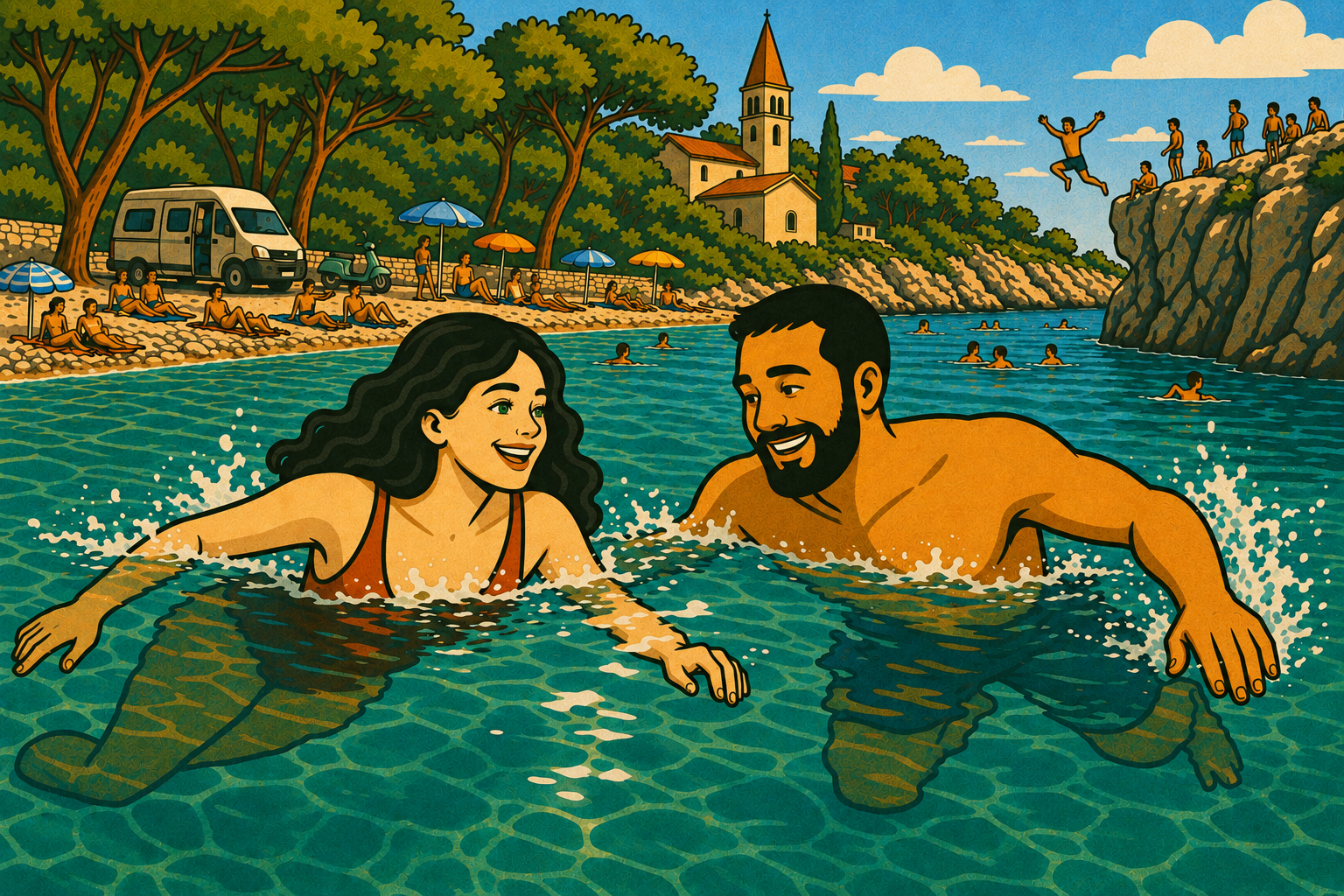
Hawaii Beach was exactly what it promised and exactly what it threatened: pebbles crowded with bodies, towels overlapping in a way that makes personal space feel like a luxury item, and water so turquoise it looked edited—until you watched swimmers cut through it and realised it was real. Off to the side, a three-metre cliff became a ritual: people queuing to jump, friends filming, strangers applauding, bravery performed in small, turn-based doses, like a theme park ride. Mo couldn’t wait. He handed me his phone with that expression that says you’re my person, therefore you’re my camera crew, and I was ready to accept defeat and just sit there peacefully—until he insisted. So I walked into the water up to my knees, phone in hand, while he climbed up toward the jump spot, already grinning.
In front of him, an Italian teenager stalled in the way only teenagers can—half terrified, half allergic to looking scared—while his friends shouted encouragement that sounded loving but had that casual cruelty adolescence always smuggles in. Then a German girl, maybe ten, cut in with the calm confidence of a child who hasn’t yet learned embarrassment: she jumped without ceremony, surfaced laughing, and her father clapped as if she had just won a medal. The teenager’s moment of hesitation suddenly became impossible to sustain, so he jumped too—more out of social survival than courage—and resurfaced to the exact same friends who had pushed him. I watched it all thinking: this is what growing up looks like sometimes—fear, performance, water, and someone filming.
Then Mo jumped, and my “recording skills” immediately became a public trial because he launched himself off the edge before my brain could even adjust the zoom. When he surfaced and reviewed the footage, he mocked me with the kind of exaggerated disappointment reserved for people you love. We bickered for five minutes—angles, timing, reflexes—until we landed on a compromise that saved our relationship and our dignity: I record with my phone, he records with his waterproof case, and we pretend we’re a competent production team.
Once his ego recovered and he’d collected at least one “acceptable shot,” he insisted I should swim. I wanted to. I really did. I just had to deal with the pad situation first—and there’s no elegant way to do that when you’re surrounded by cliff stairs, foot traffic, sunburnt strangers, and the irrational fear that the Adriatic might publicly expose you. We tried to find cover, failed, then found a better, more hidden corner behind the stairs where a tall rock gave us enough privacy to move quickly. I changed like someone doing an illegal exchange: fast hands, minimal exposure, wet wipe, swimsuit bottom on, everything packed away, no time for dignity. Mo was laughing, not cruelly—more like he was trying to keep me light—and I still asked him, dead serious, to confirm I wasn’t leaving a bloody trail behind me. He told me to stop being paranoid in that classic male way that means I love you, but I cannot fully imagine this anxiety, and then he took my hand and pulled me toward the water like that was the only cure he trusted.
And it was.
The cold hit and reset everything—pain, tension, self-consciousness—like my nervous system had been waiting all day for that exact temperature. We swam to a small cave nearby, and inside that dim pocket of rock, the beach noise softened into an echo. I wrapped myself around Mo in the water, climbed onto him, rested my head on his shoulder, and felt my body finally unclench. We kissed. Smiled. Tried to film ourselves swimming in the cave—an entire comedy of failed takes, laughing underwater, hair in our faces—until we got something good enough to keep. Time moved, the crowd thinned, and the beach became kinder. Mo kept jumping off the cliff, kept hiding in the water and pulling me down by my legs like an affectionate menace, and we chased each other and splashed around like two people who still know how to be twelve when the environment allows it.
That’s us when we’re good: nature, water, and each other—no extra entertainment required. And in those moments, my doubts about marriage felt strangely superficial, like noise that disappears the second life gets simple again. He has quirks. He has moods. He has those sudden bursts of temperament that test my patience. But he’s also a gem of a human being—good values, good heart, and the same kind of playful soul that makes time feel lighter. And honestly, what else did I really need?
When we finally got out, we disappeared into a hidden spot in the pine forest so I could put on a clean pad without another public logistics performance, then we kept walking along the cliffs, following the edge like a promise: Adriatic in front of us, yachts scattered like punctuation, intense green behind us, warm light thickening toward sunset. We reached the end of the cliffs, turned back into the forest, followed a small path near the holiday complex pool until a fence stopped us, then walked the fence like curious thieves until we found an entrance down into a small canyon. What waited there felt private—shallow water glowing turquoise, deepening into cobalt where the rock dropped away, the sun sliding down between stone walls like it wasn’t ready to leave. We climbed back up and ended on a concrete platform—an unfenced terrace over the sea—where elegant English couples posed with babies and strollers, a Russian family ate pizza straight from cardboard on the rocks, and an ancient wall ruin framed the other side like a window into a different version of the coast. We sat there quietly, watching the sun start to go to sleep, holding the kind of silence that comes when you know you’ve just collected something you’ll miss later.
Pula After Dark, and the Roman Steps That Told the Truth
We used the last dim light to get back to the Vespa, and life immediately returned in the form of obligations. I took a call from one of my bosses about a new contract—commission structure promising, base salary too low—and I asked for everything in writing while already preparing the renegotiation in my head. Mo called his mother, who was grocery shopping in Sharjah with a friend, and for a few minutes, we were both half in Croatia, half in our real lives, juggling futures while still dripping salt. Then we rode back to the campervan and the period tension came back with me: Mo wanted the city centre immediately; I needed a shower and a change like my body was negotiating for survival. He fussed, I pushed, and we settled on one hour—shower, food, ready. I moved fast, cooked the quickest veggie frittata with salad on the side, and we left again before my body could start complaining louder than my willpower.
We parked by the Arena, and Mo—sweet and predictable—reappeared with a cheese croissant like a peace offering wrapped in pastry. I grabbed sparkling water, dragged him up the Arena’s side for photos because the sky was doing that violent final-show gradient from dark orange to deep blue, and I refused to waste it. He complained dramatically that he would’ve preferred seeing the place in daylight, and I told him to stop acting like a wounded prince and enjoy the romantic stroll. Inside the Arena, a film festival was running—Croatian audio, English subtitles—and we stood there for a few minutes, long enough to feel the absurdity of it: a Roman amphitheatre built for blood and spectacle now hosting people in expensive clothes watching modern stories with expensive tickets, the same stone receiving a completely different kind of crowd. The contrast didn’t ruin it for me. It made it sharper. History doesn’t disappear—it just changes costumes.
Pula at night was busy in that summer way—crowds without panic, shop windows spilling light onto cobblestones, the smell of grilled fish and truffles drifting out of konobas. We wandered, got pulled into a jewellery shop with too many tempting options, then into a gift shop stacked with Istrian specialities—olive oils, wines, fig jam, lavender honey—where Mo shopped for his family like devotion is measured in jars. I bought body lotions for my mom, his mom, and a small one for myself, because I like leaving places with scent trapped in glass. Then we found a vegan ice cream shop: I went straight for dark chocolate, and Mo—curious to the point of self-sabotage—asked the shop assistant if the base was milk or yoghurt. The look the shop assistant gave him could’ve ended wars. “This is a vegan shop,” he said, and I laughed so hard Mo had to laugh too, and even the shop assistant cracked.
With cones in hand, we walked to the Temple of Augustus and sat on the Roman steps, stone cool under us, watching a family with three kids turn the square into theatre: the toddler launching himself into grandpa’s arms like it was his job, the five-year-old performing drama like she was already collecting applause, the oldest trying to organise everyone into photo formation with the exhausted authority of a tiny manager. And it pulled me straight into my own cousin memories—those years when we were a pack, always together, always inventing trouble. The eldest, Marko, carried a strange sense of duty that turned into control if you weren’t careful; he loved acting like the sergeant, sometimes a little too much. I still remember Sardinia, the mini club, the “Ruba Bandiera” game, me getting bored and walking back to the sunbeds alone like a queen who doesn’t need instructions—only to be slapped violently on the bum, out of nowhere, so hard it shook me into tears. I cried like the world was ending, waiting for my mom to return, while he scolded me for not “telling him” I was leaving, as if he’d been appointed my guardian by an invisible court. It was ridiculous and also very him: that instinct to control the group, especially me, the only girl, the one who could become either princess or problem depending on the day. I grew up with the potential of being a princess in a kingdom, but because I had a tendency to get into trouble—often thanks to Marko’s reckless ideas—I ended up being compared to a witch more than a princess… until I grew up, cut bangs, and with my green eyes started resembling Lucy Lawless as Xena. So yes, I became a princess after all—just not the fairytale kind, which suited me better anyway.
The two younger cousins were their own drama set. Samy—the youngest—was pure sweetness, cheeks so puffy and adorable he could flatter his way into anything from birth; it was impossible not to adore him. His older brother, Lorenzo, had always been gruffer, moodier, and troubled even before he had a little brother to blame it on. But when he was sweet—rare, sudden—it felt like the sun breaking through. I watched those three kids in Pula until they vanished into the crowd, and the square softened again, and the steps under me felt like they were holding not just Roman history but everyone’s private little family mythology, too.
That’s when the trip landed in my chest properly. Last night before my hometown. Then Dubai. Sitting on Roman stone, under warm Istrian night air, it felt impossible not to say the quiet truth out loud: I’m grateful for what Dubai gave me—work, routines, Kite Beach volleyball, the version of me that learned how to survive and earn—but it still feels foreign, more duty than belonging. Mo understood it in his own way, maybe even more than I do: he grew up there, yet residency renewals, paperwork, and a Syrian passport keep even him slightly outside the illusion of permanence. Dubai lets you build a life, but it doesn’t always let you feel like you own it. It’s a place that teaches you how conditional “home” can be.
So we talked—properly talked—about what “home” actually means when your life is split across maps and obligations. We talked about family gravity: his, pulling him back, mine, calling me north; the way love doesn’t erase responsibility, it just forces you to negotiate it differently. We talked about how bizarre it is that a city or a document can decide how safe you feel, how relaxed you are, how far ahead you’re allowed to plan. And then we reached the part that mattered most: the simplest, most inconvenient truth—home isn’t a skyline or a passport stamp; it’s the people you carry it with. For me, it’s my mother, Samy, and him. For him, it’s his family and me. Two versions of the same longing, shaped differently, both real.
We hugged hard there on the steps, holding the present tight, the way you do when you know you’re about to transition again—another drive, another border, another version of yourself. Then we walked back through Pula’s lively streets toward the campervan, letting the old glow stay behind us like a beautiful aftertaste, and for the first time that day, the “first-day curse” loosened its grip: pain, pills, paranoia, money math, all of it fading under one quiet certainty—whatever happens next, at least we’re not doing it alone.


Leave a Reply