
Heat, Tennis, and Old Hunger
We woke up a few hours later because the heat had decided we’d had enough sleep. Outside it was already hot, but inside the campervan it was worse—an oven with wheels, stubbornly retaining yesterday’s warmth as if it were sentimental about it. We had turned on every fan we owned, pointed them in strategic directions like we were conducting an air orchestra, and still the bed area—elevated, closer to the roof, closer to whatever merciless sun was doing up there—held the heat in a way that felt personal.
Through the thin walls we could hear tennis balls being hit with that dry, rhythmic thwack, the squeak of shoes, a coach’s voice cutting through the morning, and I kept wondering what sort of heroic biology allows someone to run in this temperature by choice. We threw on clothes quickly and stepped outside to check reality, and immediately it was obvious: the air out there was hot, yes—dry heat heading toward thirty-two degrees—but at least it moved. At least it didn’t trap you. The courts were right there, kids training like little disciplined machines, and it was around ten, meaning they’d been at it for hours, because I remembered hearing the first sounds earlier, half-asleep, before my brain registered what it was.
One kid—maybe nine—was genuinely good: fast feet, clean technique, hitting the ball with a precision that didn’t belong to his age, and the coach went harder on him than on the others, correcting him, challenging him, demanding more. Watching it pulled something old out of me so quickly I almost felt embarrassed, because suddenly I was back in my own childhood, in a gym with volleyball lines on the floor and my heart set on one thing only: excellence. I used to beg for harder balls, extra reps, extra drills, diving and jumping as if the sport were oxygen.
I remembered the day my afternoon school schedule accidentally overlapped with training and I threw a tantrum so dramatic it deserved an Oscar: crying until my eyes felt like they might pop out of my head, collapsing on the floor, refusing to move, bargaining with the universe through my mother’s patience until she finally caved and let me go. I went to training happy and remorseless, as if education could wait but volleyball could not. That love stayed strong until I entered a semi-pro league and learned the ugly side of sport: unstable clubs, power games, egos disguised as leadership.
That season was a disappointment wrapped in promise—I was selected as a reserve and I didn’t mind, because at nineteen my hunger was to learn, to improve, to finally be in an environment with real competition instead of the small clubs I’d known before. The first coach was perfect, almost unreal: a former coach from the Brazilian men’s national division, disciplined and competent, respected without being feared, someone who knew how to lead without humiliating. And then—because life enjoys ruining good things—the club owner started seeing him as a threat and dismissed him.
After that, the carousel began: substitutes ranging from average to terrible, with the last one being the most depressing version of authority—a puppet, chosen because he would obey the owner without question, a man who replaced coaching with bullying. He went after me in particular, not because I was factually the weakest, but because I was the youngest, the most inexperienced, and by then severely demotivated. He tore me down until the sport felt like a place where I went to be made small. I started skipping trainings and no one cared. I barely played a game. I ended up hating volleyball so much I quit for seven years, until I found my way back through beach volleyball, which became an obsession and—ironically—the reason I met Mo.
Standing there in the heat, watching that nine-year-old chase a ball with his whole soul, I found myself silently wishing him a future without the sort of adult who turns passion into shame. May he always be protected by good coaches, good environments, good people. May sport stay a home for him, not a punishment.
We had a quick breakfast and told ourselves we’d move toward Split, because that was the plan, and because plans keep you from dissolving into the day. I wanted to work out, but it was already too hot, and between me and Mo being sleepyheads and Mo being—how do I say this politely—the slowest creature alive when it comes to getting ready, we kept missing mornings the way some people miss trains.
I’m fast when I’m in motion; I can complete a full list of tasks in the time it takes someone else to decide what socks match their mood, and I rarely relax before the mandatory things are done. But I’ve never been a morning person. Even as a kid in Italy, summer meant sleeping until ten, eleven, sometimes later, going to bed at one or two, and treating sunrise like a rumour. The only time in my life I was naturally an early bird was Cape Town—my routines there felt effortless, I woke up without alarms, excited to leave the house, excited to live.
Dubai did the opposite: it made my habits worse, and the combination of summer humidity, indoor living, oxygen-starved routines, and food that often feels more “available” than “nutritious” left me tired in a way that didn’t feel like rest could fix. On this Eurotrip we woke around nine—not early, not scandalously late—and yet my energy was different. The food tasted natural. The heat was hot but not soul-draining. And I was travelling—my favourite state of being—with one of the dearest people in my life. My mind was in a good place, even when my body was sticky.
Fast Roads, Bad Parking, and the Skoda Interruption
The drive to Split wasn’t as scenic as we’d hoped, because we chose efficiency over seduction and skipped the Adriatic Coastal Road, taking the A1 motorway instead. It was fast and direct, a long ribbon of asphalt cutting inland through the Dalmatian hinterland: wide lanes, heat shimmering above the road, limestone slopes and scrubby hills rolling alongside us, occasional clusters of houses and service areas appearing like brief interruptions to the forward motion. Every now and then you’d catch glimpses of distance—ridges layered behind ridges, the landscape tightening and loosening as we moved south—but the motorway wasn’t interested in postcards, it was interested in arrival. It took us around two hours and forty-five minutes to get there.
We parked in front of a bakery factory, next to an abandoned train station—a location that looked suspicious on first glance, like the beginning of a cautionary tale, and Mo was sceptical immediately. But it was extremely close to Ultra Europe, less than ten minutes on foot, far enough from the chaos to still feel survivable, and the factory was working twenty-four hours with cameras pointed at the street. Safer than it looked, watched even if it didn’t feel welcoming. He got convinced, and I urged him to get ready fast so we could salvage sunlight and hit the beach, and of course it took him forever.
Mo is a simple creature in this particular way: praise him and he will give you affection like a loyal dog; reprimand him and he will serve you his grumpiest face. Luckily it never lasts too long, but I still have to manage the timing of my tone like a diplomat.
When we finally hopped on the Vespa and started moving, we realised after a few meters that we might have forgotten the power bank. We pulled over on the side of the road to check the bag, and I barely had time to process the pause before a Skoda Octavia slid right next to us and stopped in a way that wasn’t casual—it blocked our way, close enough to make the air change. The road was quiet. Too quiet. The abandoned station behind us looked even more abandoned in that moment, and I felt that sharp internal click of alertness I hate needing but also trust.
Then the doors opened and three giants got out. Casual clothes, rave-party vibe, intimidating and dodgy in the way strangers can look when your mind is already writing worst-case scenarios. They walked toward us slowly, confidently, like they owned the street. Mo stayed on the Vespa, body tense, a protective instinct switching on even though his recently operated shoulder meant he didn’t stand a chance against three men if things went wrong. My heart started sprinting.
The tallest one moved closer to my side and shoved his hand in his pocket, and I was fully convinced a knife was about to appear. Maybe Mo was right about the parking. Maybe isolated wasn’t the same as safe. No cars passed. No witnesses. The tallest man’s hand came out again with a small black object between his fingers, and my brain didn’t even have time to update the script before it registered: a card holder. A card holder?
He flipped it open and identified himself as police. Three plainclothes policemen. Of course. Of course it would be police and not a knife—life loves humiliating your fear by making it wrong but still reasonable. They asked if we were going to Ultra. We nodded. They asked if we were carrying drugs. We shook our heads no. I offered my bag—too quickly, too politely, the way you do when you want to look cooperative and also get this over with—so the tallest guy had me remove everything, every beach item, every random object, including my underwear, and open every pocket and case while his colleagues inspected Mo’s pockets and the Vespa.
When he found Mo’s medwakh case, he froze. He clearly had never seen it before, and I felt my stomach drop because it does look suspicious if you don’t know what it is—crushed tobacco in a tiny container, easily mistaken for something else. He passed it to the others. They smelled it, exchanged a few words in Croatian, looked at each other with those quick silent decisions cops make, and finally gave it back, unimpressed.
When the tallest guy asked for the backpack, I genuinely thought he was going to help me hold it while I tried to gather my spilled life back into one piece, so I thanked him like an idiot and started to move items toward it. He pulled it away, turned it upside down, kept searching, and then returned it to me without ceremony. No, he did not want to help. He wanted control. They left as quickly as they arrived, and the road returned to stillness like nothing had happened.
At least we found the power bank. At least we could proceed. That was the consolation prize.
Kašjuni, Long Light, and the Pre-Ultra Domestic Tragedies
We spent a few hours at Kašjuni Beach—pebbles underfoot, water so turquoise and calm it looked staged for a brochure, pine trees behind us doing that Mediterranean thing where they make even laziness feel respectable. The only problem was sound: a bar nearby had a DJ set going, and the bass kept insisting on being part of our nervous system. Full relaxation was impossible, but the sea was generous and clean, and after the last two days of tension, checkpoints, heat, and logistics, being able to lower ourselves into blue water felt like proof that the trip was still working.
It was only the second beach we’d seen in Croatia, and the vibe carried the same signature—young Europeans everywhere, sun, music, bodies moving like summer is a temporary religion. Oddly, that didn’t annoy me. It comforted me. Europe has been changing so fast that lately I’ve caught myself wondering where the youth went.
When I was a teenager, we filled the town squares, took over seaside towns in July and August, wandered shopping malls on weekends, sat in cafés on Saturday nights with the confident boredom of people who had time to waste and knew it. Now, whenever I return home or travel across Europe, I sometimes look around and feel this quiet absence—less noise, fewer packs of kids, fewer scenes that look like a generation outside together. Croatia, at least here, didn’t feel like that. There were young people again, visible, loud, alive, and it hit me with a nostalgic kind of hope.
And yet, Kašjuni wasn’t packed. There was space between towels, air between conversations, room for the view to breathe. Part of me loved that—because I don’t enjoy chaos the way I pretend I do—but another part of me noticed it anyway, the way you notice an empty restaurant at dinner time. Some places are meant for people, and when they’re too quiet it makes you wonder if something else is going on underneath.
Mo noticed it too. He kept saying how none of the places we’d visited felt as overwhelmed with tourists as he’d expected, and he even brought up Barcelona again—how it had been calmer than the stereotype. He didn’t mind the DJ, if anything he liked the steady techno-house background, and by then he was craving interaction; we’d been in our own bubble for days and he was hoping Ultra would finally deliver that social energy he’d been waiting for.
I ended up doing what I always do when I’m sun-drunk and content: I collapsed into him. I laid my head on his fluffy stomach while he played Clash Royale on his phone, half-napping, half-watching the beach, letting the music pass through me instead of fighting it. I sent a few videos to my mother—who, at that exact moment, was with my youngest cousin in Bolzano and had taken the chance to visit Lake Braies—and it felt surreal that she was surrounded by alpine water while I was stretched out by the Adriatic, both of us collecting beauty in different forms.
It was nearly eight p.m. and the sun was still up, refusing to leave, and I realised how much I missed long days—European summer light that doesn’t rush you, that gives you time to be a person before night arrives.
We headed back to the campervan to eat and get ready before the party. I was excited for pistachio pesto pasta, only to discover once it was cooked that I’d been scammed: basil-and-pistachio pesto, tasting like basil with a marketing degree, not pistachio.
I made a bresaola salad with mozzarella, black olives, cucumber, cherry tomatoes, Italian dressing on the side, because Mo hates when I make pasta without protein, and we have this debate every time: I tell him fresh egg pasta already contains protein, he looks at me like I’ve committed a nutritional crime, and then I add more protein to keep peace.
We drank some Prosecco to warm up and smoked the THC-free weed we’d bought in Ljubljana, and neither of them had any effect—no buzz, no softness, nothing, just the taste of effort. I dressed atrociously, truly offensively, in a black one-shoulder ruffled dress paired with my Decathlon black sneakers, because I didn’t want shorts (I felt bloated) and I didn’t want open shoes either (festival crowds and exposed toes are a hate crime).
Mo wore one of his usual oversized T-shirts, black shorts, and his favourite black Puma sneakers that he’s owned for so long I can’t even identify the model anymore. Then we looked at each other—two people about to go party, dressed like we’d made decisions under duress—and still, somehow, we were excited, because Ultra was waiting, because the night promised noise, because we were young enough to believe we could turn exhaustion into adrenaline if we tried hard enough.
Park Mladeži After Midnight
We walked toward the festival and immediately noticed something that didn’t sit right with me: scooters sliding up and down the same stretch of road where we’d been stopped earlier that afternoon, looping it like a habit, passing, turning, passing again, the movement too repetitive to be innocent and too casual to be officially organised. I clocked it, filed it in the back of my mind, and kept walking anyway because sometimes the only power you have is deciding not to feed a feeling with attention. Mo, meanwhile, was already in “pre-party logistics” mode, sipping a pre-mixed gin and tonic that tasted like regret in a can—sweet, chemical, vaguely medicinal—and I hated it on principle. We agreed not to open my can, and at the first opportunity (a bridge, a fence, what looked like an abandoned house with that hollow, neglected stillness) Mo did what Mo does: he improvised a solution with full confidence. He wedged the unopened can behind the fence as if we were leaving an offering for the ghosts of bad decisions. I was sceptical, of course, but I was also deeply relieved I didn’t have to drink it or carry it in my tiny purse like a metal burden of obligation.
Finding the entrance took longer than it should have, and in that moment I learned that “around the corner” can be an entire philosophy. We first ended up at the VIP gate and got redirected to the general admission entrance “around the corner,” and I swear I walked the longest corner of my life—straight lines that kept pretending they were almost done, turns that revealed more walking, fences that looked like endings and were actually just new beginnings. The crowd grew gradually, then all at once, like someone had opened a tap. We followed the herd because herds, annoyingly, are usually right, and eventually it led us to the correct entrance of Park Mladeži, which did not look like itself anymore—more like a temporary city built for noise, scaffolding and fencing and corridors of bodies, the air already vibrating from bass you could feel in your sternum before you could even identify where it was coming from. It was 1 a.m. and thousands of people were queued to enter; considering the concerts had started at 5 p.m., I could only imagine what kind of glorious chaos was already unfolding inside.
There were Spanish flags everywhere—so many that I started wondering why they hadn’t simply held the festival in Spain and spared everyone the travel. Most people looked considerably younger than us, the kind of young that still believes sleep is optional and consequences are negotiable, and we waited a good thirty minutes before we even reached security. Credit where it’s due: the system moved efficiently. We entered from a top gate, and from that vantage point I could see at least two other entrances below (excluding VIP), streams of people appearing from all directions as if they were growing from the soil or dropping from the sky—waves feeding the park, replenishing it, making the whole place feel infinite. We came in near a potable water fountain and decided to take a sip before stepping into the madness, which would have been a wholesome choice if the area hadn’t smelled aggressively like pee. I drank in small, disciplined sips, nose tucked in close, trying not to let my brain build a documentary out of it.
Right there, in perfect festival theatre, a visibly drunk guy was fighting with a security guard who was stopping him from peeing in a hedge. The drunk guy was arguing for freedom, for the right to pee wherever he pleased, and he had selected that hedge with the seriousness of a revolutionary choosing a battlefield. The security guard pointed out the existence of designated bathrooms. The drunk guy insisted the hedge was his destiny. The guard told him he could try, but then he’d be kicked out with no possibility of returning. I don’t know how it ended because Mo was already pulling my arm toward the stages, but I can guess: drunk confidence rarely wins against rules, it just makes more noise while losing.
We passed the UMF Radio stage, which was fairly empty, mostly groups fooling around rather than worshipping the music—people filming themselves more than the DJ, laughing in circles, testing how far their night could stretch—and then we entered the hallway that leads toward the main stages and got hit by a wave of bodies so dense it made my chest tighten for a second. Light strobed from somewhere ahead, bouncing off faces, sweat, sunglasses worn stubbornly at 1 a.m., glitter catching every flash; the sound thickened into a physical presence, bass pressing against ribs, the higher frequencies slicing through it like metallic confetti. I tried to swallow the anxiety and replace it with intention: I had promised Mo we would do this, properly, and have a good time, because Ultra was something he wanted more than I did. I didn’t want to do it at all. We bought the tickets too late—almost €200 per person, which feels like a criminal price for the privilege of standing in a crowd—and on top of that, I don’t even like this kind of festival music: house, techno-house, the other subgenres that sound like machines having feelings—four-on-the-floor beats that march like a heartbeat with a mission, synth lines looping until your brain either surrenders or rebels, drops built like long staircases that everyone climbs together, then explodes at the top. But relationships require compromise, so I put on my best smile and carried my reluctance like a hidden object, convincing myself I could turn it into a story instead of a complaint.
When we finally reached the main stages area we went straight to the Resistance stage, where Johannes Brecht was wrapping up his set. The space around it felt darker and more focused than the rest, a pocket of intensity—lights cut lower, the crowd packed tighter, the sound tuned to that moodier, more hypnotic lane where melodies feel restrained and the rhythm does the talking. We pushed forward, because of course we did; every square meter of that park was filled with people pressed together, and moving through them felt like negotiating space molecule by molecule. We eventually landed near the entrance to the VIP section, right behind the DJ, and I thought we’d found a corner where we wouldn’t be bothered. Wrong. People kept mistaking it for an exit and spent half the night trying to negotiate with security to escape through it and avoid the thickest crowd. Poor people have no privileges. At one point I even tried to intercept them before they reached the guard, explaining it wasn’t an exit, but drunk people believe they are born diplomats and nothing I said could compete with their conviction.
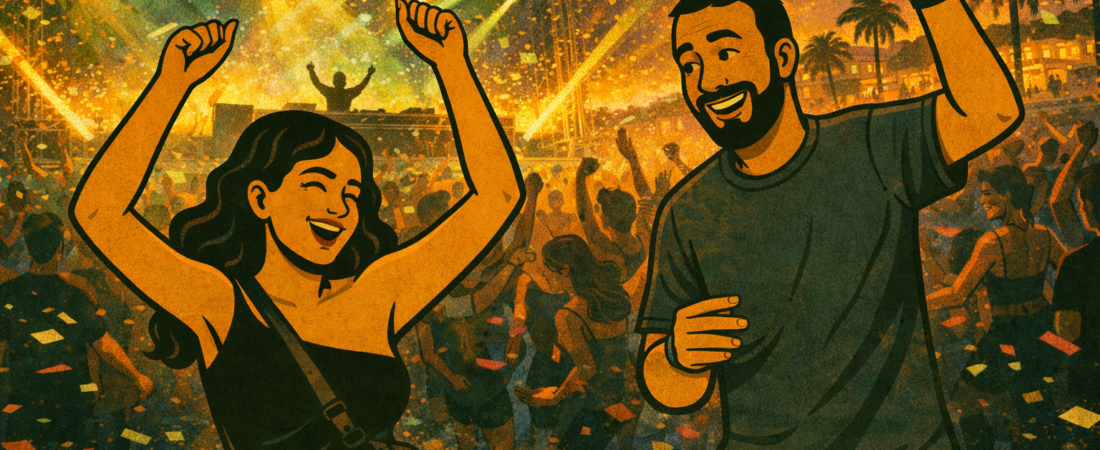
Then Solomun started, and Mo lit up. He genuinely knows and likes his music, and his excitement is contagious in a way that makes me soften even when I’m stubborn. Solomun’s sound held the crowd like a slow spell—deep, pulsing, patient; basslines rolling under everything like a tide, percussion crisp but not frantic, the rhythm steady enough to hypnotise without demanding you perform. The lights behind the stage breathed instead of attacked—dark flashes, pale bursts, silhouettes of arms raised like a forest of moving branches—and I danced through almost all of it, not because I suddenly became an Ultra superfan, but because my body doesn’t like being bored in public; it prefers movement. The only break I took was when we stepped out to change scenery and wandered to the main stage where Vini Vici was playing—definitely not my style, but I still danced and vibed because at festivals the music doesn’t need to be your soulmate to get your hips involved. Their sound was louder, sharper, more aggressive in its brightness—faster builds, more dramatic peaks, melodies that felt like neon zigzags, the crowd responding with that jump-and-shout energy that looks like worship from a distance. In front of us there was a family of three—mother, father, son—wearing matching outfits with rubber duck prints: oversized cabana shirts and shorts for the guys, sports bra and hot pants for the mother. The mother danced like her spine had no limits, the son rocked his body left to right with patient determination, and the father filmed the stage like it was his job. It was oddly sweet, and it also reminded me that whatever I thought about my outfit, it could always be worse.
The fashion situation around us was its own side-show. Lots of girls in cowboy boots with sports bras and jean shorts, which I assume is the current trend, and I couldn’t stop thinking about the commitment required to travel with those boots—either sacrificing suitcase space or paying extra baggage fees for the privilege of discomfort. Stingy me was always in saving mode; even on this trip I’d decided Mo and I didn’t need a check-in bag each and could survive with one. Looking around, it was hard not to conclude that good taste in fashion had died officially, with only a few exceptions—people who had clearly done an artistic job with their makeup, added stickers and glitter, and matched the outfit to it in a way that suited the context and looked genuinely cute. For the rest, it was a festival of trash. And who was I to judge, wearing a summer dress with running shoes like I’d dressed under duress?
We went back to Resistance for the last part of Solomun. I enjoyed it a lot; Mo said it wasn’t one of his best performances. He was also in full protective mode, more focused on shielding me from the constant human compression than on critiquing transitions. We were both sober. I’m the same dancing goofball regardless of state—not a good dancer, but an enthusiastic one. Mo needs a bit of alcohol or Arabic music to really let loose, and since he wasn’t doing either, his energy came out as caretaking. When Solomun wrapped up, Carl Cox stepped in and something inside me sparked. Yes, this contradicts everything I say about not liking these festivals, but I’m not lying: I’ve seen Carl Cox twice before and both times were insane in the best way.
It was 2011. I was seventeen, and that year I somehow got the privilege of two holidays—Riccione in July with my mom and my friend Gio, and Ibiza in September with my older cousin Marko, fresh out of cooking school, alive with that “adult life just opened” energy. I randomly ended up at Carl Cox in Cocoricò and then again at his closing party at Space Ibiza, and I still remember dancing for hours like my body had been built for nothing else. So seeing him on stage again—different country, different version of me—made me genuinely happy. The man is sixty-three and still knows exactly how to command a crowd, and his set had that classic, muscular drive: drums that hit clean and relentless, grooves that don’t ask permission, tension-and-release done with the confidence of someone who’s been reading rooms for decades, and his signature “Oh yes, Oh yes!”. The lights around Resistance sharpened with him—more punch, more strobe, the crowd turning into a single breathing organism, shoulders brushing, sweat and perfume and smoke and heat braided together into one shared atmosphere. I found a better spot in front of the stage and didn’t stop dancing until the end of his set, sweat and bass and joy merging into something simple. Mo was happy to see me enjoying myself, because he knows I won’t disappoint him when it comes to having fun; I’m rarely a party pooper. If anything, I’m often one of the souls of the party—maybe not the main fire-starter, but I do my part.
We walked back home at 5 a.m., tired but satisfied. The campervan was intact, and we were so exhausted we didn’t even have time to worry about anything else. We showered and passed out.
Leave a Reply