
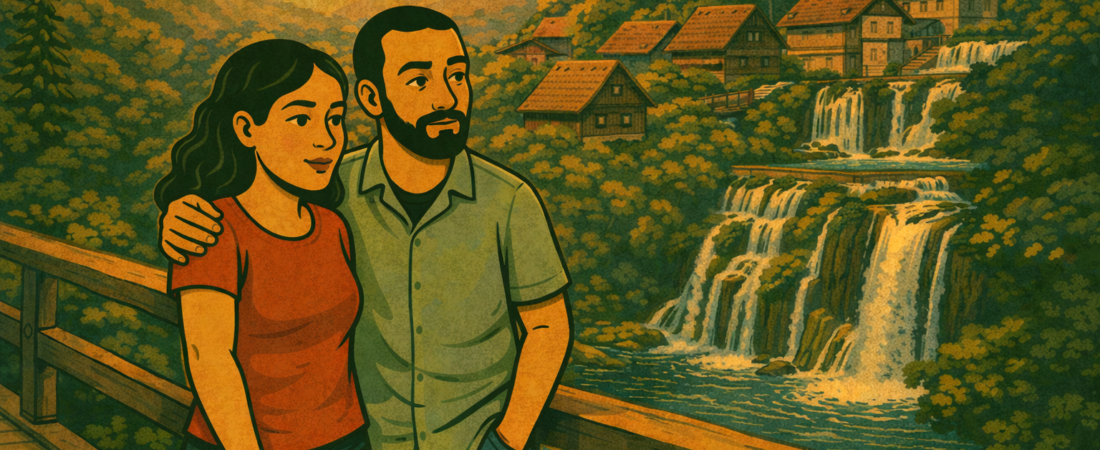
Rastoke, or the Place Where the Questions Caught Up With Us
We found Rastoke through a practical question typed into ChatGPT while trying to optimise a route without exhausting ourselves. A small place on the map between Zagreb and Plitvice Lakes. Close enough to make sense. Far enough to feel intentional. We decided to stop there to spare ourselves forty-five minutes of driving we could easily finish the next morning.
It felt like a sensible choice. Efficient. Tidy.
Emotionally, nothing about that drive was tidy at all.
As the road unfolded, everything I had carefully postponed feeling over the previous days surfaced at once. Not gently. Not progressively. It arrived all together, heavy and unavoidable. I was suddenly terrified we were moving too fast, charging toward something irreversible without having checked whether we truly knew how to stand next to each other once the rush faded.
We had fought badly just before leaving. For the first time since we met, we hadn’t seen each other or spoken for three full days. It might sound insignificant to anyone watching from the outside, but for me it felt seismic. A quiet rupture. A crack that made me question how stable the ground beneath us actually was. We had been arguing about the same things on repeat, never quite resolving them, and I didn’t feel particularly understood by Mo. His instinct is always to downplay, to smooth things over quickly, to seal every wound with a temporary patch and trust time to do the rest. That approach doesn’t reassure me. It postpones pain rather than addressing it.
That postponement always leads to a larger explosion later on. By then, we are both exhausted, but I am usually the one left hollowed out, emotionally drained, slightly more distant than before. Sometimes I’m afraid that once the chemistry that binds us so tightly begins to thin out—as it inevitably will—we’ll be left facing layers of resentment we never learned how to release safely. And once resentment reaches a certain temperature, I don’t know if repair is still possible.
What unsettles me most is how familiar this dynamic feels. I keep recognising fragments of our parents’ relationships replaying themselves quietly in front of us, as if we are reenacting scripts we never consciously chose. I don’t know whether this is a self-fulfilling prophecy or a Karamazov-style inevitability, where family history pulls you toward a predetermined outcome no matter how much awareness you carry. I want to believe we can do better. I genuinely do. But the moment the idea of marriage became real—of tying our lives together and starting a family—I panicked.
The road out of Zagreb pulled us steadily away from the city’s fatigue and back toward something greener, more vertical, more alive. Hills rose again, layered and uneven, folding into one another as we headed toward the national park. Forests thickened on both sides of the road, dense and unapologetic, absorbing sound instead of reflecting it. The light filtered through the trees in fragments, shifting with every bend, cooling the air inside the car.
The road curved gently but insistently, climbing without drama, asking for attention but not tension. It felt directional. Deliberate. As if we were being guided somewhere rather than pushed forward. Evening didn’t arrive suddenly—it settled, deepened. Shadows stretched between trunks. The sky cooled into layered blues and soft golds where it still managed to break through the canopy.
Mo doesn’t like talking while driving. I do. For me, it’s the safest place for difficult conversations. Eyes forward. Hands occupied. No performance. No escape. Words move in the same direction as the road.
Somewhere along that stretch—between trees, curves, and the slow dimming of the day—I said it. That I was scared. Scared because nine months into the relationship we were still floating on the intoxication of new love, without having tested what it means to live together, to build something as heavy and permanent as a family.
He told me he hadn’t expected me to be so non-committal.
I explained that this had nothing to do with commitment. It had everything to do with time. With patterns. With experience. I know from having lived enough that it takes at least a couple of years to see someone clearly—not just when everything is exciting and affectionate, but when life becomes repetitive, disappointing, inconvenient. People evolve, yes, but certain core traits remain stubbornly consistent. Those are the traits that shape a marriage.
I also told him I don’t come from a place where marriage looks safe or simple. Between my mother’s and father’s families, there are eleven couples. I can think of one that has been healthy and stable from the beginning. Two that managed to find equilibrium later in life. The rest are, frankly, disastrous. My parents aren’t even the worst example—thank God I didn’t grow up witnessing alcoholism or physical abuse like some of my cousins did. Some of those cousins repeated their parents’ patterns. Some didn’t. I suppose individual differences determine how trauma is metabolised.
Then there is my own history. The sexual abuse. My father’s emotional distance. I won’t unpack it fully here, but those experiences hardened something inside me. They made me defensive with men. They pulled me into a phase of depression, substance abuse, and sex addiction that I would have gladly erased if that were possible. I’ve done the work since. I’ve healed in many ways. But some scars remain, quiet until marriage enters the picture and wakes them up.
I’m not only afraid of what a dysfunctional marriage could do to me. I’m terrified of what it could turn me into as a mother. Of passing unresolved damage forward. Mo knows most of this. That’s why it hurts when I feel he minimises it. If you know my history, how can you reduce my fear to a lack of commitment?
I explained everything carefully, choosing neutral words, measuring my tone, trying not to let fear sharpen my sentences. I told him my doubts didn’t mean I didn’t want to be his wife. I love him deeply. And if the alternative to not getting married were separation, I wouldn’t even be able to imagine it.
The Quran says: “A believing man should not hate a believing woman; if he dislikes one of her traits, he will be pleased with another.” That wisdom moves in both directions. I see the good in him clearly. I never forget it. I listed it for him.
Mo is genuinely considerate. He is kind to everyone, including strangers. He loves his family deeply and never hesitates to show up for them. He is playful, light-spirited, affectionate. He struggles to watch people he cares about suffer and does whatever he can to lift their mood. He takes his job seriously and shows up even when he is tired or restless. He carries a strong sense of responsibility and can be held accountable. He is loyal to his friends even when that loyalty isn’t returned. He is sensitive without being weak. Firm without being cruel.
Once he felt truly seen, his defensiveness softened. He listened. He understood where my fears were rooted. He invited me to speak openly whenever those fears resurfaced. He reminded me not to confuse myself with other people’s stories, not to let proximity overwrite my own narrative. Influence exists, yes—but identity still belongs to the individual.
Then I raised the questions we had somehow skipped. The practical ones. The uncomfortable ones. Finances. Goals. Timelines for children. Our actual ability to resolve conflict. Housing. We both live in studios. I own more than his apartment can hold. His job doesn’t pay well right now. Is he content with that? Does he want something else? If so, what—and how does he plan to get there? He doesn’t enjoy staying home much. I do. What happens when children enter the picture? Does he understand that I cannot work, raise children, and manage a household alone without his involvement?
He became defensive again. Said he had already made his choice. That he understands what marriage demands. That these matters are implicit. That I shouldn’t question his intentions.
I wanted to shout. Instead, I reminded him that marriage doesn’t function on unspoken assumptions. Some things must be verbalised, even when they create discomfort. He didn’t like that. He said he expected more trust from me.
I reminded him he had invited me to open up whenever fear appeared. Did that invitation only apply when the fear didn’t involve him?
He responded by invoking religion. In Islam, he said, the man carries greater responsibility—financially and morally. He knows he must provide. He knows he must work harder. For him, these obligations don’t require discussion. They are already understood.
I told him all I needed was clarity. Reflection. Evidence that he had thought these things through. A direction, even if imperfect. And a place for me inside that process. I cannot assume he has considered everything without involving me. Especially not when I am expected to build my life around those decisions.
He didn’t concede. He defended his position. That is still one of my greatest struggles with him: he adds fuel instead of water. He only starts extinguishing the fire once significant damage has already been done.
We continued back and forth until Rastoke appeared ahead of us, eventually agreeing that we should have approached things differently. Counseling. Classes at the Islamic center. Time to set intentions consciously. A prenup. A five-year financial plan—though he wasn’t enthusiastic about it.
We reached the school parking lot around 9:30 PM. A group of teenagers lingered nearby, waved at us, approached the campervan in silence, curious, observant, then lost interest and drifted back into their own lives. We cooked steak with mushroom sauce and burrata. Took a shower. Crawled into bed.
We held each other tightly. Even though I knew the conversation had left a bitter aftertaste for Mo. Even though not everything was resolved. We slept like that anyway. As if closeness could keep the cracks from spreading for one more night.
A Morning We Didn’t Schedule
The heat woke us before the alarm did. The conversation from the night before was still suspended somewhere between us, present but no longer sharp. It hadn’t dissolved, but it wasn’t pressing on our chests either. More like a thin layer of humidity in the air: noticeable, manageable, impossible to ignore completely. Despite that, we moved on with our day, determined to make it a good one.
We stepped outside early, while the day was still deciding what it wanted to become. I set up my dumbbells on the gravel beside the campervan. Mo unrolled a mat and moved through his shoulder rehabilitation exercises with careful precision—slow rotations and controlled resistance. Across from us, a group of kids were already playing football on the small pitch, their voices bouncing off the school walls, laughter and shouted instructions cutting cleanly through the morning stillness.
Movement helped. It always does. Muscles waking up. Breath finding rhythm again. The body reminding the mind that it exists in the present, not just in projection.
Afterwards, we made breakfast—the reliable, grounding kind. Eggs. Sourdough. A simple salad. Food that fills you properly and keeps you steady. We ate without rush, then headed downhill toward Rastoke’s heart.
Rastoke revealed itself gradually, not all at once. A descent into sound before sight. Water rushing, overlapping, multiplying. The village sits where the Slunjčica River meets the Korana, and instead of forcing order onto the collision, it lets it happen openly. Dozens of small waterfalls spill over limestone ledges, threading themselves between wooden houses, old mills, stone paths softened by moss. Water doesn’t frame the village here—it inhabits it.
Rastoke has been lived in for centuries, shaped by necessity rather than tourism. The mills once ground grain using the current’s force. Houses were built to coexist with movement, not resist it. Nothing feels imposed. Everything feels adapted. The architecture bends gently around the water, as if acknowledging it will always have the final word.
The air was cooler near the falls, damp and clean. Droplets settled on our skin. The sound was constant but not overwhelming—a layered rush that quiets internal noise instead of amplifying it. I felt myself slow down without effort.
We wandered without direction. Bought lavender oil from an elderly man sitting quietly beside his small setup. He spoke little. His calm felt earned, not performative. We lingered, then video-called our mothers, turning the camera slowly to let them see what we were seeing.
My mother said it reminded her of la Glera, the stream that runs through her hometown. She’s been saying that a lot lately—finding echoes of home everywhere. I disagreed immediately. I paced back and forth, pointing at angles, depth, density, determined to prove Rastoke was something else entirely. Eventually, she laughed and admitted it was prettier.
Mo’s mother said it reminded her of a place in Syria. I’ve forgotten the name. Mo didn’t argue. He never does with her. Instead, he tried to find a photo online to support her memory. As usual, it looked nothing like Rastoke. As usual, I said I could see the resemblance anyway.
We stayed just under two hours. On the way back uphill, away from the roar of the water, Rastoke softened again. Past the footbridges and viewpoints, past the small clusters of visitors lingering near the falls, we slipped into the quieter stretch where people actually live.
Some were unmistakably old—wooden roofs darkened by time, heavy beams exposed, balconies patched together with the kind of practical care that comes from fixing things yourself rather than replacing them. Window shutters framed in wood, some slightly crooked, some freshly repainted, others left to weather on their own terms. They reminded me of the houses scattered along the mountains where I’m from.
One garden stopped me completely.
It wasn’t large. Just generous. Flowers spilling wherever they pleased, not arranged but allowed. Small insects moved freely between stems and petals, entirely unbothered by our presence. Bees. Ladybirds. Things still allowed to exist without being fenced out. On one of the balconies, pots of crane’s-bill overflowed—soft pinks and reds catching the light. The sight of it hit me unexpectedly. My late grandmother’s house. Same flowers. Same quiet pride in tending something alive. Same sense of continuity that doesn’t need explaining.
Those homes felt inhabited in the deepest sense of the word. Walking past them grounded me more than the waterfalls had.
By the time we reached the campervan, the noise of the river had faded behind us, replaced by the ordinary sounds of footsteps on gravel, distant voices, the hum of a place returning to itself once visitors pass through. It felt right to leave then—before the memory could harden into something fixed.
We packed up quietly and drove on.
We did start driving toward Plitvice Lakes, at least in theory. The road led us deeper into protected land, threading through dense greenery that felt carefully preserved. Trees closed in on both sides, tall and layered, their canopies filtering the light into uneven patches that flickered across the windshield. It was greener than the rest of Croatia we had seen so far, though the vegetation felt slightly tougher, more resilient—less lush than Slovenia, more accustomed to heat and endurance. The air smelled of pine and warm earth. The kind of landscape that promises water long before it reveals it.
By the time we reached the access area, the promise dissolved into logistics. No free parking. No discreet corners. Just designated lots, barriers, signs, queues. Campervan parking: fifty euros. To leave the vehicle. To join a line. To follow a prescribed path through the waterfalls. To leave shortly after, funnelled back out with the rest of the day-trippers.
Neither of us felt inclined to do that.
We had already had Rastoke that morning—water moving freely, without gates or time slots. It had satisfied something quieter in us. We told ourselves we would see waterfalls again. Krka National Park was still ahead on our route, and we trusted that it would meet us differently. Plitvice could wait. Or remain unseen. Not everything needs to be collected.
So we headed South toward Zadar.
Leave a Reply