Gardaland, or How Childhood Hijacked the Route
The next day, we woke up at a decent hour and, in what felt like a rare act of mercy, I offered Mo the option to go back into the city centre so he could finally see the Arena properly in daylight. He refused—flat, immediate—and suggested we start our ascent back toward Italy instead. And, honestly, it wasn’t his usual stubbornness; he looked genuinely ready for the road, like his body had already packed before his mouth did. We stuffed ourselves with the last respectable pieces of bread and eggs we had left, changed into “driving clothes” (anything comfortable and decent enough to survive a petrol station stop without looking like a hostage), and started folding our lives back into motion.
At first, we flirted with Venice—romantic, iconic, inevitable—until we remembered that a campervan near Venice is basically a cry for help. Verona followed in the fantasy sequence and got dismissed for the same reason: too much beauty, too many rules, too many ways to lose time and money just to stand somewhere and say we stood there. Lazise sounded softer. Lake Garda sounded doable. And then, as soon as I pictured that lake, something ancient in me woke up with the force of a childhood obsession I didn’t know I’d kept: Gardaland.
An amusement park. One hour from my hometown. The place that used to steal my sleep the night before we’d go with my cousins, because my brain couldn’t handle the idea that a day could contain jungles and pirates and fake waterfalls and rollercoasters all at once and still be considered “normal.” I checked the timing: we could make it through the evening. Mo wasn’t sold—polite, but unconvinced in that quiet male way that screams queues, shrieking teenagers, sticky benches. I didn’t negotiate. I set my mind to it. He reluctantly agreed. And I buckled my seatbelt like we were about to do something important.
It would take five hours if we drove as we meant it, and the first part—Pula up to the Slovenian border—was beautiful enough to make me forget, briefly, that we were racing time. We left Istria behind through that mix of summer dryness and stubborn green: low pines, pale stone, red-brown earth, little villages that look sun-worn rather than neglected, and stretches where the sea reappears between trees like a reminder you’re still on the edge of something. The road kept shifting its mood—open views, then tight curves, then a sudden glimpse of a bay, then the inland pull again—Croatia doing what it does best: making you pay attention without ever formally asking.
Two and a half hours into my “mad drive” (not reckless, but definitely too fast for an old campervan with a personality), I reached the border with Slovenia and discovered our e-vignette had expired. Not the kind of detail you want to meet when you’re already sprinting against time, running on adrenaline, and pretending you’re calm. The Italian border was closed, so I did what I always do when life corners me: I improvised. I found an alternative route off the motorway connection—away from the Slovenian highway network we couldn’t legally use—onto smaller roads that climbed and twisted through hills, the kind of route that makes you grateful for brakes and suspicious of your own optimism. It was steeper, narrower, more “locals know this, tourists don’t,” and it brought us exactly what we needed: forward movement without the vignette. When we reached the frontier, there was an abandoned checkpoint—empty booths, old barriers, the ghost of a time when borders meant stopping—and we crossed it like two people slipping through a forgotten era. Suddenly, we were in Veneto. Two more hours.
While I was driving, I tried my luck and called my mother again, hoping I’d finally catch her alone and we could talk about the proposal properly. I knew I’d see her soon, but I couldn’t wait. The doubts had started to settle, yes—but they were also being fed by her first reaction, that cold, instinctive stiffness when I told her, and by the fact that since then we hadn’t had one real, uninterrupted conversation about it.
She picked up—and for once, she was on her own. I went straight in, almost abruptly, because I was afraid that if we warmed up with small talk, something would interrupt us again and I’d lose my window. I told her not to call Mo by his name, so he would not suspect we were talking about him and begin asking questions.
She still couldn’t be excited. Her own fears and her own history were standing in the way of joy. She told me she was happy for me and that I should enjoy the moment, but her voice kept circling back to warnings: think carefully. Mo is a good man, she said, but what about his temperament—those sudden bursts of anger when something irritates him? Maybe I can handle them now because we’re still in the early, shiny part of love. But what about later—after years, after routine, after children, after exhaustion makes everything sharper? In her mind, those edges don’t soften with time. They harden.
Then she moved to what worries her even more: his relationship with the family home. That pull. That guilt. That devotion that sometimes looks less like love and more like a gravitational force. If we have kids, will he still be present with me—or will I end up raising them alone while he disappears into that house, sitting on the couch, saying little, just “being there” because being there is what he knows? She said she could at least understand it if he talked about it—if he explained where that obsession comes from, what he feels, what he’s afraid of. But instead, he just does what he does, without offering the kind of context that helps a woman breathe.
And what about his constant need to go out, his inability to truly rest? What happens when children enter the picture? Will he still need to escape the house, will he still chase noise, will he leave me behind with the heaviness while he goes out to feel light? “Marriage is more than the wedding day,” she reminded me. “More than the honeymoon. It’s building a life with someone. Sharing the private parts of survival.”
That’s when her voice tightened, because she wasn’t only talking about me anymore—she was talking about herself. She told me that when things weren’t working with my father, nobody stepped in. My father’s silences. His emotional absence. His impracticality with managing a house and a business. My mother carrying everything because he was too busy living inside his own bubble. And then, when she finally chose divorce, she became the villain. The one who “broke the family.” The one everyone points at when they don’t want to look at what actually happened.
“If you don’t say it, Hillary, they’ll always point at you,” she said. “If something isn’t working, don’t accept it. Fight for it. Be vocal. Don’t let it slide.” And then she said the sentence that always hits me like a small slap, because it’s both advice and prophecy: “Don’t become the man of the house.”
She ended where she began: she is happy for me—but she needs me to think. To think very, very carefully.
I listened without interrupting. I understood where she was coming from. I just wished she could have started differently. Celebrate first. Let me breathe in the joy for a second before pouring fear into it. Because the proposal didn’t only trigger her memories—it amplified mine. Still, I couldn’t deny the point underneath her anxiety. If I let things slip now, I will pay for them later. And I already knew the plan: counselling, classes, prenup, all of it. Not because I don’t love him—because I do. Because I want the love to survive real life.
I ended the call not sad, not satisfied either—just… full. I reminded myself I was driving to the place of my childhood dreams, so I should not overthink about that conversation and reignite the fears. I shuold just enjoy the day and what was left of our holiday.
Then the A4 arrived, and there isn’t much to romanticise about it. It’s not a scenic drive; it’s a utilitarian corridor—traffic, trucks, vans, the moving wall of commerce that makes you understand why some roads exist only to get you somewhere else. I drove the way I drive when I refuse to lose: hyperfocused, hands steady, brain running ahead. Mo fought sleep in the passenger seat, forcing himself to stay awake to keep an eye on me. He trusts my driving, but even he looked vaguely concerned by the pace I was pushing that old campervan to, as if it were a sports car rather than a wheeled box with a nervous system.
We stopped at an Autogrill for the classic overpriced coffees and sandwiches—prices that get more criminal every year. How do you charge €30 for two Apollo sandwiches and two cappuccinos and still look like the victim behind the counter? I rushed—drank fast, ate fast, ready to move—while Mo did what he always does: moved through time like it’s optional. I urged him. He got upset. And I felt that familiar irritation rise, the one that shows up when you’re late and you’re watching someone behave like lateness is a personality trait. Even when I have to pick an outfit, do makeup, choose jewellery—things that should take longer—he still manages to finish after me. It’s almost impressive, in the way that makes you want to scream.
Still, we made it. Five hours to reach the free hospital parking. Five. I lied to Mo and told him that if we got inside after 6:30 p.m., we’d lose our tickets—pure manipulation, delivered with love—because it was 6 p.m. sharp and I needed urgency to survive. We changed at light speed, pulled the Vespa out like a pit crew, and rushed toward the park.
Gardaland, or The Part of Me That Never Grew Up
The moment I reached the arch that announces the underpass to the entrance gates, something inside me split open in the best way. Not anxiety. Not nerves. Pure, childish excitement—clean and immediate, like my body remembered Gardaland before my brain did. I sent a voice note to Jules, my childhood best friend, with a shaky little video attached, just to prove it was real: me, there, finally, with Mo beside me. He looked at me the way you look at someone you love when they’re both adorable and slightly unhinged. And I was. Having him in that place felt unreal, because Gardaland never belonged to geography in my head—it belonged to my imaginary world. I know I said it before, but I truly cannot forget the nights before going as a kid: barely sleeping, mind buzzing, heart convinced I was about to step into a portal. Powerful and genuine emotions that I haven’t felt in a very long time. One summer, I went twice in a couple of months, and I honestly thought I’d hacked happiness: rides, sunlight, no consequences, the illusion that joy could last forever if you just stayed inside the gates. Coming back now—older, engaged, with my fiancé—brought the same frequency back into my body. Like my nervous system recognised the location and hit “play.”
I hoped the park wouldn’t be packed. I wanted the fantasy without the punishment of queues. We were lucky. It was busy, but not unbearable—enough people to make it feel alive, not enough to make it feel like a test.
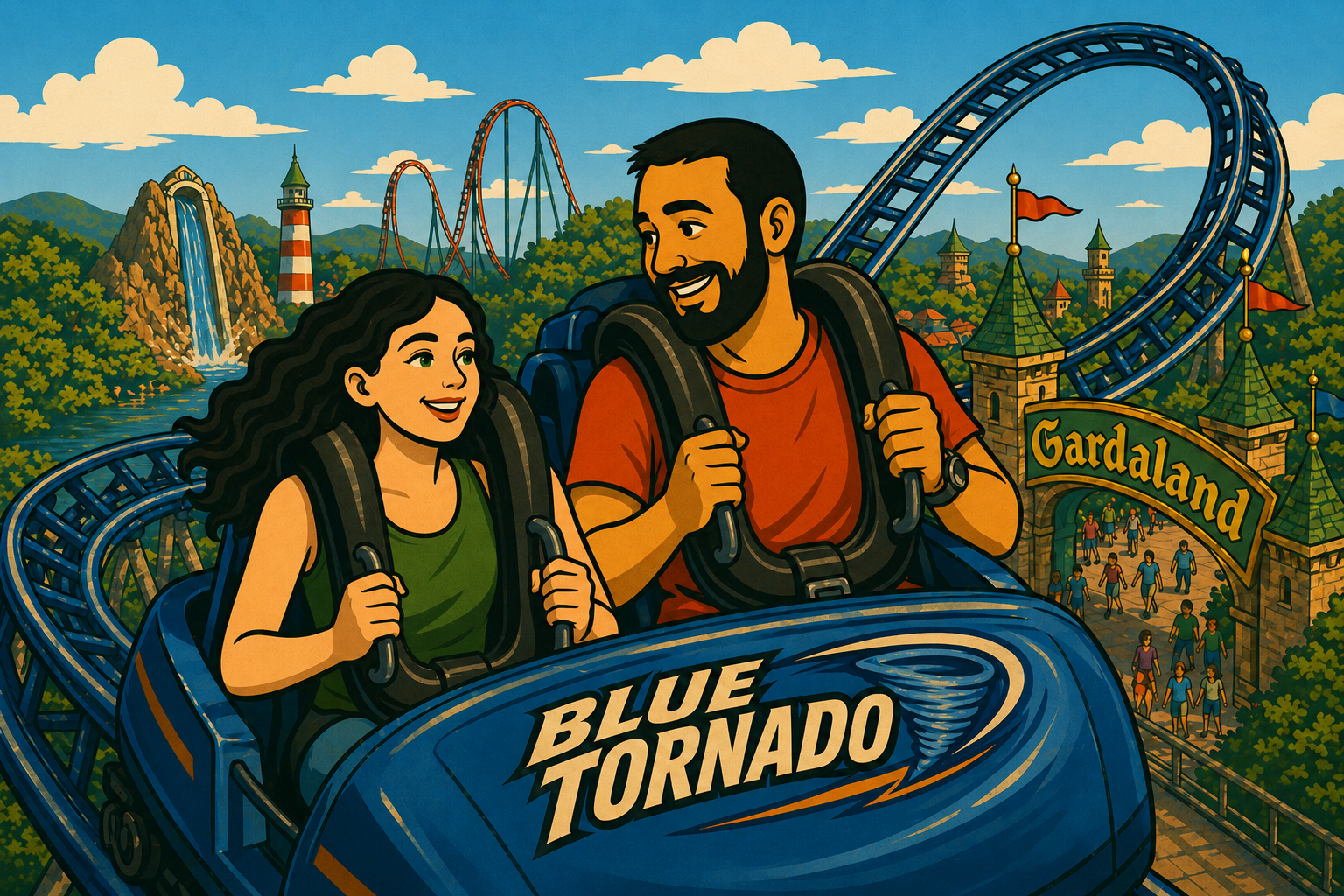
We started with Blue Tornado—that suspended coaster where your legs hang free and the world flips underneath you. It was the perfect first hit: the climb, the quick pause at the top where you have time to regret your confidence, then the drop and the twists arriving all at once, fast and sharp, wind tearing through your face, feet kicking in the air with zero dignity. Mo came out looking genuinely offended by what had just happened to his body, and I laughed harder than I should admit. Not at him exactly—at the contrast. Big man, big confidence, completely humbled by a ride designed for teenagers.
Right next to it was Mammut, so we did the logical thing and queued again. Slightly longer line, still moving. While we waited, we wished our friend John back in Dubai a happy birthday and apologised for missing his party. We also scanned a QR code on a wall and ended up playing an online game linked to the attraction—because theme parks now come with apps, like joy needs a digital extension. I lost. Mo won. He didn’t even try to hide how pleased he was with himself. When it was our turn, we strapped in, and he recorded the whole ride, proud and focused, like he was documenting a historical event. Mammut felt rougher and louder, a wooden coaster with that classic rhythm: climb, rattle, drop, shake, repeat—fast enough to pull screams out of people who weren’t planning to scream. Someone near us was letting out this dramatic, operatic yell, and Mo immediately started mocking it for the video, repeating the same scream on purpose every time we hit a drop. He was laughing mid-scream, which made it even worse. I was crying from laughter and holding on like my arms had signed a contract.
Then came Oblivion—the tall drop, the one you see from far away and instantly understand it’s there to humble you. Mo doesn’t enjoy those. He was about to back out. I begged. I negotiated gently, then not so gently, because sometimes I need my partner to suffer with me for the sake of romance. We did it. The pause at the edge felt illegal. The drop was pure violence and pure pleasure at the same time—your stomach left behind, your brain going blank, your body just surrendering to speed. I was thrilled. Mo came down with a headache and looked at me like I owed him compensation. We looked at the photos at the end of the ride and found ourselves with ridiculously frightened faces as we went down the drop at full speed. But we were not half as funny as the guy whose photo was displayed next to us. His face was completely distorted by fear, making him look as if it had been painted by Salvador Dali. We pointed at it and laughed, just to find out he was standing next to us. He laughed, too.
Mo asked for food. Fair.
We settled for fries, because fries are the simplest form of comfort when your organs have been rearranged. I accidentally ordered two maxi portions because I thought “maxi” meant bigger fries, not a bigger container. What arrived looked like a dare: an obscene quantity of fries, more than any two people should ever face. I tried to fix it by asking the cook to swap one portion for a kebab. He hesitated, told me to wait, finished a few orders first, then came back with two portions of fries and an extra kebab for free. No speech. No drama. Just generosity. A legend. A man of the people. Whoever you are, you’re appreciated.
We ate fast and kept moving. We wanted to try Shaman, but we decided to postpone it until the fries had stopped actively existing inside our bodies. We walked past it and drifted into the newer area inspired by China and Kung Fu Panda, and that’s where we made what we thought would be a gentle choice: Peter Pan boats in the kids’ section. In my mind, it was supposed to be slow, cute, a little break. Mo even started recording, joking around, relaxed for once—until the ride betrayed us. The pace picked up so suddenly it felt personal. Within seconds, we were spinning too fast, and the boat kept slamming me into the side like it had decided I was the problem. We were laughing and half-panicking, the kind of laughter you do when you’re not sure if you’re having fun or surviving. When it finally stopped, we sat down and took a moment to gather ourselves. We are not kids anymore, even if we often like to act like such.
Fifteen minutes later, we went back for Shaman—that old-school coaster with the dark sections and the feeling of being thrown around more than guided. Mo expected it to be easier. It wasn’t. Three spins in a row, and he was dizzy. I was drunk on laughter, fully alive again, fully twelve again.
By then, the sun was starting to set, and the park’s mood changed. Softer light. Longer shadows. Everything looks more cinematic without trying. We passed the carousel we’d seen earlier, and Mo asked if we could do it before the next ride. He’d tried one once in Florence, and apparently it left a mark on his soul. The carousel was almost empty, so we ran from horse to horse while it started moving, switching like kids trying to break a small rule. A lady in the control booth told us to sit down and stop acting like children. We did not stop. We laughed even harder.
It was getting dark and late, and I insisted we go to Escape from Atlantis before we missed it—the water ride with the big splash that looks harmless until you’re sitting inside it. Mo worried about getting wet. I promised him it would be light. A little spray. Romantic moisture.
I lied.
We ended up in the front row. Fully soaked. But the weather was warm, and once you’re already drenched, resistance becomes pointless. So, I proposed Jungle Rapids next—those round boats that spin and bump and pretend they’re gentle. There were so few people that we ended up alone in the boat, sitting close, hugging, spraying each other on purpose when we got near the waterfalls, acting like idiots in love. At the end, all the boats got stuck, and two security guys had to come help us out, pulling and pushing. We climbed off dripping, laughing, ridiculous.
We had time for one last attraction, and I chose Prezzemolo’s House because it was near the exit—one of those walk-throughs with optical effects that mess with your balance and your pride. Mo was genuinely surprised by the illusions. I was satisfied in that specific way you get when you’ve squeezed every possible drop out of limited time. We left the park exhausted and bright-eyed.
Back at the parking, the Vespa refused to start.
A guy in a wheelchair nearby joked in English that we wouldn’t get home that night and asked if we needed a ride. I told him—proudly—that I’d had that Vespa since I was fifteen and she wouldn’t abandon me now, sixteen years later. He looked impressed. Then, with zero warning, he offered to “entertain us” while we tried again. He told us to watch closely for a magic trick, pulled up his trousers, and casually started peeing through a small tube coming down from his leg. Mo and I laughed.
We chatted while the Vespa kept testing my patience. He said he’s Iraqi but grew up in Germany. Mo lit up instantly, happy to meet a fellow Arab. When Mo mentioned he’s Syrian and I’m Italian, the guy looked at me and asked if I was sure about what I was doing. I told him I was reckless enough to take the risk. People always carry opinions about Arab men marrying non-Arab women. I’ve heard them. I’ve learned to let them pass. Maybe one day I’ll regret ignoring the warnings. Or maybe the only voice that matters is the one inside me saying he has a good heart, and I’m lucky.
Who knows how it will unfold?
For once, I wanted to stay inside the present and enjoy it.
Eventually, the Vespa started. The Iraqi guy cheered with us. We waved goodbye, rode back to the campervan, loaded the scooter in the storage, and I drove in the darkness for another hour toward my hometown—clothes still damp in places, bodies tired in the sweetest way.
We arrived just before 2 a.m. We showered like it was a religious act and fell asleep in each other’s arms once again with a smile on our faces—like kids who broke the rules and somehow didn’t get caught.

Leave a Reply