Krka on a Deadline, Love on the Dashboard
We were supposed to drive to Dubrovnik. It had been sitting in our plan like a jewel we kept looking forward to touching. But we did the math—time, distance, and that European law of physics where one “quick stop” expands into a full day the second you park—and we realised Dubrovnik would steal too much of what we had left. And since we got engaged, all we wanted, suddenly, was to get back to my hometown a day earlier than planned and celebrate with my family, in person, properly, the way news should be delivered when it matters. It hurt to cross it off, because we wanted it. Still, the desire to celebrate was louder than the desire to collect another beautiful place. And I was quietly relieved to see that Mo didn’t protest, didn’t try to bargain with reality, didn’t suggest the classic “we can go for a few hours and drive back right after.” He seemed completely fine with skipping that longed destination. I didn’t even point it out. I just enjoyed it—silently—and started the engine.
We left Split and headed back north, sacrificing the coastal road for the A1 motorway because we were chasing time now, not seduction. The A1 pulled us away from postcard Dalmatia and into the inland spine of it: wide lanes, clean cuts through limestone, long stretches where the horizon was made of pale rock and stubborn green, a landscape rougher and more honest than anything the beach sells. It still wasn’t disappointing—not with Krka waiting for us—because even on the motorway, nature kept insisting on being part of the ride: rocky slopes, scrubby fields, pockets of pine and low brush, occasional clusters of houses set back from the road like they’d learned not to expect visitors, the light strong, the sky open, and every so often a widening view that reminded you Croatia is built on contrasts—stone and green, harsh and soft, endurance and beauty sharing the same frame. The campervan carried our wet clothes, our laundry victory, and that new impatience that shows up after a sharp turn in your life: suddenly you don’t want to arrive somewhere on a map, you want to arrive somewhere that feels like belonging.
The drive took about two hours, filled with video recordings of whatever looked like it might disappear, casual chats, one earnest attempt at a finance-and-investments podcast, and the usual fight against sleep that creeps in when the road is straight and the speed stays constant. When we reached the first Park4Night suggestion—an empty space slightly bending to the right, surrounded by kilometres of grass fields like a forgotten stop in the middle of nowhere—we were immediately met by a security guard who discouraged us from staying. “Maybe you will be lucky,” he said, “but if the night shift ranger sees you, he will send you away.” And since we already knew what it felt like to be woken up in the middle of the night by someone else’s authority, we didn’t feel like gambling. We thanked him politely and kept driving.
I found another suggested spot that looked closer to the swimmable side, got excited, backtracked to the main road, drove a few kilometres more, then turned off onto a narrower lane where the park started to pull us in properly. The landscape shifted the second we left the main road—shade first, tall trees gathering overhead, then a drop in terrain and the beginning of a serpentine that forced you to slow down and look whether you wanted to or not. Below, the Krka canyon opened in layers: dense green pressed into steep walls, the river sitting deep and calm in places, then breaking into movement where it met stone, the vegetation thickening closer to the water as if the river fed everything around it with a private generosity, the air cooler even from the road, scented with resin and earth in a way that made your shoulders loosen before your brain could explain why.
When we finally reached the suggested spot, we saw too much movement to feel safe about it—then a ranger signaled us to stop and asked where we were headed because the park was about to close; it was around six. We asked if we could park where the map suggested. No. We asked where else we could park. He offered a campsite down the road. No chance—we weren’t there to pay just to exist. We thanked him and kept driving, hoping the road would offer something else. It stayed narrow, shaded, then began climbing again, and I started worrying we were moving too far away from what we came for—until a slope opened up in front of us, inclined but spacious, empty, possible, the sort of accidental mercy you recognise instantly. That’s it.
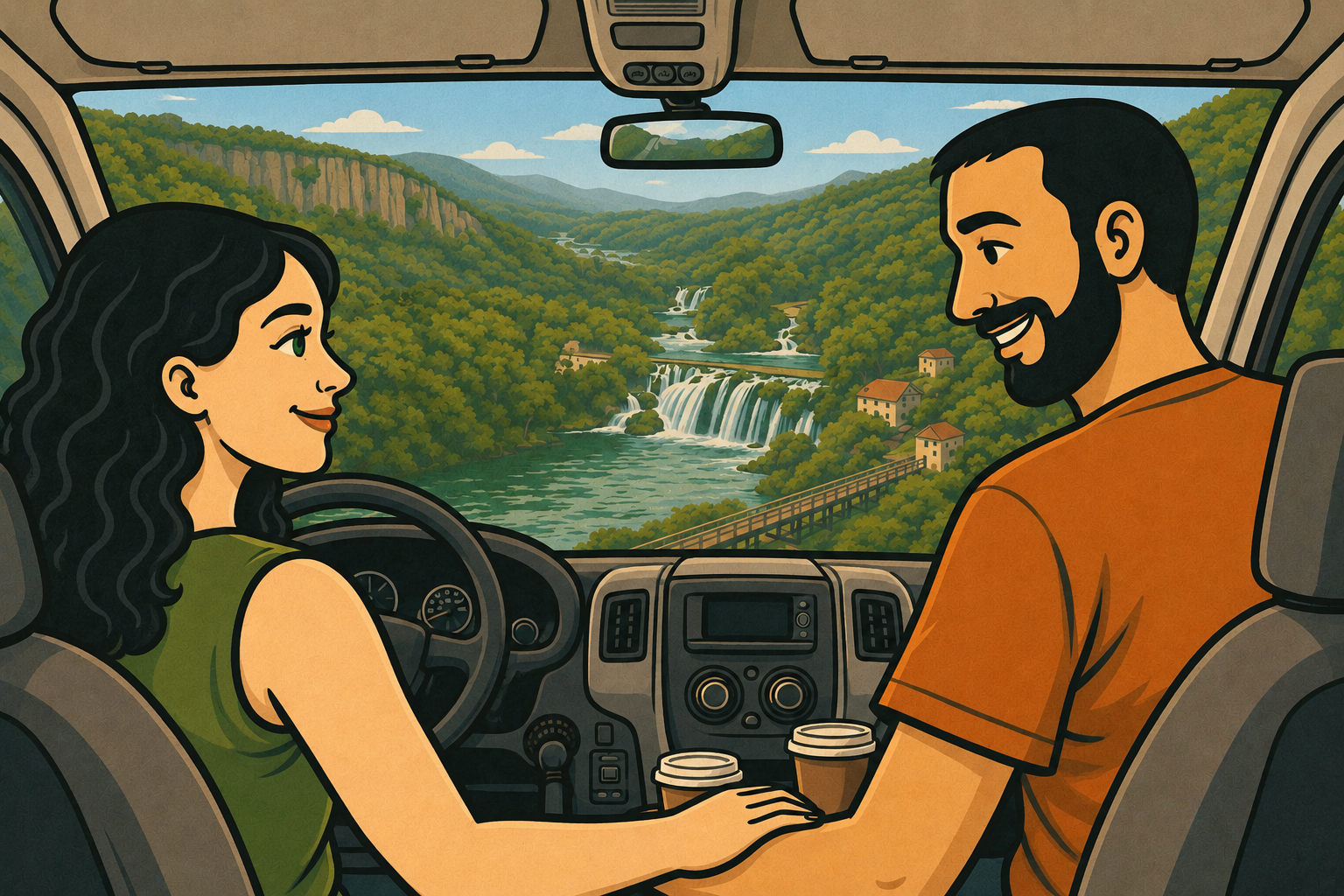
And then the view hit. The Belvedere of Roški Slap was little more than a pull-off along the road, just big enough for a single vehicle, but it felt like a secret balcony over the Krka River, slightly sloped yet steady enough for a campervan, opening wide in a way that made my lungs expand before my mind could catch up. Below, the “Necklaces” cascades shimmered as water spilled over travertine steps, threading silver through deep green trees clinging to canyon walls; in the distance a wooden footbridge crossed the river toward old stone watermills, tiny reminders of a quieter past still leaving fingerprints here. The air carried the soft rush of water and the scent of pine and earth, and by evening—when most visitors had gone—it felt like the canyon belonged to us: the campervan perched on the edge of something breathtaking, falls murmuring below, cliffs catching the last touch of sunlight. It was the most beautiful parking spot we’d found so far—better even than the harbour view in Zadar before we got kicked away, which says a lot because I was still emotionally attached to that water.
Of course, my brain couldn’t let beauty exist without turning it into a schedule, so I rushed a sunset workout outside before the sun disappeared, while Mo was grumpy because he was hungry and because he was still traumatised by the fox in Lake Bohinj, as if every forest in Europe had been personally assigned to haunt us. I followed a YouTube workout for forty minutes—enough to pump my muscles and silence the guilt for the next day—rushed so hard it turned into cardio and strength at once, and got so sweaty I had to shower before touching food like I was trying not to contaminate dinner with my own existence.
Then I made pasta with ragù—an express version, but still ragù, because I refuse to call it Bolognese sauce—and we ate while watching the Sinner vs Alcaraz Wimbledon final, finishing dinner at the exact moment Sinner hit the last ball and got declared the new King of Wimbledon. I was genuinely happy for him after the losses against Alcaraz, even if I like the latter too and I’m sure he’ll soon surpass Sinner again as world number one. We were commenting the match via WhatsApp with our friend Marwan—the reason Mo and I got together in the first place—and he was shocked by the victory, but happy for my fellow Italian.
After two days of festival chaos, nothing sounded better than a quiet night inside. Staying in is my natural habitat—cooking, reading, writing, watching something dumb, watching something brilliant—so we continued season three of Squid Games, since we’d only watched one episode together before the holidays. We lay down with that small TV by the bed, hugging, watched an episode and a half before I fell asleep, and Mo stayed up a little longer scrolling TikTok like the last person alive who still had energy, until even he surrendered and the canyon kept whispering below us while the day finally ended.
Cardio, Caves, and a Softer Brain
The next morning we woke up around 8:30, rested and fresh in a way that felt almost suspicious—like we hadn’t been dragged through festivals, heat, and campervan admin for days. Maybe it really was the Krka air. We opened the curtains that shade the windscreen and just stood there for a second, staring at the view like idiots, instantly excited for the day ahead.
Breakfast was a reduced version of our signature ritual because bread was becoming scarce and bresaola had become a mythical creature at this point in the trip. We put on our swimsuits, chose comfortable clothes for walking, and I took my position in the driver seat—my natural habitat—while waiting for Mo to complete his morning routine, which always looks short on paper and somehow takes a lifetime in real life. Turkish coffee sipped slowly, clothes for the day chosen with calm conviction, a generous cloud of Axe Temptation Dark Chocolate deodorant sprayed like a signature move, teeth brushed with the seriousness of a man who believes mint can fix anything. When he finally finished those few but long steps, we drove a couple of kilometres down and started our visit inside the park.
The same ranger from the day before directed us to park the campervan in a small lot a couple of kilometres before the entrance. From there we had to walk along the side of the road—narrow, fortunately not too trafficked, and shaded by trees like the park was already trying to take care of us. It was the same road we’d taken with the campervan the day before on our way to the Belvedere. Only now, on foot, you notice everything: little water streams running beside the asphalt, swampy pockets where the light looks different, and dragonflies floating lazily above the surface like they’re not working, they’re simply existing.
As we got closer to the entrance, the water widened into a larger pond, and we could already spot hints of the falls beyond it. In that pond a school of brown trout formed a dense, dark moving shape, swimming undisturbed with the quiet arrogance of animals that know no fisherman is allowed to bother them. Mo looked at them with full, childlike excitement—nostalgia hitting him hard. His father taught him how to fish. He used to go with him and his siblings to Al Mamzar Beach Park, on the Sharjah side, when he was a kid, and the passion stuck past childhood into his teenage years, when he started going with friends to a nearby spot, trying to recreate those early mornings. But Dubai changed. The city grew into what it is now. Shores got overcrowded, water got polluted, and space for fish shrank the way space for everything shrinks when a place decides it only exists for building. Now, if you want to catch fish or even find decent seashells, you go deep sea, or closer to the Oman side. Today wasn’t the day to reignite that part of him. Today he could only admire the trout from afar and let the memory of the “good fishing days” sink in without trying to lure anything into a hook.
We passed an abandoned hotel, took a few more curves, and reached the ticket kiosk. It was around 11:00, and the line wasn’t what you’d expect for summer high season. Apparently, the Croatian islands take the main hit during this time; inland still has tourists, but it’s not as loud about it. Good for us. The crowd was light, but the prices weren’t. We chose the pass for Roški Slap plus the swimming area instead of full access because we only had a few hours, and we ended up paying €20 each—double what the full access costs in other seasons, which is criminal on principle. Still, with hindsight, it was worth every euro.
We went to Roški Slap first—opposite the swimming area—because neither of us wanted to hike, even briefly, while soaked. Tickets checked, we followed the entrance path and started walking alongside the Krka River. Up close it begins almost modestly, a stream behaving politely, and then it pours into those travertine cascades they call the “Necklaces,” water weaving silver ribbons through reeds and dense green. I spotted fig trees and felt something in my chest soften immediately, because figs are pure childhood for me. We had a huge fig tree outside my childhood house, the one that gave the sweetest fruits in summer, and my mother was an unapologetic glutton for them. Here, the trees had already been stripped—only a few ripe ones and the rotten ones on the ground remained, leftovers of someone else’s timing.
We wanted to test the water temperature. Wearing our loyal water shoes—surprisingly comfortable even on mixed surfaces—we found a shallow, accessible spot and dipped our feet in. Cold, but not punishing. Refreshingly cold. The warm breeze around us turned it into something medicinal: cold water, warm air, lungs finally remembering they’re allowed to expand. I could breathe. That heavy pressure I carry from Dubai—work, future worries, the constant feeling of being behind—quieted down so fast it felt like it had been waiting for permission. For a moment I genuinely thought: maybe we can build a small space of heaven somewhere. Maybe we can be happy like this for a long time. I stayed in the water longer than Mo, then jumped out, went straight into his arms, and kissed him vigorously on the cheek like I needed to physically express the relief. He smiled and held me tight.
We continued walking, our hands constantly searching for each other again whenever we split to stare at a dragonfly or point out an unusual flower. Then we reached a wooden staircase climbing steeply up the hillside toward Oziđana Pećina cave. I won’t lie: the cave was not the main reason I wanted those steps. The steps were. The cardio. The chance to earn “points” in my head. Mo wasn’t thrilled about the stairs, but he never denies physical activity or an adventure, so up we went. The steps creaked underfoot but stayed solid and dry, and the trees kept us shaded, making the climb easier than it would have been under full sun, which was shining undisturbed in a blue sky.
After about fifteen minutes we reached the cave entrance, and two women from the staff handed us yellow safety helmets. We laughed at how ridiculous we looked and took a selfie, of course. Inside, the cave felt like a quick mouth of the mountain rather than a whole underworld: cool air breathing out, damp limestone close to your shoulders, a low, contained space that made the helmet suddenly feel less stupid and more like common sense. It was darker than outside but not dramatic—more “brief pause from heat” than “journey to the centre of the earth.” We expected more, and I was secretly glad my goal was cardio and not cave worship, because otherwise I would’ve been disappointed properly.
When we came back out, we climbed a bit more just because there were more stairs and we weren’t tired. Then the steps ended, and the land turned dry and open. We could’ve wandered into a spontaneous hike to nowhere, but time wasn’t on our side. So we took in the view of the Necklaces from above—river shining through green, the cascades threading the canyon—and I called my mother to show her the landscape, needing to share it the way you share something that feels too good to keep private. Again, not a good time to have a chat about the proposal. Then we headed back down. We raced a little until Mo asked me to stop near a bending tree because he wanted silly pictures pretending he was hanging from it. Things you do for love. Things you do because the day is light enough to allow stupidity.
Back near the river, we followed the wooden bridge that crosses the cascades, the water rushing beneath our feet as we made our way to the opposite side. That’s when my phone vibrated with a message from a former colleague: the guy they hired to replace me had been fired in less than three months because he turned out to be a parasite—there for the decent salary and nothing else. “I thought you’d be happy to know,” she wrote. I wasn’t. I don’t need other people to fail for me to feel fine. I would’ve been happy if they’d treated me with more respect while I was there, considering I was always professional. But it wasn’t my problem anymore. I sent her a photo of the view and basically said: With scenery like this, I’m immune to drama. Mo called me to keep moving, and I let the message dissolve back into the river noise.
We kept following the path after the bridge, the boards guiding us through vegetation that feels overfed by water—reeds, thick grasses, pockets of shade, occasional openings where the river shows itself like a polished strip of glass before breaking into movement again. We stopped for photos. We found another shallow spot and dipped our feet in again. Mo went first. I followed quickly—then jumped out even faster when I spotted small water snakes sliding right beside my feet, thin and effortless like they belonged there more than I ever will. Mo laughed at my phobia, of course. When I calmed down, we realised the path had looped us back toward the same side where we’d seen the brown trout earlier, which meant we were reconnecting with the swimming area.
Cold Water and Warm Hearts
We passed the ticket kiosk and followed the road downhill, the one that immediately changes your posture—less “stroll,” more “attention.” It curved through shade, dipped again, and delivered us to a short wooden staircase that felt like the park’s way of saying: now you’re entering the water’s jurisdiction. After a couple more turns, we reached the Alte Mühle Kristija restaurant—old-wood, waterwheel energy, the kind of place that looks like it was built to surrender to the river rather than fight it. We were about to pass it and continue our descent, focused on the river as if it were an appointment, when we noticed a thin waterfall spilling from the side of the building, running down stone steps as if it had always been part of the architecture.
A toddler was there with her father, dipping her feet shyly into the stream, testing the cold like a small scientist. Mo and I slowed down instinctively, carefully slipped around them, then followed the stairs upward because the waterfall had turned into a breadcrumb trail. It led us to the backside of the restaurant—and that’s where the scene became almost absurd: tables set inside the water, people sitting with their plates inches above the current, as if wet ankles were a normal dining requirement. Right beside them, a small waterfall dropped into a mildly deep hole—deep enough to feel like an invitation, shallow enough to feel safe.
Mo didn’t negotiate with it. He decided immediately that he had to jump in. His sleeveless shirt came off at light speed, the speed men reserve for moments when they want to impress God, he took one deep breath, and then he dropped into the cold like he was baptising himself into a better mood. The waterfall landed on his head and shoulders, and he smiled that wide, shocked smile you only get when cold water slaps your nervous system awake. I stood there filming, taking pictures, laughing, half proud, half convinced he’s insane.
“Come,” he urged, obviously.
After five years of swimming in the Atlantic in Cape Town, cold water doesn’t scare me. It just reminds me I’m alive. I found a dry spot for our bags, stripped down fast, and jumped in as soon as Mo left me space. The hole looked deeper than it was—cinematic illusion—because I could stand on tiptoes and still keep my nose and mouth above water. We stayed there a few minutes, letting the waterfall hammer our shoulders, while people sat at their tables eating what looked like family-sized plates of pork cold cuts and cheese, casually observing two adults turning their lunch area into a swim zone. Then we grabbed our things, dripping and bright-eyed, and continued down toward the river like nothing had happened.
A little further down we passed another restaurant with a similar rustic-watermill vibe—wood, stone, the river woven into the setting—and nearby a small museum section about the windmill and old farm life, the sort of place that hints at how Dalmatia used to be explained through work, seasons, and stories… including those tales about fairies that people once used to make sense of forests and rivers and bad luck. We clocked it mentally for later and kept moving, because the water was calling louder than the exhibits.
The swimmable area opened up into a patch of grass mostly shaded by tall trees, the kind that make you feel protected from the sun without stealing the light. We spread our towels close to the water so they’d be waiting for us like loyal friends when we got out, and then we ran in—both of us—like we always regress into children the second water becomes accessible. The Krka here was clear and cold, moving with that steady confidence rivers have when they know they’ve been doing this longer than humans have been naming things.
Mo pulled out his phone, now sealed inside a newly bought waterproof cover, and asked me to take videos of him swimming underwater. This is where my personality gets exposed: my old soul is suspicious of technology even when it’s trying to help, and I disappointed him almost immediately. I tried. I really did. But the angles were wrong, the framing was chaotic, and my instinct while holding expensive electronics over water is basically to panic politely. Mo took some videos of me to demonstrate what he wanted—smooth, steady, cinematic—and then handed the phone back like a coach who still believes in you despite your limitations. I tried again. Better. Not great. We settled for what we had.
We swam and splashed for about an hour, drifting in and out of the shade, floating on our backs, looking up at leaves and sky, then turning our heads to take in the scenery—riverbanks thick with green, the sound of water always present, dragonflies flashing like tiny blue sparks, the whole area feeling quietly alive without being loud about it. When our arms and legs started asking for a break, we climbed out and lay down for a few minutes under a sunny patch—until I realised my body was starting to ask for something small, a light snack, a reward. Mo agreed, so we left our towels like placeholders and walked back to the restaurant to check the menu.
Disappointment. Surprise. Mild outrage.
They were serving only one thing: that plate of pork cold cuts and cheese. Hell on a plate for me. Half-hell for Mo, because he loves cheese but doesn’t eat pork. The only alternative was ice cream. We accepted it, even though I wanted something savoury, something that felt like it could anchor me. Chocolate cone for me. Berry for Mo. Back to the grass bank we went, and we sat on a cut tree trunk like two campers who had temporarily joined civilisation.
We ate our ice cream and talked—properly talked—about friends and drama, that inevitable mess that appears when a friend group grows too large to stay simple. There’s always the one who enjoys gossip too much. The two who flirt when they shouldn’t and then fracture the group into invisible alliances. The one who disappears and reappears in cycles, returning only when the last date ends badly or the new hobby stops being exciting. The one brought in by someone else who seems full of potential, then vanishes like they were never there. And then the rare ones who arrive and stay—who marry into the group, who change your life quietly—as it happened with me when Marwan introduced me to Mo. And of course, the original ones, the ones who were there since the beginning and therefore feel permanent, whether you like it or not.
When the cones were finished, Mo decided he needed one more dip. I was almost dry and didn’t want to get wet again. It was already three. The road was calling, and I could feel that internal countdown starting—the one that measures daylight, distance, and how long it’ll take Mo to do anything once we’re back at the van. He went anyway, swam a few more minutes, then came back to the grass bank to dry.
On our way out, we stopped at that small windmill museum section—briefly—just enough to see the old mechanisms and the story they were preserving: how the river’s force used to translate into bread, into routine, into survival, how water once powered daily life instead of being something you posed next to. Then we headed back up toward the campervan.
Mo changed into something dry, brewed his Turkish coffee like it was a necessary ritual before motion, and I grabbed popcorn and peaches for the road. And just like that—sun still high, skin still smelling faintly of river—we were ready to leave Krka behind and let the next stretch of asphalt decide what mood we’d be in next.
When the Map Stopped Being Romantic
Pula was meant to be our last Croatian chapter before Italy. A final dot on the route, the neat conclusion. But driving straight from Krka would have meant almost four hours on the road, arriving in the middle of the night with that specific kind of fatigue that makes you hate every decision you made earlier in the day. So I did what I’ve started doing more and more on this trip: I zoomed out, stared at Google Maps like it was a tarot deck, and looked for something that could hold us gently on the way. My eyes landed on Senj. I asked ChatGPT for an opinion—because at this point it was part navigator, part therapist—and it suggested exactly what I wanted to hear: a quiet, suggestive small town by the sea, no major detour, no wasted day.
We started the engine and said goodbye to Krka National Park with that bittersweet feeling you only get when a place treated you well. I was sad to leave it behind, but we were also getting closer to what mattered most now: going back to my hometown earlier than planned and telling my family in person.
We took the A1 again and let Croatia change costumes around us. First, it was limestone hills and scattered pine forests, inland villages tucked between fields, tunnels carved through rock, long viaducts opening into valleys that made you forget you were in a hurry. Then, somewhere along the way, the scenery flipped like a mood: the Adriatic opened on our left in shades of blue that look edited even when they’re not, and the Velebit Mountains rose sharply on our right, grey-green cliffs pressing close as the road started winding with more intention, as if it didn’t trust you to stay awake on beauty alone. The closer we got to Senj, the rawer everything felt—sea endless, cliffs more rugged, wind stronger—especially where the bura sweeps down from the mountains with that sudden violence that makes you grip the wheel tighter.
Since we stored the ring, I started missing it. My ring finger felt naked in a way that surprised me. A few days earlier, the same stone had felt heavy with responsibility. Now the absence felt heavier. Of course, it wasn’t about the ring itself. It was about what it represented—how badly I did want to be Mo’s wife, even while I was still dragging my list of doubts and conditions behind me like a suitcase I refuse to check in.
We found a mini market in a tiny village along the way that was still open—one of the few places willing to tolerate outsiders on a late Saturday afternoon—and we pulled in to restock the essentials: bread, eggs, whatever could keep us functioning without another overpriced stop.
Inside, the air had that small-shop smell of mixed eras: detergent, ripe fruit, cardboard, and the faint cold of a fridge that’s been humming for years. A couple of people glanced up and then glanced again, the way people do when they’re trying to file you into a category fast enough to feel safe. And I knew exactly which drawer they were reaching for.
With Mo’s Syrian features, my face that gets misread as “Eastern European” when I’m literally Italian, our outfits chosen for comfort and survival rather than aesthetics, and that 2007 Fiat Moncayo Mediterráneo campervan parked outside like a tired animal… we had the perfect look for the role Europe loves to cast without auditions: the suspicious ones. The “gypsies.” The thieves. The trouble.
It wasn’t the first time we’d collected those looks, and honestly, I found it funny. There’s something almost playful about it—knowing who you are while strangers invent the worst version of you in their heads. Mo felt it too. We exchanged that quick, silent amusement that says: let them. Let them misread. Let them keep their distance. Sometimes looking like someone people should stay away from is an unexpected form of protection—fewer questions, fewer vultures, fewer opportunists circling with friendly smiles and inflated prices.
So we kept it simple. We grabbed the groceries, paid, nodded politely, and left—back into the campervan, back into our own reality, carrying bread and eggs like contraband from a world that had decided we didn’t quite belong.
By the time evening began to fade properly, the road had turned steep, dark, and forested. There was still movement—cars in both directions, headlights cutting through trees—but I wanted to reach wherever we were sleeping before darkness fully took over or the wind decided to get ambitious. The parking spot our loyal app suggested sounded perfect on paper: a bay view, romantic, scenic, worth the detour. In reality, it came with a detail it forgot to mention: a brutal gravel slope. Mo walked up to check it. Yes, the spot existed. Yes, the view was “insane,” he said. And then I tried the slope and gave up at the first slip. Even if I somehow made it up, I’d have to drive down the next morning with the same gravel waiting to betray me. No chance. I wasn’t going to trade a view for a panic attack, or worse.
So we kept driving, giving up the postcard version of Senj for the version that simply lets you sleep. The road through the woods began dropping downhill again. Signs for tiny hamlets appeared. A few sporadic houses popped up along the side like shy witnesses. Night set in fully, and suddenly every truck on that road seemed to know exactly what it was doing while I was concentrating as my life depended on it, because on unfamiliar streets, it does. A couple of brave cars overtook me. I wasn’t crawling, but clearly I wasn’t matching the local definition of “normal.”
At that point, we accepted we needed basic things more than romance: fuel and water. We descended into Senj and reached a service station about twenty minutes later. Mo handled the fuel. I went inside, hoping to find bread for breakfast, because at this stage, bread had become a daily anxiety. No luck. I paid, then moved the campervan to the side with a modest water pump so we could refill the tank.
I stayed inside while Mo took care of the hose, and he decided—because sometimes he does this—that it would be funny to spray the windscreen. I asked him if he was crazy and handed him a cloth to wipe it down. A practical gesture. A harmless one. He didn’t take it that way. And because I was still unaware I’d stepped on something sensitive, I made it worse by filming him. The second I saw his face—grumpy, closed—I stopped and asked what was wrong. He didn’t answer. I asked again. He told me to stop.
Outside, a few men were sitting at the station bar with beers, the casual kind of scene that makes you feel like you’re passing through someone else’s normal life. One of them stood up, walked behind a nearby car, and started peeing like it was nothing. No shame. No effort to hide. Just confidence and urine. I looked away, disgusted, and tried to focus on finding an alternative parking spot because I could feel the night becoming heavier and Mo’s mood becoming sharper.
When he came back into the campervan, I asked him again why he was suddenly mad. He said he genuinely thought the windscreen needed cleaning and that I was rude for scolding him and handing him the cloth. I didn’t have the energy to argue. I apologised for the misunderstanding, not because I felt guilty, but because I wanted peace more than I wanted to be right.
Then we drove back up toward the road we’d come from, because I’d found a possible parking bay. My windscreen was still dirty, which made seeing in the dark harder than it needed to be, so I used the campervan’s automatic windscreen-washer button. It helped a little—just enough to feel less blind, not enough to feel confident. When we reached the spot, it was too steep. I knew immediately we’d sleep badly, sliding mentally downhill all night.
Mo mentioned he’d seen a resting bay further up. I didn’t want to dismiss him and trigger another mood spiral, so I followed his direction. Ten minutes later, we found it. Also slightly steep. Also isolated. Road on one side. Woods on the other. A massive truck was already parked there like a warning.
I’m not dramatic, but that place looked creepy.
Cars passed by consistently, which helped—noise as a form of protection. I told myself it would be difficult for someone to break in unnoticed if we parked with the door facing the road. Then my imagination did what it always does and offered a second option: ghosts and monsters from the forest. And honestly, if that was the threat, what were we supposed to do? Negotiate?
So I shut the engine, locked us in, and closed every curtain. I didn’t want to see where we were. I didn’t want to give my brain more material. I cooked a modest couscous salad—Tropea onion, tuna, leftover vegetables—then took a shower like I could rinse off the whole day, including the wind, the irritation, and the strange heaviness that comes from trying to make good decisions in the dark.
We gave ourselves one more Squid Game episode, curled up in our moving box, and then let sleep take over—road noise on one side, forest on the other, and the quiet agreement between us that sometimes “safe enough” is the only luxury you get.
Senj, With Blood and Stone
The next morning I woke up in the kind of pain that feels personal, like my body has hired an assassin and given it a key. My period had started, and I’d forgotten my painkillers—an error that always comes back to punish me with interest. If I don’t take them right at the beginning, I’m condemned to an excruciating day: lower back, lower abdomen, the whole internal geography turning into one sharp, dragging ache that leaks into mood, into patience, into the way you look at sunlight.
I wish I could describe that pain properly, but no matter how good a writer is with words, nothing captures the monthly humiliation of it. You spend one week feeling like a stable, energetic human, and the rest is a cycle of discomfort: recovering, catching up, bracing again. It’s frustrating to know you can be “your best self” on a timetable you didn’t choose, while the rest of the month you’re just hoping PMS won’t hit too hard, hoping the first day won’t come back with a vengeance. This month, I’d been spared the worst of the PMS, which only meant the first day arrived to collect everything at once.
Mo wasn’t particularly understanding. He didn’t offer to let me rest. He didn’t move into help mode. He was concerned about time—about the fact it was already around ten, about Pula still being two hours away, about wanting to explore—and he thought I was being dramatic. I know it sounds harsh, but I’ve never met a man who truly understands the degree of pain women are expected to endure as if it’s a minor inconvenience. Arguing would have made it worse, and the pain had already stolen most of my voice anyway. So we skipped breakfast. I forced myself behind the steering wheel and drove us up to Senj Castle because apparently my uterus doesn’t get a vote in the itinerary.
We made it slow and safe to that rocky hill above the sea, where Nehaj Fortress looks austere and unshakable—thick stone walls rising square and simple, built in the 16th century to guard Senj against pirates and Ottoman raids. From the terrace, the view was breathtaking: the Adriatic stretching wide and glittering, dotted with islands like Rab, Krk, and Goli, while behind the fortress, the Velebit slopes rose steep and wild. Standing there felt like being pressed between two worlds—sea and mountain, both insistent, both dramatic. And I wished I wasn’t in so much pain, because the beauty deserved a version of me that could receive it properly. Instead, I stood there with clenched teeth, trying to absorb the panorama through a fog.
From the fortress, a stone path wound down toward town—steady and dusty, lined with scrubby vegetation, wildflowers, and occasional shade from pines. Terracotta rooftops appeared below, narrow streets pulling you toward the waterfront like a magnet. I wanted to drive down instead of walking, because the pain made every step feel like a negotiation, but Mo thought I was exaggerating and got stubborn and irritable. He has this peculiar habit of matching my negative energy instead of compensating it: if I’m irritable, he becomes more irritable; if I’m mad, he gets madder. I didn’t have the strength to fight him. I just hoped walking might help.
It didn’t.
We walked downhill under the warm sun, stopping occasionally so I could breathe through it, while Mo grew impatient in that quiet way impatience shows itself when someone isn’t the one hurting. The view gradually disappeared as we dropped lower, replaced by streets and walls and the ordinary mechanics of a town. Within ten minutes, we reached Senj’s old quarter—compact, weathered, built for defence and endurance. Historically, it’s always been a border-town energy: fortified, windswept, shaped by sea trade and pressure from empires, a place that learned to stand its ground. The streets still carry that feeling—narrow lanes, stone façades, corners that turn abruptly, buildings that look like they’ve been repaired more times than they’ve been renovated. It felt calmer than anywhere we’d been so far. People existed, but not in a rush. Everyone moved slowly, as if their only task was to float through the day.
We continued toward a small pebbly beach washed by turquoise water, crowded with families despite its modest size, then onto the promenade—a long strip beside the harbour with benches, cafés, and locals strolling for sea air and habit. And then I spotted the green pharmacy cross like a sign from God. I rushed toward it as if my life depended on it, while Mo took his sweet time, admiring the view, filming, collecting beauty as if it were free. Inside, I asked for the strongest painkiller they had. The pharmacist looked unsure, then handed me three different boxes and made me choose my own salvation. I picked the one with the highest concentration of paracetamol and ibuprofen, popped it without water like a desperate person, paid, and walked out.
Mo was waiting outside. We didn’t say much. We just kept moving, past fishing boats rocking gently in the harbour, past families lingering over coffee, then back through the old town’s quiet maze. We browsed a few small shops while Mo bought souvenirs for his family—of course—his love always expressed in objects and quantities. I got thirsty, so we stopped at a bar for cold sparkling water. The first sip hit, and with it came the first sign of mercy: the pill finally working, the pain beginning to dull around the edges, the world slowly returning to a tolerable volume. I told Mo. He looked relieved. His mood had already started shifting after the pharmacy, because that’s when he finally realised I wasn’t being dramatic—I was just suffering. He wouldn’t admit he’d been an asshole, of course. He can never be wrong. But I could feel him trying to soften anyway.
We stayed in Senj a little longer, letting the calm seep into us, then retraced our steps back up—through the streets, up the stone path, climbing toward the fortress again as the view widened over town, sea, and distant islands glowing in the fading light. We tried to visit inside the fortress, but they asked for ten euros each. I know we sound extremely cheap every time money appears in the story, but it’s simple math: if you pay for every castle, every parking, every museum, and eat out often, your budget explodes. We weren’t trying to “do” Slovenia and Croatia like a checklist. We were trying to live it without financial self-sabotage.
By the time we got back to the top, the pain had eased enough to make me human again. Not radiant, not heroic—just functional. Back at the campervan, I cut tomatoes, opened a buffalo mozzarella, pulled out the container with the couscous salad from the day before, and that became our brunch. Late. Simple. Practical. And somehow still a form of care—proof that even on days when my body turns against me, we can still feed ourselves and keep moving.

Leave a Reply