
Žnjan to the Riva, No Costume Change
We left Žnjan with salt still drying on our shoulders and pebbles still hiding in the soles of our water shoes, and the Vespa carried us back along the Žnjanski plato, that coastal strip where the sea stays in your peripheral vision like a stubborn companion. On our right, the shoreline kept flashing between low walls, concrete platforms, and small gaps where you could see straight into the turquoise—people still scattered along the promenade, some walking shirtless with towels over one shoulder, others perched on benches with plastic cups sweating in their hands. Behind us, Žnjan’s newer-looking stretch—fresh walkways, construction pockets, pale apartment blocks—started to drop away, replaced by the more lived-in parts of Split: older buildings, busier intersections, roadside kiosks, parked scooters squeezed into absurdly tight spaces.
The closer we got to the centre, the more the ride tightened into city rhythm. Traffic lights began dictating our pace. Buses lumbered past like mobile walls. Cars slid in and out with that Mediterranean driving confidence that always feels like it runs on intuition rather than rules. We passed long rows of apartment blocks with shaded balconies and open windows, and the air shifted from sea-clean to city-warm—sun bouncing off asphalt, exhaust mixing with sunscreen, heat sitting heavier in the streets. Somewhere along the way the harbour started announcing itself before we could fully see it: more tourist foot traffic, more rental bikes, more people moving with dinner plans, and glimpses of masts and moored boats appearing between buildings like little previews.
Then the old town edge arrived abruptly—Split does that. One moment you’re just following roads, and the next you’re threading along the perimeter where the city turns into theatre. The Riva opened in front of us with its wide palm-lined promenade and that polished harbour calm: yachts and smaller boats rocking gently, café terraces packed with people already dressed like the evening had an agenda, waiters weaving through tables with that practiced impatience of places that never truly slow down. We parked just outside the walls, still half-beach people, and stepped into the glow as if we were about to enter a different version of the day.
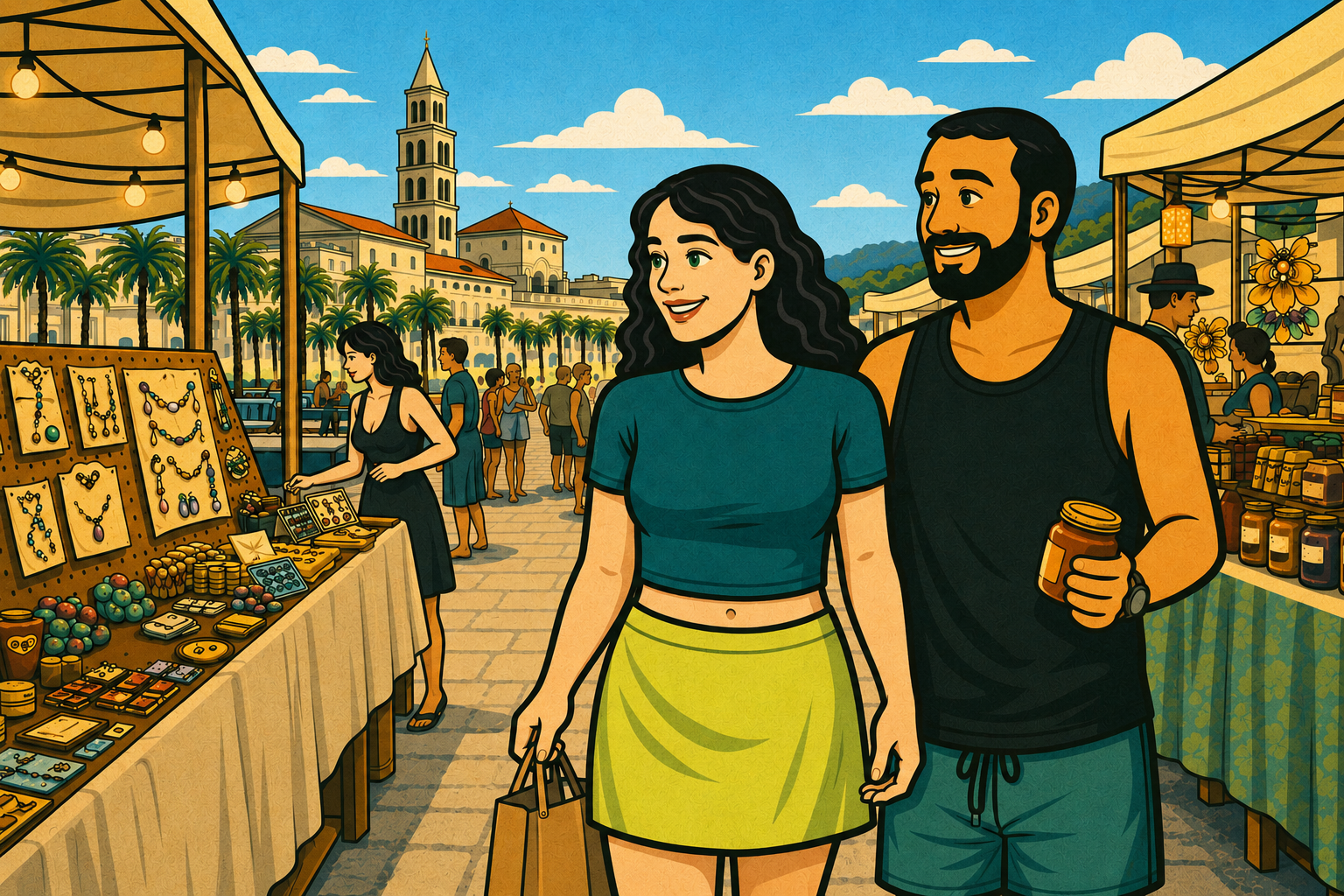
Right there along the promenade, we walked straight into a market—one of those rare ones that doesn’t sell “souvenirs” so much as it sells proof that someone’s hands still make things properly. Stalls sat under cloth canopies fluttering in the breeze, tables arranged with the quiet pride you only see when the seller isn’t just reselling. Hand-printed scarves hung like soft flags—waves, geometric patterns, botanical sketches—ink slightly uneven in the best way, proof of a human hand. Jewellery lay displayed like tiny sculptures: hammered metals, sea-glass pieces, little charms shaped like moons and shells, stones set imperfectly but intentionally, like character mattered more than symmetry. Jars of honey caught the sun—amber, gold, almost red—next to cheeses wrapped carefully, dried herbs, olive oils, soaps that smelled like lavender and rosemary, small ceramics painted with patient hands, postcards that looked like art prints rather than tourist filler. Even the food had personality; nothing screamed “trap,” nothing looked designed to steal money through repetition.
Mo, of course, stopped and started buying gifts for his family, happily overcommitting the way he always does when love is involved, as if affection can be measured in quantities. In his defence, it was genuinely hard to resist—everything had a story baked into it, and you could feel the maker behind the object, whether it was fabric, jewellery, or something edible. Too bad art costs money. If I had endless reserves, I’d be an art collector without shame—clothes, jewellery, furniture, paintings, books, kitchen utensils, things so unique there’s only one of them in the whole world. But that isn’t my reality: if I want to keep travelling, I have to sacrifice souvenir shopping along with other forms of shopping. So I only looked. Mo insisted I should buy something, and I resisted—half like it was a moral stance, half like it was simply budget survival.
The Market, and the Ghost of Thursday Mornings
And it wasn’t only relief I felt, seeing something made with care instead of manufactured to vacuum your wallet. It was nostalgia—sharp, immediate, unfair. Markets used to be a habit, almost a ritual. Something you did more naturally, more frequently, than visiting shopping malls. Buying online was completely unimaginable. This was the early 2000s: Amazon and its books were already a thing, but not in Italy, and no one would have dreamed of ordering anything they couldn’t see first. The online world still felt unexplored and vaguely threatening, introduced by that robotic scream of agony you had to endure just to gain connection.
Ironically, I remember when the Internet came to our small town. They hung a massive banner by the football pitch—the spot that could be seen from the youth club, which was buzzing back then, especially on weekends. “The Internet is among us,” it said. No better way to describe the arrival of an invisible presence that would soon get between us, not just among us. But we didn’t know that yet. We were still busy planning our visits to the markets. There was one in a different town each day of the week, and the jewel of the crown was the Thursday morning one in Sarnico, where the town square returned to its original purpose and filled with people and trades. As students, we lived for those rare announcements that school would start later or end earlier, because it meant we could rush to the market.
In summertime, when school was off, the market felt like the real beginning of the day. Warm air, time moving at lake speed, days feeling longer and fuller because you started them browsing burned CDs of your favourite bands, costume jewellery that made my friends and me feel like queens, cheap replicas of popular clothes that made us feel like we belonged. The smells were part of the experience—so strong they changed the lake air into something else entirely: fresh local cheese, fish, frogs, a variety of chicken and meat cuts, including cow tongues and trippa, heavy fried food with those smiley potato croquettes that kids and teens lived for, then the sweet smell of local honey or jams cutting through the grease. The sound was just as specific: people chatting loudly when they bumped into acquaintances, vendors yelling to attract customers, that whole communal hum of a place doing what it was built to do.
We walked around spotting people our age, especially once we hit our teen years. We were looking for friends from other towns to prove our “global” connection pool, or hoping to spot that boy we liked and catch eye contact so we could rush home to MSN and update our status with some romantic song quote that would refer to the moment—hoping he, rigorously already among our contacts, would notice it and message us.
And I loved going with my auntie, cousin, and mother too. My mom and her sister would bargain with vendors from anywhere between Senegal, Morocco, southern Italy, and Veneto for home tools, linen, towels, socks, underwear—always leaving proud if they managed to reach their desired price. My cousin would spot the weirdest toys (mainly weapons) and tools and send me to negotiate with our mothers on his behalf, sometimes successfully, sometimes not. And there was always the breakfast break in between—juice, cappuccino, cornetto—like a small ceremony of reward before returning to the chaos.
That was the good life at its finest: time with family and friends, time that could have been dedicated to work, shopping based on need and pleasure, when prices were still reasonable and you didn’t feel punished for existing. I visited a market in a neighbouring town with my mom before Mo came to Italy and we started our road trip, after a long time without markets in my routine. It was pleasant to be there again, but the prices were insane—especially now that we can’t help comparing everything with the absurdly low prices online. And that comparison changes behaviour. It affects attendance. The market was emptier than it used to be, and even its size had reduced as a consequence.
This market in Split was different from the ones I grew up with—it was meant for tourists more than for locals. But it was still nice to see that they still exist, even if they are shrinking. These traditions remind us who we are and where we come from. And creating beautiful and tasty goods is a craft that should never be lost, because losing it would mean losing something essential about human identity.
Marble Glare, Ancient Echoes
While I was getting lost in all that, and Mo was carefully browsing the stands not to miss a single gift opportunity, we walked all the way to the end of the promenade, the harbour on one side and the old city waiting on the other. When we finally entered, it hit us with that immediate, cinematic beauty that makes you stop mid-step. Tourists crowded the cafés, some already dressed elegantly for happy hour or an early dinner, while we wandered in our beach clothes, matching water shoes showing the outline of our toes—an Amazon last-minute buy for this trip that made strangers smile when they noticed. The contrast made me laugh: them in linen and perfume, us in salt and practicality, still carrying the beach on our bodies like a scent. But Split didn’t care. It let everyone in.
We slipped through the Brass Gate into the cool shade of the cellars, and the temperature dropped instantly, like the city had pulled us underground to calm us down. Stone arches towered above us, corridors stretching out like a spine, vaulted halls holding that damp ancient coolness that makes you feel small in the best way. The air smelled like stone and shadow, like time itself had a scent. Our hands brushed as we laughed and filmed quick clips—light catching the edges of arches, people moving through the dimness like silhouettes in a historical film. Down there, nostalgia shifted shape: not for something we had lived, but for a world we had only met in books and old cinema, a time when cities were built slowly and people wrote letters instead of leaving voice notes. It’s a strange ache, craving a century you never touched, but Split is full of that sensation.
Climbing up into the Peristyle, the glare of marble and columns blinded us for a moment. It felt like stepping from a cave into a stage. The square opened with that formal beauty only ancient architecture can hold—columns standing with quiet authority, stone worn smooth by endless feet. The Cathedral of St. Domnius rose sharply, and people circled around with their cameras like satellites. We held each other close, hugging when not recording the scene, our toes squeaking on polished stones. A musician strummed his guitar by the ancient walls, and the sound echoed over chatter and footsteps, softening the square in a way that felt almost unfair—like history was performing for us, not just existing. For a second it was easy to imagine other lives layered over ours: priests, merchants, soldiers, lovers meeting in corners, the same stone hearing different languages across centuries, still keeping every secret.
We drifted deeper into the old town, slipping into narrow alleys where the maze of streets glistened underfoot, stones worn smooth by time and bodies. The air was thick with life—voices in a dozen languages, families, couples, groups of friends weaving through the labyrinth as if they’d all been assigned different routes and told to collide politely. Little shop windows glowed warmly, restaurants spilled tables into tiny squares, wine glasses caught the last light like small flames. Every turn gave you another scene: a staircase leading nowhere, a balcony heavy with plants, laundry hanging above stone arches, a cat sitting like it owned the city. That’s the thing about Split: it doesn’t just show you monuments, it makes you walk through history while it continues behaving like a living place.
We found a lionheaded fountain tucked in a corner and couldn’t resist. Mo pretended to activate the water by touching the lion’s nose, then pulled the camera back to reveal me secretly pressing the button. People nearby laughed at our little scene, and we laughed louder still, finding joy in the smallest, dumbest moments—because sometimes love is exactly that: a shared joke with strangers as background witnesses.
We continued through the Temple of Jupiter—dark and compact, guarded by the ancient sphinx—and then into the open circle of the Vestibule, where sunlight poured from above and bathed the stone walls in gold. The acoustics there made every sound feel important: footsteps, laughter, a voice echoing like it belonged to an opera. We kissed quickly in the shadow, then slipped back down into the cellars again, where vendors sold lavender and jewellery, the smell of stone dust and flowers mixing in the cool air. At the far end, daylight spilled out onto the Riva again, and we emerged hand in hand, slightly sunburnt, laughing, still in our beach clothes while the city around us sparkled with evening elegance. And I carried that odd nostalgia with me—the ache of a time I never lived, stirred up by stone and music and golden light—as if Split had reminded me that some beauty doesn’t just impress you, it reawakens something you forgot you were missing.
And with that sentiment, we hopped on our Vespa and rode back to the campervan—Ultra Europe day 2 was waiting.
Water Runs Out, Headlights Turn On
We went back to the campervan and made ourselves mushroom risotto. We ate in that narrow little space we now called “home,” our bodies still warm from Split’s stone and sea. Then came the dishes. Halfway through the washing-up, the water stopped pumping. That blunt silence forced the realisation: we’d used more water than we thought, and we were officially out. The glamorous part of van life ends exactly there, with soap on your hands and no way to rinse it off.
So we did what you always end up doing on the road—turned the evening into logistics. We decided to find a petrol station to refill the tank and empty both black and grey waters, since we were at it. Luckily, there was one ten minutes away. While the tank was filling, we showered quickly, taking advantage of the fact that, on rare occasions like that, water was not something we had to negotiate with. And because my brain cannot witness a refilling hose without turning into a cleaning supervisor, I used the moment to clean the van too.
A couple of people approached the campervan with irritated faces while I was monitoring the water pump and Mo was taking a shower, ready to complain because they thought we had parked there just to turn around and block the space. The second they realised we were using the water fountain to refill the campervan tank, they went red and apologised, suddenly polite, suddenly embarrassed. We smiled. We kept moving.
The problem was discharge. We couldn’t find a proper space to empty the grey and black water. It was getting late, and we still had a festival to attend, so we decided to go back to our parking spot and deal with the mess the next day. Except we didn’t fully let it go.
Back near the driving school parking lot—next to the bakery, our familiar “this looks dodgy, but it works” zone—we spotted a manhole and decided to discharge the grey water there. Not ideal. Not heroic. Just what you do when you’re out of options, and you want to avoid making tomorrow worse.
I pulled in, stopped the campervan, and the moment the engine died, the place felt emptier than it had any right to. The driving school lot was dark and wide, the kind of space that looks innocent in daylight and suddenly becomes a stage for your imagination at night. The bakery was closed. The abandoned station was a black silhouette in the distance. No passing cars. No casual walkers. Just our engine ticking as it cooled, and that thin, uneasy quiet that makes you hear your own breath.
That’s when I noticed the car. Parked far enough to look uninvolved, close enough to be watching. At first it was just a shape—something sitting there, patient, unbothered. Then, as if it had been waiting for the exact second I stopped, it switched on its lights. Not to see the road. Not to leave. To blind the space in front of us. The headlights hit like a wall, flattening everything into glare and shadow, turning our little grey-water operation into something exposed, theatrical, measurable.
My stomach tightened. I told Mo to be fast—fast in the way you say it when you suddenly don’t want to be in a place anymore, when you don’t want time to stretch, when you want the scene to end before it becomes a story. We moved without speaking much: hose out, manhole open, water gone, done. My body was in that strange state of efficiency that fear produces—hands working smoothly while the mind runs ten scenarios ahead. We finished in five minutes and got moving again without discussion. Only once the campervan rolled forward did I feel my lungs remember what breathing normally is.
As we exited the parking, a scooter rolled in. And from the angle of the road, we could see it go straight to that same car. Straight to the headlights. Straight to the “nothing to see here” posture. I dare to say nothing is suspicious any longer. And I couldn’t help wondering why the police had stopped us in plain daylight, before the festival even started, and made such a scene—bags emptied, underwear exposed—while traffic like that had been going back and forth all evening, completely unchecked.
Ultra Again, Because Love Is Compromise
Regardless, it was Ultra night again. We got ready quickly: I wore shorts, a black tank top, my loyal Decathlon sneakers; Mo wore another one of his baggy short-sleeve shirts, baggy cargo shorts, and his favourite black Puma shoes. He offered me a beer. I declined. I was bloated, and the fact that I’d reduced my workout intensity by a good eighty per cent had been eating at my mood all day. I tried to ignore it and focus on enjoying the night.
Truthfully, I wasn’t in the mood for the festival. One night had been more than enough for me. But we had spent a lot of money, and we knew we would miss the closing event the next day. And I knew how excited Mo was for it. So I put on my best face, took his hand, and headed with him toward the now familiar location.
We started at the Resistance stage, where Brina Knauss was playing. The atmosphere was the same dark, pressurised tunnel of sound and strobes, but the set didn’t catch us the way the night before had. So we moved to the Main Stage, danced through Steve Angello while waiting for Tiësto, and maybe—maybe—the idea slipped into my head that dancing could replace my workouts. Because even though the music wasn’t exactly my taste, I couldn’t stop moving. My body didn’t care about my opinions; it wanted motion.
Mo stayed close, letting me dance while shielding me from the constant collisions of people flowing in every direction. Somehow, I always end up choosing the entry/exit pathway whenever I stop somewhere to dance at these events. Maybe it’s just an impression. Maybe it’s a subconscious need to keep an escape route visible.
Just before Tiësto started, we spotted the family we’d seen the night before, right in front of us again, dressed in new matching outfits. Same formula: short-sleeve shirts and shorts for the boys, sports bra and hot pants for the mother—this time with a magic mushroom theme instead of rubber ducks. I was genuinely sad we were missing the closing event, only because I wanted to know if they would have matched again. And the dynamic was identical too: the father filming, the son casually swaying left to right, the mother serving dance moves like she was on a payroll.
Unfortunately, Tiësto’s performance was disappointing. He didn’t play most of his most famous songs—he barely played his songs at all. We left the Main Stage before he wrapped up and went back toward Resistance, hoping for better luck. On the way, we crossed a field where people sat on the ground in groups—drinking, sleeping, chatting, kissing—little islands of exhaustion inside the chaos.
Again, the crowd felt very young. That was expected, of course, but it didn’t motivate me to interact with anyone. There were so many people that I became immune to them. It felt like they weren’t even there. I wasn’t looking at outfits, accents, or mannerisms; I wasn’t curious. It felt like walking through a dense human wallpaper—bodies everywhere, all texture and movement, but no individual detail calling for attention—just a mass illuminated by strobes and polluted by loud music. People felt like inanimate things placed there to decorate the environment.
Their presence wasn’t a concern to me. I made space through them with a certain degree of carelessness, walking straight and letting my shoulder move the crowd away without apology. I wouldn’t look anyone in the eyes, wouldn’t smile the way I normally do. I just wanted to reach the front of the dance floor, get as close as possible to the stage, and disappear into loud sound.
Because I wanted to escape reality. Not because something catastrophic was happening—because sometimes you just get stuck in the pressure of work and commitments and responsibilities, and your brain feels eaten alive by it. I wished I were high on shrooms. Mo was more relaxed than I was; that’s his nature, but I know he felt it, too. Sometimes you want to switch off your mind because routine feels like a cage, especially when you’re forced to live it against your nature, in a fast-paced city that lacks natural beauty, is hot as hell, and offers jobs that don’t resonate with human life at all.
When you feel drained, unmotivated, uninspired, you want a small trip elsewhere—somewhere your mind feels light and bright, where nothing can really stress you out. Especially a mind like mine, that moves at light speed and worries about things that don’t even exist.
But we didn’t take that trip. Although I won’t deny it, we thought about paying a visit to that dodgy car for a second. But was it worth the risk? Of course not.
So we took the one trip available: music, bodies, bass, motion. Even if the night wasn’t as good as the one before, we stayed in it until around 3:30 a.m.
A lot of people were visibly drunk. I will never understand why alcohol isn’t restricted like other drugs. I have rarely seen a drug worse than alcohol in my life. I hoped those people would feel better, but I was also grateful I wasn’t living through that same hell. There was a time when I overdid it, too. I used to go clubbing almost every night, drinking uncontrollably—especially during my last year of high school. Only God knows how I deserved His mercy. I learned a lot, but I made a fool of myself more times than I can count and caused trouble for myself and others. Anyhow, that story can wait.
Mo and I walked back to the van, visibly tired. We gathered our strength to take a shower and brush our teeth, then fell asleep the moment we touched the bed.

Leave a Reply