
The Adriatic Teases
We drove for almost three hours, sliding gradually between mountain curves and glimpses of coast, the landscape changing its mind every few kilometres as if it could not decide whether it preferred altitude or horizon. It was an undeniably beautiful drive, the type that loosens your shoulders without asking permission, that keeps your eyes busy and your thoughts temporarily obedient. Leaving the Plitvice area behind, the road cut cleanly through the national park’s outer edges, dense with trees that leaned close enough to make the asphalt feel protected rather than confined. Forests thickened, thinned, then regrouped again, opening occasionally into clearings where sunlight spilt generously across grass and low shrubs. The terrain stayed alive and vertical for longer than expected—rolling hills rather than flattening plains—green in a sturdier, less ornamental way than Slovenia, vegetation shaped by endurance rather than display.
While we were still threading through that quieter stretch, Mo suddenly announced he wanted to stop. Just briefly. On the roadside stood a small wooden kiosk, modest and unapologetic, offering local products without performance. He emerged moments later holding goat cheese and jars of honey, clearly satisfied, clearly unconcerned with quantities. Enough, he explained, for himself and his mother. Enough, in practice, for a small battalion. I laughed and didn’t interfere. Some gestures are less about need and more about intention. We got back on the road immediately after, committed now to reaching Zadar early enough to still belong to the day, to sunlight, to salt.
We tried, with admirable discipline, to listen to a podcast about match fixing in football, a topic that normally pulls both of us in immediately—secret agreements, invisible hands, money travelling faster than truth—yet the narration unfolded so slowly, so tangled in its own suspense, that after a while we found ourselves exchanging confused glances, unsure who had done what to whom and why we were supposed to care. We turned it off without ceremony and returned to the far more entertaining unpredictability of our own conversations, which moved from absurd hypotheticals to memories, from food cravings to philosophical nonsense, always circling back to us in one way or another. I drove, as usual, because Mo’s relationship with the manual gearbox still lacked mutual trust, especially uphill, where hesitation becomes choreography, and the engine begins to judge you openly. I didn’t mind; I like driving, I like the control, I like the feeling of guiding a machine toward somewhere that might surprise me.
And then, without warning, the sea appeared.
Just a flash at first. A sudden blue opening beyond the guardrail. Too quick to register properly, too brief to trust. We both went silent. A curve swallowed it again. Then another bend returned it, wider this time, brighter, impossibly calm. We started filming instinctively, phones lifted, only for the road to twist and steal the view again the moment we pressed record. It became a game—anticipation, disappointment, reward—each reappearance perfectly mistimed, each disappearance sharpening the desire to see it again. The Adriatic revealed itself in fragments, never fully, as if it wanted to be pursued rather than consumed.
By the time we descended fully toward the city, the magic receded into functionality. The entrance into Zadar was unceremonious, stripped of drama—port infrastructure, industrial edges, working spaces doing their job without aesthetic ambition. It wasn’t charming, but it was honest. We didn’t linger on it. Instead, we followed the guidance of our loyal companion, Park4Night, toward a suggested parking spot near the harbour, reportedly offering a view over a small bay. And just like that, the promise of water returned—waiting, patient, blue—exactly where we hoped it would be.
When the map finally showed the selected parking spot was approaching, the harbour lay wide and shimmering, boats anchored in elegant stillness, sunlight ricocheting off white surfaces with theatrical generosity. We stopped at the closest point to the seaside.
Beach First, Logic Later
We arrived around four in the afternoon and, after the routine Vespa offload, change of clothes, and security lock, we rushed almost immediately toward Kolovare Beach, propelled by the impatience of bodies that had postponed salt for too many days.
The ride from Marina Vitrenjak felt like slipping through Zadar’s different moods in fast succession: first the marina’s clean geometry—masts ticking gently in the wind, ropes clinking, polished hulls, a few people moving with that quiet competence sailors always seem to have—then the coastal stretch where pine trees and low villas soften the city’s edges, where the sea keeps appearing beside you like a companion you can’t stop checking on.
We passed hotel façades and balconies with towels drying in the sun, cafés that smelled faintly of fried things and sunscreen, little side streets opening toward the water and closing again before you could commit to them. The closer we got to the centre, the atmosphere thickened: more traffic, more pedestrians, more noise collecting in layers, the air warming with exhaust and sun-baked stone, the city starting to feel like a place that expects you to keep up.
Kolovare announced itself before we even saw the shoreline properly—clusters of people moving with beach purpose, cars slowing to hunt for impossible parking, the distant pulse of music that makes your brain anticipate a crowd before your eyes confirm it.
We left the Vespa on the road side of the beach, slightly exposed, slightly resigned, then walked down toward the water through that narrow corridor between street and shore—past signs, bins, and sun-bleached railings, past people balancing floaties and plastic bags, past teenagers already damp and loud, before the path finally opened and the sea hit us in full view: a bright, restless sheet framed by stone steps and concrete platforms, dotted with swimmers, with bodies laid out like punctuation marks, with umbrellas and towels forming a temporary city of their own.
The shore was crowded, towels overlapping like negotiations, families staking temporary territories on stone, voices travelling in warm gusts of different languages, techno music from the bar adding to the noise. We found a fragment of space and dropped our things without discussion, then ran into the water as if responding to an emergency.
The sea was cold in the most intelligent way, sharp enough to interrupt thought, pleasant enough to keep you inside. It cleaned the heat off our skin instantly. Most people hesitated near the edge, reconsidering their courage, but we stayed in, floating, grateful. Nearby, a small boy tried to climb out with the help of his inflatable ring, failed spectacularly, retreated, and began again from a different angle. His stubborn choreography turned into a miniature epic. When he finally succeeded, dripping and victorious, everyone around him smiled. Resilience often arrives disguised as comedy. We splashed, hugged, kissed, and I couldn’t help but think how happy I was. Fears aside, I could not think of anyone better as a life companion, a thought that kept returning with the patience of something true: yes, Mo has his quirks and moods, but they aren’t unbearable, and when our time together is good—which is most of the time—it feels right in a way that doesn’t require explanation.
Eventually, we returned to land, showered, stretched ourselves in the sun, and let the warmth pin us there. It felt like a reward we had earned. That was when we decided to celebrate the engagement with a dinner outside—our first since the beginning of the trip—and I began scrolling through restaurants with immediate financial indignation. Everything looked expensive. I searched for discounts, secret offers, and digital mercy. Nothing appeared. Reality remained stable. We accepted it.
Old Town Afterglow
By seven, the beach had started emptying, noise dissolving into a calmer register, and we lingered in that softening before walking back to the campervan to transform ourselves into evening people. For the first time in weeks, we abandoned sportswear and rain-styled/salt-stiff hair; we wanted a version of ourselves that looked like we had plans. I put on makeup cautiously, almost ceremonially. Since the LASIK surgery, I had avoided eye products, and in my logic, if the eyes cannot participate, then no one should, so I’d embraced bare face with surprising pleasure. And my skin had improved dramatically in that stripped-down phase: fewer eruptions, calmer texture, less rebellion. The routine that did it was almost insulting in its simplicity—Vichy SPF 50 by day and Sudocrem by night—after years of expensive serums and complicated promises that had mostly made me worse. Tonight, though, deserved theatre, and I wanted to look like I was celebrating something.
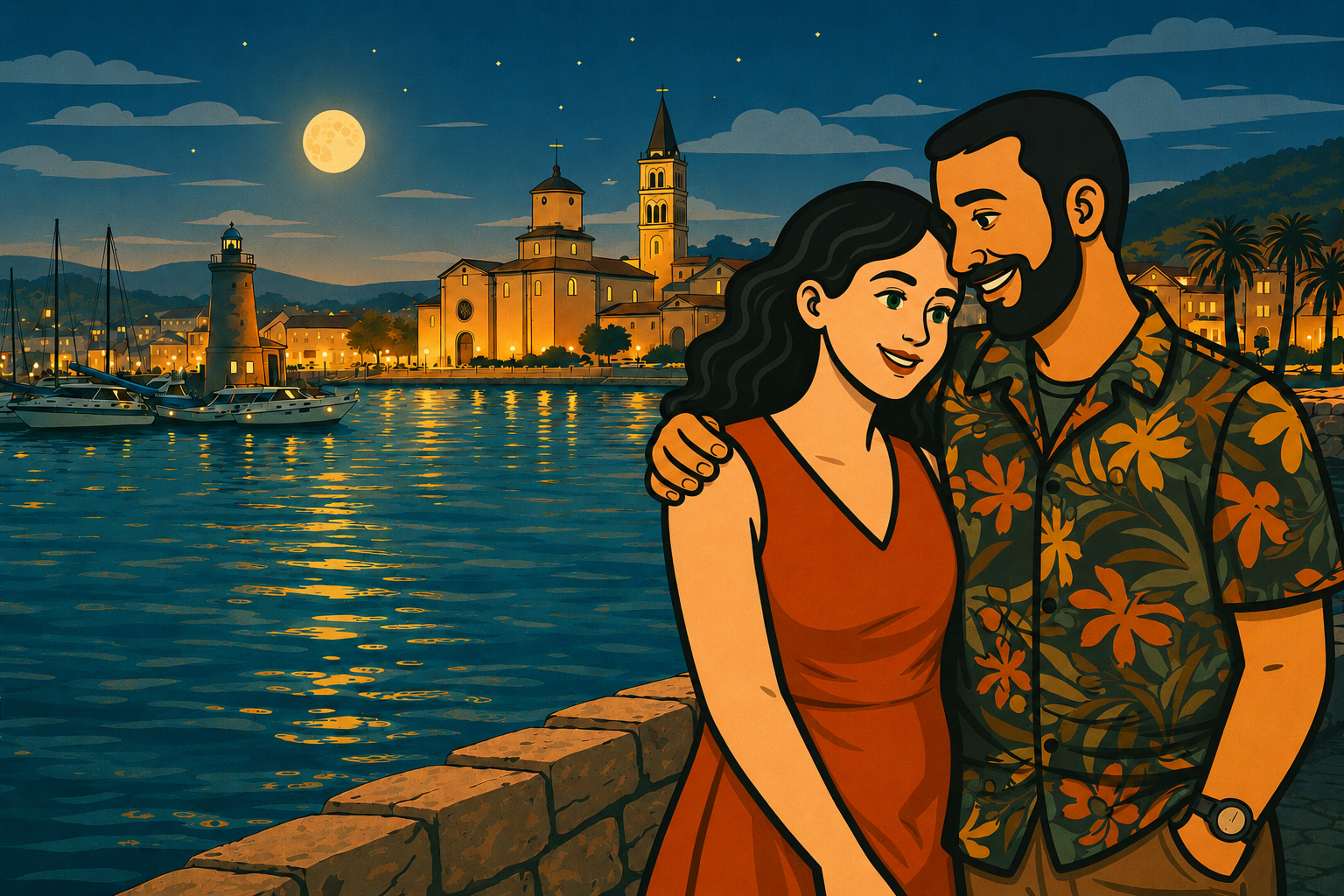
I wore a sleeveless, bodycon, midi orange dress that made my skin look sun-kissed even when it wasn’t, brown flats, a small purse in the same tone, and the baguette diamond on my left hand—radiant and undeniable. Mo aligned himself with my palette effortlessly, as if he’d been waiting for a cue: a patterned short-sleeve shirt with dark green, brown, and orange woven into it, and light brown cargo shorts. He looked handsome without trying too hard, which is always the most dangerous category of handsome.
We hopped on the Vespa with the giddy seriousness of people pretending they are “going out” even though they still have sand in their bags, and Mo drove toward the centre while I wrapped my arms around him from behind, cheek close to his shoulder, noticing that the involuntary smile spreading across my face was coming back. The road into the city was a small transition film: the clean order of the marina giving way to wider streets, then residential blocks, then the gradual tightening of movement as the centre approached. We passed rows of parked cars, pockets of greenery, people strolling as if the evening belonged to them by birthright, and glimpses of the sea that kept slipping into view between buildings, as if it were following us. Zadar began to glow—stone warming under the last light, façades catching gold, palm silhouettes and streetlamps preparing to take over, the air turning softer. We parked in a small spot by the road near the centre, slightly suspicious of the ease of it, and walked toward the promenade with that particular energy you get when you know you will be fed soon.
The sun was negotiating its exit, and the colours did what they always do at that hour—made everything look kinder, more cinematic, more worth forgiving. Along the promenade, we got pulled into a crowd right by the Greeting to the Sun, already collecting the last of the day’s light, glass panels swallowing sunset and holding it like a secret that would turn electric later. There, street performers whose athletic confidence bordered on insolence, backflipped through the air as if gravity was a rumour, stacked themselves vertically, then introduced a ladder balanced on a man’s shoulders like it was the most normal thing to place on a human body. The audience reacted with uncomplicated joy. They even brought in a young child from the spectators, who immediately tried to imitate them with bold, reckless confidence, backflipping badly but proudly, as if the point was courage more than accuracy. The performers pretended they were going to let him onto the ladder, and he was ready—fully ready—to take on the challenge, his little face lit up with a belief that adults often lose too early. Thank God they ended the joke right there, sent him back to his parents with a high five and a tap on the back, and let the crowd exhale again.
Once the show ended, the light had mostly left, and we continued walking down the promenade, still smiling from other people’s energy, when we realised we had been standing on top of the Sea Organ without knowing it. Marble steps, elegant and wide, and beneath them hidden tubes that turn waves into sound—music pushed out by water, a melody made by physics rather than intention. I loved that we hadn’t come searching for it. I loved discovering it by accident, like the city had kept a secret until we were relaxed enough to notice. Surprise remained intact. We lingered a moment, letting the notes rise and fall, then found an easy entrance into the old town and took it without thinking, as if the streets themselves were guiding us.
Inside, Zadar tightened into intimacy. Marble underfoot, polished smooth by centuries of footsteps, the narrow streets turning into arteries that carried people in both directions. We drifted onto Kalelarga (Široka ulica) with its evening crowd moving like a slow current, crossed into Narodni trg (People’s Square) where cafés were spilling outward, and the air smelled like dinner and perfume and warm stone, and then the city started placing its history directly in our path. The Roman Forum lay open and stubborn in the middle of things, fragments of columns and ancient blocks resting under modern feet as if time had simply decided to sit down there; nearby, St. Donatus held its round silhouette like a statement, and the Cathedral of St. Anastasia rose with that steady, watchful presence cathedrals carry—ornate but not desperate about it. The crowd was definitely there; Zadar was a place to be for many, and it was wearing that popularity with confidence. We walked past shop windows lit warmly, small boutiques and souvenir stands, families drifting slowly, couples dressed for the evening, and teenagers moving in packs with loud certainty. Somewhere a musician was playing, somewhere else laughter spilt out of a bar, and the whole place had that summer-night pulse where history feels less like a museum and more like a stage set that people still inhabit. We were heading toward a restaurant I had chosen in advance, but when we reached it, it felt too self-conscious, too curated, the atmosphere trying a bit too hard to impress. So we defected—quietly, instinctively—to another one we had passed earlier, humbler, breathing more easily. The prices barely changed, but the energy did. With fewer people packed around us, we could hear each other better, which mattered because the streets were already buzzy enough.
We ordered smoked and marinated local seafood as a starter—anchovies, sardines, mussels, and scampi—along with warm bread that arrived looking innocent but proved essential. Then calamari with roasted potatoes and greens, and a cuttlefish risotto, dark and persuasive, the kind of dish that tastes like someone knows what they’re doing and doesn’t need applause for it. We drank San Pellegrino, and that’s where my brain did what it always does: it took one overpriced bottle and used it as a door into a larger rant. It still amazes me how a water-borne thirty minutes from my hometown can travel internationally with aristocratic ambition and come back to the table inflated, branded, and treated like luxury. It used to taste like something. Now it tastes like a business model. At some point, it got absorbed into a global system where quality becomes secondary to distribution, and where we end up paying more for our own goods without improvement—just a shinier narrative. It made me think about how easily we sold ourselves to the consumerist model exported from the USA, not only economically but culturally—attention to detail diluted, patience replaced by speed, the entire relationship with “good” slowly rewritten into “marketable.” Then I remembered none of these thoughts was new. Giorgio Gaber had already dissected that drift decades ago, with the clarity of someone who saw the pattern forming while everyone else was still calling it progress. My observations weren’t revolutionary; they were just late, arriving over fizzy water in a seaside city while I tried to pretend I’m not the type who turns dinner into sociology.
So I pulled myself back. I tried to suppress my urge to look at politics even when sipping sparkling water and focused on Mo, because the point of this dinner wasn’t to win an argument with an invisible system. The point was us. And since we’d already had a heavy conversation after the proposal, I wanted to reassure him—not by denying my fears, because they were still there, but by making space for the truth that lived next to them. I told him I was happy. I told him I was looking forward to starting our family. I told him, plainly, that I was madly in love with him and I couldn’t imagine a better partner in life. Then I did something I don’t do enough: I let myself dream out loud. I started talking about plans and fantasies, about a life that could feel spacious rather than constricted. Where could we move to stay closer to nature? What jobs could we do remotely so we wouldn’t stop travelling? How could we build a home that didn’t feel like a box but like a world? I described a Syrian-and-Italian blend that made us both smile—light, stone, warmth, food always central—and I went further into the image: a house built around a large patio in the middle, the way many homes in the region hold life inward, with multiple apartments to accommodate family members, so everyone could be close without suffocating each other, so we could meet and dine in the same spot without needing a formal invitation. We spoke about kids—names, languages, how we’d raise them with both origins intact, Syrian and Italian not competing but coexisting, heritage as something lived rather than claimed. Pausing my pragmatism to allow dreaming felt essential. It changed the temperature between us. We smiled more. We held hands. Our eyes glimmered when we looked at each other, and for a while, the future didn’t feel like a threat; it felt like a place we might actually build.
We asked for the bill, and it came just under one hundred euros, which is insane considering the few items we ordered. My mind did the math immediately, because it always does: if we ate out like this every day for fifteen or twenty days, our budget would have exploded into smoke. I love cooking, yes, but I don’t cook only because I love it. I cook because it’s financially smart and because my body thanks me for it. Eating out too often makes me feel sick in a way I can’t romanticise—heavy, swollen, sluggish—and the truth is I love saving even more than I love indulgence. Denying myself a purchase releases something electric in me. It gives me a sense of control that borders on pleasure, and I know control is a big topic in my life, but that deserves its own chapter. For now, it’s enough to say that resisting “treat yourself” culture makes me feel powerful, like I’m refusing to be managed by impulse.
Mo paid, and we continued walking. We browsed shop windows without entering, letting the city pass by like a film we didn’t need to star in. We let the old town guide us back through its landmarks like we were tracing a loop on instinct—back past the Forum stones glowing under streetlights, back through the cathedral’s shadow, back into the busier ribbons of Kalelarga—people sitting on steps, drinks catching light, laughter spilling out of narrow doorways. We found ice cream—organic, dairy-free, chosen purely because the colours looked honest and the tubs looked freshly refilled—and I went for dark chocolate, my guilty pleasure, while Mo chose pistachio with walnuts. He stopped a couple of fellow tourists to take pictures of us, and I felt quietly grateful because I am terrible at remembering to document anything. Since I quit social media five years ago, taking photos of myself lost its urgency; I forget that memory sometimes needs help. We kept strolling, letting the night deepen, until we climbed up to the edge of the walls overlooking the Adriatic. The sea and sky were dark now, but the full moon and centuries of Roman, medieval, and Venetian inheritance created a romance so excessive it almost embarrassed me. After the emotional rubble that came before this holiday, I felt stunned by how generous reality had been. Gratitude flooded in—complete, humbling. I am usually the woman declaring starvation while holding bread, dissatisfied because cake is the fantasy. That night, I wanted nothing else. I didn’t want another city, another man, another life. I wanted exactly what I had.
Mo was happy too. I could see it in the way he looked at me, in the depth he rarely verbalises but always inhabits. He isn’t a man of many words, but he feels deeply, and he shows it. I remembered the first time he held me, how he refused distance, how safety can exist without force. And I remembered his face when he proposed—eyes wet, love unhidden—everything I had ever hoped to receive concentrated into a single expression that I will carry for the rest of my life.
Five A.M. Reality Check
We walked back to the campervan with that satisfied heaviness that comes after salt, dinner, and wandering. The night felt complete. Too complete, almost, like it was asking to be left alone. Inside, the campervan was warm and familiar, our little moving home, and we fell asleep quickly, almost arrogantly convinced the day had ended flawlessly. And yet, somewhere in the dark, my mind did that slight shift it does when something is about to happen—an unconscious alertness, a small internal door opening. It didn’t feel like fear yet. It felt like a pause in the body’s certainty.
Then the knocking arrived.
Metallic. Foreign. Authoritative.
I froze. Mo kept sleeping. I waited, hoping it would stop, hoping it was a mistake, hoping the sound belonged to someone else’s life. The second knock convinced me this was real, and I shook Mo gently, whispering that someone was knocking. He asked, half-asleep, “Who?” How am I supposed to know? His voice was thick with sleep and, in that moment, he was not the protector I fantasise about in my head. Still, he got up and moved toward the door with alarming innocence. I hissed instructions—window first, check, don’t expose us too quickly—while remembering he grew up in Dubai, where suspicion is an optional hobby, and I grew up with the European reflex that teaches you to treat every night interruption like a potential story you don’t want. These are the moments when my overanalysing mind turns cruel: it judges Mo harshly, it spirals into “is this really the right man,” it forgets everything good and zooms in on one flaw as if it’s the whole character.
He went to the window. Opened it slightly. Too slightly for my comfort, too much for my nerves. My whole body tightened. I wanted to kick his ass and hug him at the same time, which is marriage in its earliest draft.
Outside, a silhouette shifted. A voice, poor English, impatient tone. Not a thief. Not a drunk tourist. Not a random threat. Something more mundane, which is sometimes worse.
Harbour security.
He told us we were not allowed to stay there. We had to leave immediately. If not, he would call the police. In my head, arguments lined up like soldiers—no sign mentioning camping is forbidden, no proper parking lines, no sign saying it’s private, and for Lord’s sake it was almost five in the morning, couldn’t you wait until seven?—but five a.m. is not the time for philosophy, and a sleepy confrontation in the dark is not the hill I wanted to die on. Mo told him we would move soon, the man nodded like a judge granting mercy, and he proceeded to the next campervan with the same dull authority.
We drove off, found a free parking near some tennis courts, and crawled back into bed, adrenaline fading into exhaustion. My heart took longer to settle than my body. We slept again, hoping no one would jump-scare us one more time, grateful that even interruption hadn’t managed to steal what the evening had given.

Leave a Reply