
Southbound, With Questions
We left Otočec in the late afternoon with that familiar Eurotrip logic running the show: what looks romantic on a map can quietly become an entire extra day once you count the driving, the parking, the “let’s just stop for a photo” detours, the way time stretches when you’re living inside it. Zagreb was next. It hadn’t been part of the original plan, but I’d been persuaded by a YouTube video, by articles and comments calling it “one of the most underrated capitals in Europe,” and by Mo’s calm confidence that it deserved at least a walk. I agreed, as I often do, because curiosity has a stronger grip on me than instinct, even when instinct is already clearing its throat.
Before anything else, we had campervan duties to handle, so we stopped at a service station just outside town. While Mo dealt with tanks and hoses, I took the small mercy of using an actual restroom. Avoiding the campervan toilet whenever possible is a survival principle on the road—especially after emptying the black water tank—because nothing makes you question your life choices faster than cleaning a tiny bathroom when you’re already tired and your patience is running on fumes.
On my way out I noticed a door marked as a shower room and, like an optimist with poor self-preservation, I tried the handle. If there was a chance to rinse properly, why not take it? I barely had time to register the idea before the cleaning lady appeared and started yelling at me in Slovenian, sharp and relentless, as if I’d tried to rob the place rather than touch a door. I attempted a calm explanation—no language, only checking, potentially planning to use the service—while her tone stayed exactly the same: loud, angry, unmoved. I responded the only way you can when you don’t understand the words, but you understand the hostility: confused smile, small retreat, dignity folded into my pocket like a receipt.
I might have been sad to leave Slovenia’s beauty behind, but I was quietly relieved to leave that specific rudeness with it. There’s a point in a trip where you stop romanticising a place and start craving neutrality—just basic human decency, no extra flavour—especially when you’re already emotionally crowded inside yourself.
The drive toward Zagreb unfolded smoothly, almost meditatively. Music low. Conversation light. Mo fought sleep in that loyal, stubborn way—nodding, blinking, forcing himself awake just to keep me company—while the road did what roads do best: hypnotise you into thinking everything is fine as long as the lane is straight. My left hand rested on the steering wheel, and I couldn’t stop looking at the ring. I loved it, and still it felt heavy—not in weight, but in meaning, like a beautiful object that had already started asking questions I wasn’t ready to answer out loud. I didn’t have the right words for Mo yet. I didn’t even know where to begin. But I knew he could feel it anyway. He always does. Silence has its own grammar when two people share a small space and too much future.
Crossing into Croatia, the landscape shifted—subtly at first, then with more clarity. The greens dulled. The hills flattened further. Fields looked a little less generous, a little more worked over. Houses lost that fairy-tale neatness Slovenia wears so effortlessly; yards felt improvised, paint more tired, details less cared for. Beauty didn’t disappear. It simply stopped performing. It became practical, and maybe that was the point. We were leaving the river-and-hike dream behind and driving toward something more urban, more complicated, more like real life.
We reached Zagreb in less than two hours and parked on the outskirts of the city in what used to be the University Hospital complex—an abandoned megastructure that shows up online as a “touristic attraction,” mainly because graffiti and decay have a way of becoming content. In reality, the parking area felt like a neglected no-man’s land: garbage piled unevenly along the edges, old furniture left mid-collapse, used condoms scattered without embarrassment. It wasn’t the theatrical ruin of an art film; it was the mundane ugliness of a place that no one is responsible for anymore.
The hospital loomed behind us, concrete and glass frozen halfway into becoming something important. It had been started in the 1980s, meant to be a flagship of Croatian healthcare, then abandoned in the early ’90s before it was finished—half-built, never completed, left open to the weather, time, and whoever felt like walking in. Inside, the graffiti was raw and political, layered over cracked walls and broken windows, decay dressed up as expression. Maybe it would’ve been worth exploring the street art properly. Maybe. But filth isn’t automatically art, and we weren’t in the mood to romanticise neglect or test our luck in a place that looked designed to host people who don’t want to be found. Parking the campervan there already felt like a compromise; going deeper felt unnecessary. Park4Night said it was the only free option close enough to the centre, so we stayed practical and didn’t linger.
The Overrated Detour
We mounted the Vespa and officially began our visit to Zagreb, and the city welcomed us immediately—loud, strange, and slightly comedic. At the first traffic light outside the abandoned complex, a car pulled up beside us: two men in the front, three girls in the back, windows down, Mr Saxo Beat blasting at full volume like it was a civic duty. The driver turned toward us, raised the volume even higher, performing for an audience that hadn’t asked to be part of the show. The passenger laughed. The girls hyped him up with fists pumping to the rhythm, eyes locked on us like we were props. When the light turned green, the driver shouted something in Croatian—no idea what—and sped off dramatically, leaving behind nothing but noise and the faint feeling that Zagreb was going to be a little chaotic.
Mo and I burst out laughing, exchanged a look that said, “What did we just sign up for?,” and followed the flow of traffic toward the city. The ride into the centre cut through wide roads and industrial edges first, then worn residential blocks with long façades and peeling paint, balconies cluttered with old furniture, shops with faded signs that looked like they’d been there long enough to see several economic eras pass through. Nothing aggressive. Nothing shocking. Just tired. After Slovenia—after Ljubljana, with its clean lines, pastel cohesion, and that curated romance, even its industrial zones seem to maintain—it was hard not to feel underwhelmed. Not degraded. Just worn out, like momentum had stalled years ago and never fully restarted.
As we got closer to the centre, fragments of old Europe began to surface: heavier architecture, straighter lines, more stone, more history trying to hold its ground. And yet the fatigue clung to everything, even the beautiful parts, the way a city can feel like it’s carrying a long story with not enough money to edit it properly.
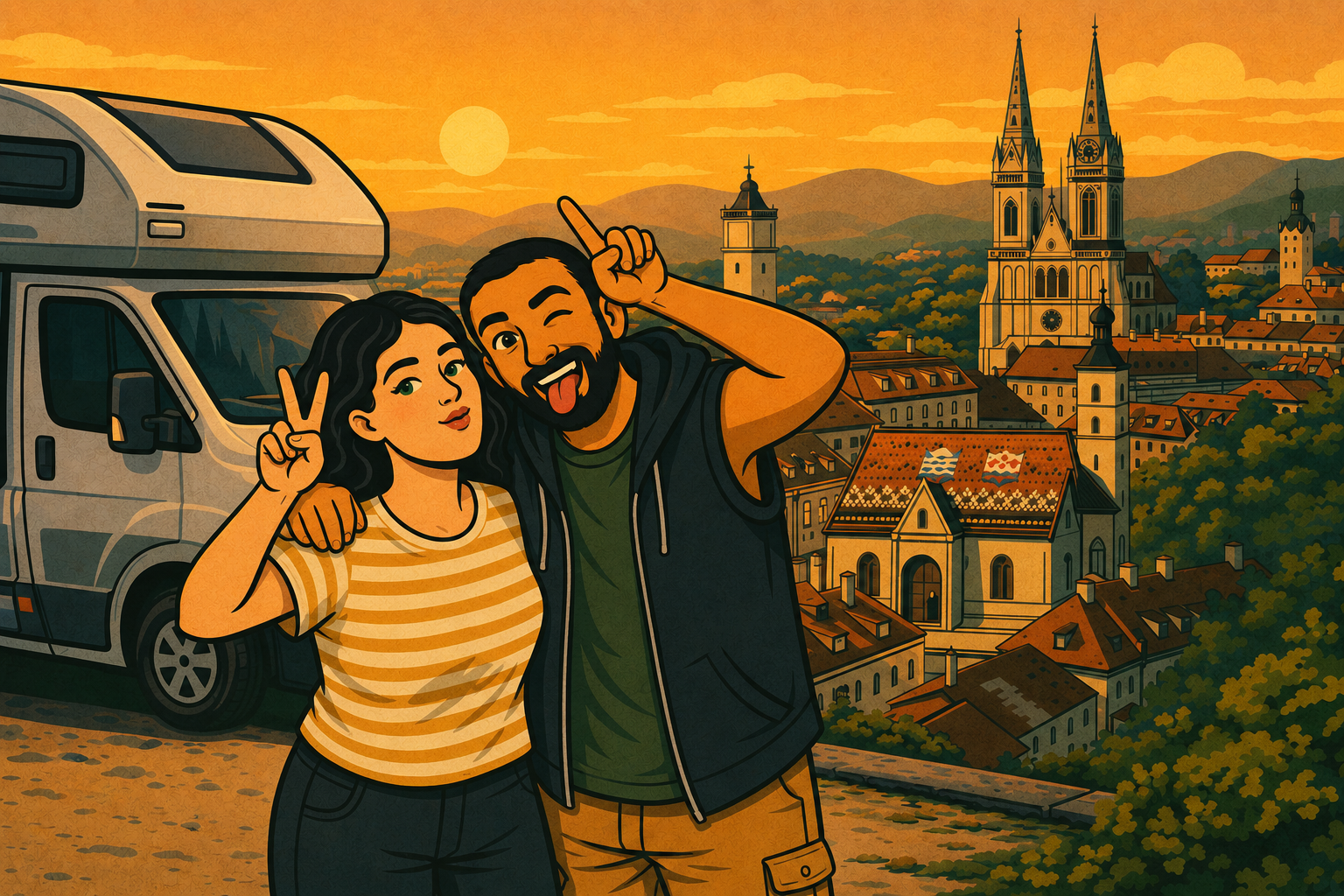
We parked near the Cathedral of the Assumption of the Blessed Virgin Mary—Zagreb’s iconic neo-Gothic landmark, twin spires piercing the sky—and I hesitated because there was no scooter parking in sight. We left the Vespa on the sidewalk, slightly tucked away, slightly exposed, and my brain immediately ran its usual checklist: fine? stolen? removed? humiliated? Mo waved my worries away with that familiar confidence of his and urged me to start walking, so I did, trying to behave like a person who doesn’t anticipate disasters for entertainment.
The cathedral stood tall and imposing, all pointed arches and ornate stonework, the kind of structure that has watched a city burn, rebuild, fracture, and persist. We took a few photos—of ourselves, of tourists, of the façade—and then slipped into Dolac Market just as vendors were packing up. Red umbrellas folded halfway. Wooden stalls are closing. The air still held the smell of fruit, cheese, herbs, and something fried that made my stomach remember it exists. Mo grabbed burek—warm, flaky, comforting—and added a few magnets to his growing souvenir collection, because Mo collects proof of place the way some people collect feelings.
From there, we walked back toward the cathedral and headed south down Dolac Street into a stretch filled with bakeries, cafés, small shops, and that quick shift in energy that tells you you’re drifting away from the old town again. I spotted a small café that felt genuine—not polished, not franchised, not trying too hard—and we stopped. The cappuccino was below average, which felt almost offensive, given the effort I was putting into Zagreb by being there.
We kept walking as the streets widened into Ban Josip Jelačić Square, large and open with trams slicing through, people passing without lingering, statues and façades doing their best to look important while everyone moved like they had somewhere else to be. A street performer attempted an acrobatic routine with more enthusiasm than skill; we watched briefly, took a couple of photos, and moved on.
Then came Ilica—a long commercial street, shops on repeat—until one boutique selling handmade clothes caught my eye. Inside, a maxi dress hung quietly: clean silhouette, pops of pink and yellow, no embroidery, no theatrics, just shape and colour. I asked the price. Six hundred euros. Silk, she insisted. It didn’t feel like silk to me, but either way, it didn’t matter. We walked out. A few steps later, we passed Calliope, a brand I used to love when I was nineteen. It hadn’t evolved much. It suited the girl I once was better than the woman I am now, and Mo was already irritated because, to him, shopping is a necessary evil with a ten-minute battery life. I like shopping alone. Or with my mother. Mo shops like a man on a timed mission: souvenirs, then done. Even for himself, he always goes to the same shop in Sharjah and leaves with oversized T-shirts, maybe a polo if I’m lucky, then wears the same cargo shorts or baggy jeans on rotation like they’re part of a uniform.
So I abandoned my teenage shopping fantasy and kept walking.
After getting lost in a narrow alley that led absolutely nowhere, we found the funicular and climbed the stairs beside it, reaching the Upper Town. At the foot of Lotrščak Tower—the medieval defensive structure marking the old city’s edge—the crowd thickened immediately: tour groups, cameras raised, voices colliding rather than blending. We escaped toward St. Mark’s Church, one of the few places I genuinely wanted to see because of its tiled roof decorated with coats of arms. Or it would’ve been worth it if the church hadn’t been under renovation—fully wrapped in scaffolding, construction barriers everywhere, photos ruined. I had the predictable European thought: who renovates in summer? and then the even more predictable European answer: they probably started two years ago.
By then, Zagreb still hadn’t made its case. We discussed ending the visit early, passed through the Stone Gate—a narrow medieval passageway holding a shrine to the Virgin Mary, candles flickering, people pausing briefly in devotion—and descended into Tkalčićeva Street, lively and loud, packed with bars and cafés, life unfolding efficiently. We joked about all the videos calling Zagreb “the most underrated capital in Europe,” and yes, it was a joke, but not entirely. Too many construction sites. Too many interruptions. Everything felt scattered, unfinished, diluted, like the city couldn’t decide whether it wanted to be charming or simply survive.
We crossed Park Opatovina, took Kaptol Street, and suddenly found ourselves back in front of the cathedral again, loop completed as if the city itself was saying, ” You’ve seen enough. We retrieved the Vespa—still there, thankfully—and rode back toward the campervan. The hospital parking lot had filled up. A security figure had appeared. Sunset was approaching, and the place felt less neutral now, more alert, like it would start telling a different story once it got dark.
We didn’t linger.
As beautiful and historic as Zagreb is, it didn’t speak to me. It felt important, sure—necessary if you want to understand Croatia beyond its coast—but not somewhere I felt drawn to return. We left as the light softened, pointed the campervan toward Plitvice Lakes, and let Zagreb recede behind us quietly, the way you leave a place that didn’t hurt you, but didn’t hold you either.


Leave a Reply