
I’ve been around. Over forty countries, a lifetime of airports, too many boarding passes that all start feeling like the same lie in different fonts. But there’s still nothing like home in summer.
Not the lemon-scented Italy they sell in films. Not the postcard Italy—Rome drowning in gelato, Florence posing like a museum, Venice doing its daily waterlogged theatre. I mean the Italy no one romanticises because it doesn’t need the attention. The part most people don’t even know exists.
Val Cavallina.
Tucked between soft-shouldered hills and the blue hush of Lago d’Iseo, with Monte Bronzone sitting above it like a quiet guardian who doesn’t brag about the job. Town names that don’t sound sexy unless you grew up pronouncing them with your mouth full of bread: Adrara San Martino, San Rocco, Gandosso, Villongo, Sarnico. They scatter the slopes like confetti left from some old celebration that no one bothered to clean up—because why would you? It’s part of the charm. It’s part of the evidence that life happened here long before you arrived with your camera.
You don’t arrive in Val Cavallina with fanfare. You slip in. Like bees moving from elderberry to mallow. Like you’re trying not to wake the place up, even though it’s already awake and watching you. The roads still buckle from decades of patchwork repairs, and even the fanciest car—Alfa, BMW, some guy’s third-generation Fiat Panda with a dented soul—rattles a little on the way down, as if the valley is reminding everyone: you’re not in control here, sweetheart.
Mornings begin with sound and scent. The low hum of lawnmowers. The hiss of espresso machines. The sweet rot of fruit that’s been allowed to fall and decompose in peace, like nature intended. And the sharper tang of rubber from the nearby factories—because yes, even paradise has industry sneaking around the edges like a guilty habit. Somewhere between all that, a fox slips through a fence and chickens kick up a scandal, the air pulsing with wet leaves, wild mint, and gossip.
And gossip is the real currency here.
Tino is already out, his van lumbering from workshop to factory, always hunting work or a bargain worth flipping. He knows everyone, and everyone knows: if you want a rumour to travel, give it to Tino, and he’ll take it on tour. Not far behind him, Rosa is sweeping her sidewalk like she’s defending a fortress, polishing her corner of the world until it shines as hard as her reputation.
Kids rocket past on souped-up boosters and phantoms, engines whining through the valley like determined mosquitoes. Somewhere near the Glera, the old crew has reclaimed their concrete throne by the waterfall’s hush, sunning themselves like they never left and never will. That’s where you’ll find Pietro—the mayor’s father, ninety-two and still sharper than most men at thirty. He’ll dance with you if you let him. He’ll cut off his own story mid-punchline if the music catches him first. Priorities, the way they should be.
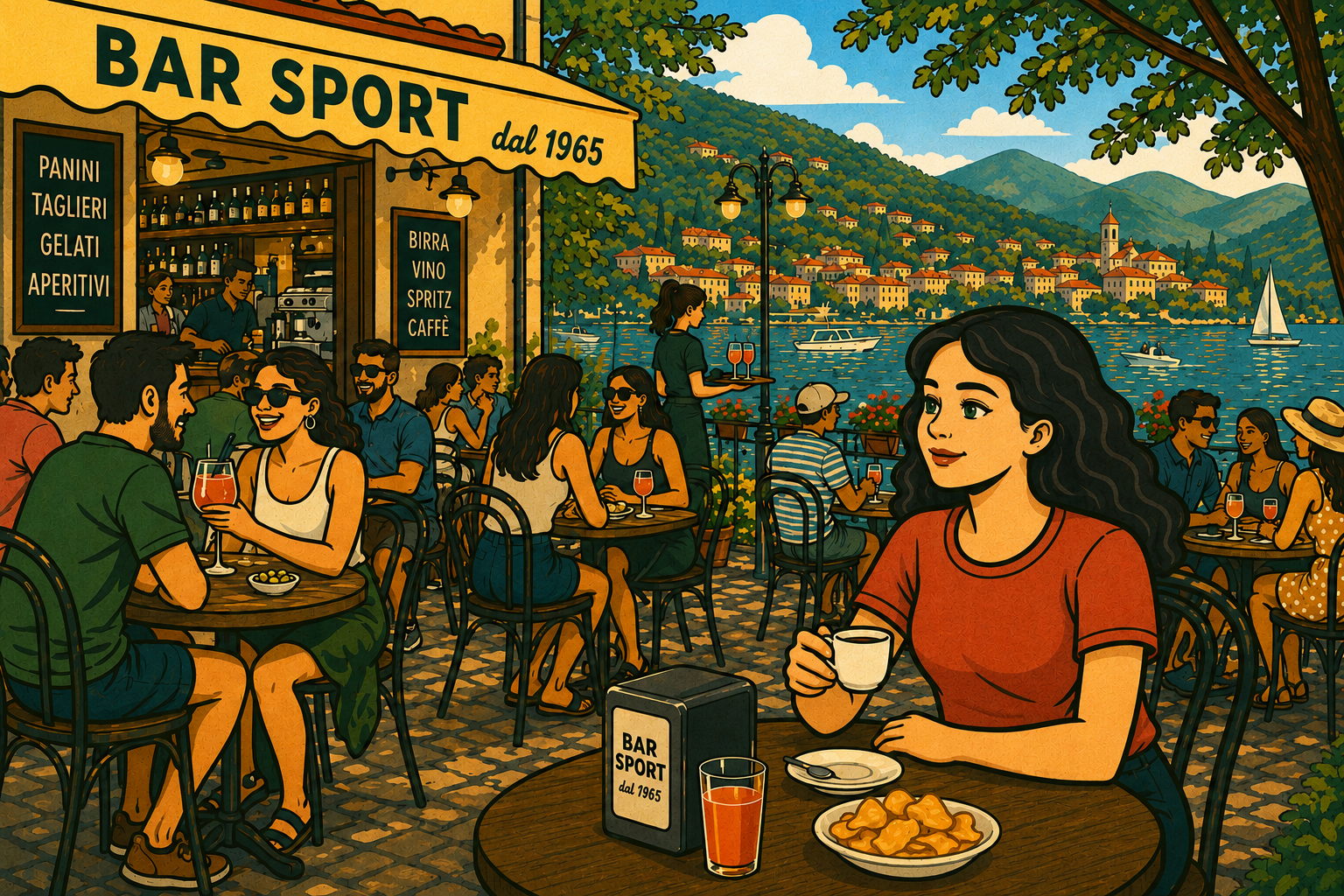
Life here clings to the details. Vittoria, behind the sports bar counter, knows who’s cheating, who’s spending too much, and who’s finally pregnant. She could’ve been an interior designer, they say, but she chose espresso and secrets instead, which honestly sounds like a better career path than most. Her bar is ground zero for the afternoon women’s council: half caffè, half confessional, full surveillance.
Gina runs her minimarket like a command centre. No one beats her at slicing prosciutto or judging character. People complain about her prices but never about her bread. Rumour has it she once had an affair with the town priest. She never married. She didn’t need to. Some women don’t. Some women are the institution.
Even the animals have an opinion.
Hoopoes laugh in the trees. Buzzards circle slowly over the hills like they’re on payroll. Herons keep cool by the reeds. Foxes lope between walnut groves. Roe deer wait till night to leap into your headlights like they’re auditioning for a tragedy. Badgers grunt. Fire salamanders gleam like spilled ink. Marmots whistle somewhere offstage, like stagehands keeping time.
And then there’s Giulio—one of the few young ones still betting on the valley—filming another YouTube video, hyping the local pizzaiolo or giving a tour of a baita like he’s selling the dream back to the people who forgot to value it. His pizza delivery route doubles as political canvassing. He tried running for mayor once. The incumbent kept his throne, probably by promising the most beloved policy of all: that nothing would ever change.
There’s a smell in this air that no other place can replicate. It’s not just grass, or espresso, or the lake. It’s cows grazing under walnut trees. Fresh bread cooling on windowsills. Goat bells. Weeds sprouting between paving stones. And the boom of blasphemies when two drivers meet at a curve too tight for both, and neither is willing to concede. It’s ancestral. It’s poetic. It’s extremely Italian.
You eat polenta e coniglio on Sundays. You walk after dinner, or you argue politics so fiercely it ends in a toast, because what else can you do when you’re surrounded by people who have known each other since birth and will probably still show up at each other’s funerals? You dress up because there’s always somewhere to go—even if “somewhere” is just the bar where everyone will assess your shoes and your choices.
You see Marina heading to the salon—her alone-time session. No one else books during her slot. Too many stories. Too loud a laugh. Too many memories of that married man she stole and returned just in time for the funeral. This valley doesn’t forget. It just rebrands its grudges as anecdotes.
There are fewer young faces now. The valley greys with grace. But Nino, suit-clad and helmeted, still pedals his bicycle from Adrara to Colli di San Fermo, quoting proverbs I’m convinced he invents on the spot like blessings for any kid who’ll listen: “Attento Mario, perché le Marie sono furbe.” Careful, Mario, because Marias are cunning. Or: “Dove c’è Luigi, c’è Parigi.” Where there’s Luigi, there’s Paris. Ridiculous. Perfect. True in the way only nonsense can be.
There’s no Uber Eats here. No taxis. No Deliveroo. You either drive, walk, or stay home. And most don’t mind. They know the path to the lake by heart. They know the hills, the woods, the shortcuts. They understand that every stone has a story, and it will tell it to you if you stop moving long enough.
And me?
I don’t live here anymore. I left a decade ago. I built a life elsewhere—hotter, louder, shinier. The kind of life that looks impressive until you realise it’s mostly made of speed and coping mechanisms.
Now I return in the summer. I drink in the light, the slowness, the sounds. I don’t mourn the life I could’ve had—I fantasise about it, which is different. Mourning is heavy. Fantasising is a flirt. The dialect still rises in my throat. The names still land with weight. The land moves at the pace of memory.
And somehow, even after everything—
I still belong.


Leave a Reply