
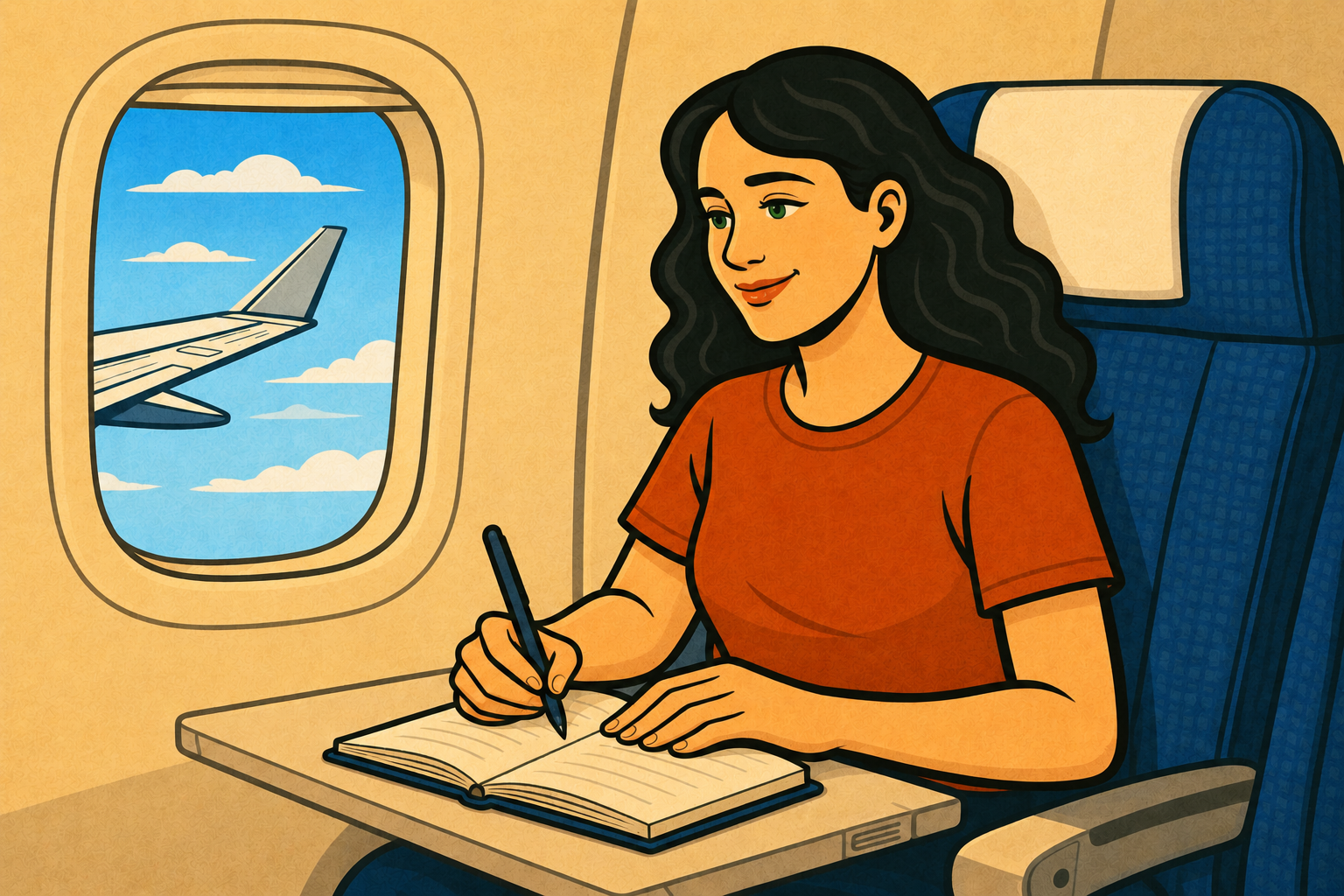
I fly often. Too often. And I always end up writing mid-air — maybe because it’s the only place where life can’t reach me properly. No doorbells. No “quick call.” No expectations disguised as friendliness. Just cabin hum, recycled air, and my brain finally untethered from everyone else’s timelines.
Back in 2016, when I first started flying regularly, my way of living was embarrassingly romantic. Not Disney romantic. Not “love wins” romantic. Gothic romantic. Henry Fuseli’s The Nightmare romantic — me limp on the bed, a demon squatting on my chest like it pays rent, the whole scene staged by my own mind. I’d obsess over boys the way Goethe’s Werther did, minus the finesse to make it art instead of a private meltdown. Tormented. Theatrical. Convinced that suffering meant depth.
Then something shifted.
Like Europe at the end of the 18th century, I moved from Romanticism to Realism — or Verismo, because I’m Italian and Verga is basically a family member at this point. I stopped being the mythologised heroine of my own tragedy. I was no longer the Wanderer Above the Sea of Fog looking noble and existential on a cliff. I became the sea. Foggy. Still. Unimpressed. Less “look at my pain” and more “look at the mechanisms.” I started noticing ugliness — not just inside me, but around me. Social ugliness. Human ugliness. Systems that chew people quietly. But unlike Pellizza da Volpedo or Tolstoy, I wasn’t denouncing injustice from a canvas or a pulpit. I was arguing with strangers in the smoking area of parties, high on weed and whatever else was floating through the night like dust. Sometimes older men — dazzled by my fury, and also clearly hoping to bed a younger storm — would linger beside me, nodding like they were allies when they were really just entertained. Nobody changed. No revolutions were born. Unless you count the small internal ones — the ones that don’t trend, but still rearrange you.
So naturally, I entered my Decadent phase.
If I were a painting, I’d be The Young Decadent by Ramon Casas — cigarette, posture, bored elegance, the vibe of a person who’s read too much and lived too little. If I were literature, I’d be the first chapter of The Pleasure by D’Annunzio — ornate, embroidered, self-aware to the point of comedy, and still somehow empty underneath the lace. I numbed myself with YouTube Shorts. Lazy gym sessions. A life lived without ceremony. The fate of the overeducated and underinspired: you can name the sickness, but you still let it sit with you at the table.
But maybe something’s changing again.
When I quit my job, it cracked the shell from the inside. Not in a dramatic “rebirth” montage way. In a quiet, frightening way. I chose stillness. I chose uncertainty. I chose not to keep sprinting just because running looks like purpose. And I promised myself I wouldn’t fall back into that familiar abyss where despair becomes aesthetic — beautifully lit, perfectly narrated, ultimately useless.
This time, I want my own avant-garde. My own -ism. Something that isn’t borrowed, isn’t performative, isn’t made to impress anyone. I want to weave all my past selves together — the gothic tragic, the realist observer, the decadent drifter — into something coherent. Maybe even meaningful. I want nostalgia without naïveté. I want to care about fairness without trying to save the world and then spiralling when the world shrugs back. I want reflection without drowning. Speech without performance. Change without self-erasure.
I want to figure out what kind of woman I am without defaulting to whatever hashtag feminism or aestheticised rebellion is trending this month. Use the narrative, sure — but don’t get swallowed by it. Follow curiosity without monetising it immediately. Chase joy without asking it to pay rent. Want recognition, yes — but not as a footnote in someone else’s movement, or a pretty quote under someone else’s brand.
Just me. In all my contradictions. Me as a dot in this absurd, dazzling constellation — not the centre of it, not the victim of it, not the heroine of it. Just… present.
And if that sounds humanistic, fine. But not human-centric. Because I want God and nature at the centre of this — not just my search for meaning, but my surrender to it. The reminder that my feelings aren’t the universe. They’re weather. They pass. They teach. They don’t rule.
Because sometimes, when you’re sitting in seat 20A, halfway between a city you never loved and a home that doesn’t exist yet, that’s all you really have: a shaky hand, a notebook, and a sky that doesn’t care — but still lets you write anyway.

Leave a Reply